It's tempting to dismiss cryptocurrency as a speculative trend, but doing so would be a significant oversight. We're witnessing the rise of a new asset class with genuine potential to diversify a modern portfolio. This guide isn't just about the basics; it's a deep dive into why digital assets have a place in a serious wealth strategy and how they compare to the traditional investments you already understand.
Understanding Digital Assets in a Modern Portfolio
For high-net-worth investors, the key is to view cryptocurrency through the correct lens. Set aside the market noise for a moment. Instead, think of it as a disruptive technology with long-term value potential, much like the early internet. This shift in perspective moves the discussion from short-term speculation to strategic, long-term allocation.
At its core, cryptocurrency represents a fundamental reinvention of how we store and transfer value. Traditional finance operates through intermediaries—banks, governments, clearinghouses. Digital assets, in contrast, function on a decentralized network. This foundational difference gives them their unique characteristics and forms a compelling investment thesis.
The Power of Decentralization
The engine behind most cryptocurrencies is blockchain technology. Imagine a digital ledger, but instead of being stored in one central location, it's distributed and copied across thousands of computers. This distribution makes it exceptionally difficult for any single entity to tamper with. Every transaction is grouped into a "block" and added to the "chain," creating a permanent, transparent record of all activity on the network.
This decentralized structure offers powerful advantages for a portfolio:
- Reduced Counterparty Risk: With peer-to-peer transactions, you aren't reliant on a single institution that could fail, freeze your assets, or impose arbitrary restrictions.
- Enhanced Security: The cryptographic nature of the blockchain provides robust security, making fraud and unauthorized alterations incredibly difficult.
- Global, 24/7 Access: Digital assets can be transferred anywhere in the world with an internet connection. The market never closes, operating outside the constraints of traditional banking hours.
By eliminating central points of failure, decentralization fosters a new kind of financial resilience. It enables systems that are more transparent, efficient, and globally accessible—a core component of the investment case for digital assets.
How Crypto Compares to Traditional Assets
To fully grasp where crypto fits, it's useful to compare it with familiar assets like stocks and real estate. While traditional investments follow a well-established playbook, digital assets introduce new dynamics, especially concerning volatility, accessibility, and control.
This isn't about replacing stocks or property; it's about recognizing that cryptocurrency isn't just another commodity. It is an entirely different asset class with its own rules and potential.
Digital Assets vs. Traditional Investments: A Comparative Overview
The table below outlines the fundamental differences between cryptocurrencies and traditional asset classes. This at-a-glance comparison highlights their distinct core properties.
As the table shows, from market hours to scarcity, digital assets operate on a fundamentally different set of principles. Recognizing these distinctions is the first step toward determining how—or if—they belong in your wealth strategy.
Where the Cryptocurrency Market is Heading
With the fundamentals established, let's examine the market itself. For any serious investor, understanding the scale and velocity of the crypto market is non-negotiable. This is no longer a niche corner of the financial world; it has grown into a major global asset class with a growth trajectory that is impossible to ignore. The momentum suggests continued expansion, driven by fundamental shifts in technology and finance.
The global cryptocurrency market has experienced explosive growth, making it a powerful option for high-net-worth individuals seeking diversification. The market is currently valued at USD 3.35 billion and is projected to reach USD 6.33 billion, representing a compound annual growth rate (CAGR) of 17.3%. What's fueling this? A surge in institutional adoption, with major financial players now allocating significant capital to digital assets. This is occurring alongside rising demand for more efficient cross-border payment solutions and tokenized instruments.
This rapid expansion is a clear indicator that the market is maturing. It's moving beyond early adopters and into the realm of strategic asset allocation for sophisticated portfolios.
The Big Money is Finally Here
The conversation around crypto has fundamentally changed. It’s no longer just about retail speculation; we are now seeing significant institutional investment. Major financial firms are not just observing—they are actively participating. This shift is perhaps the strongest validation we have for the long-term viability of digital assets.
Several key factors are driving this trend:
- A Search for Uncorrelated Returns: In a market where traditional assets like stocks and bonds often move in tandem, crypto offers a unique source of returns that doesn't necessarily follow the same patterns.
- An Inflation Hedge: Assets like Bitcoin, with their fixed and predictable supply, are increasingly viewed as a digital counterpart to gold—a potential hedge against currency debasement and rising inflation.
- Client Demand: As high-net-worth clients become more educated about digital assets, they are requesting exposure. This is compelling wealth managers and institutions to develop their crypto offerings.
The influx of institutional capital brings more than just money. It brings infrastructure, invites regulatory scrutiny, and adds a measure of stability. This helps create a more robust and predictable market—precisely what long-term investors seek.
The chart below provides a simplified visual of how crypto can fit alongside traditional assets in a modern portfolio.

As you can see, digital assets add a completely new dimension to portfolio construction, offering distinct characteristics that complement established investments.
The Rise of Decentralized Finance
Beyond Bitcoin, the growth of Decentralized Finance (DeFi) is another major catalyst for the market's expansion. DeFi is an effort to rebuild traditional financial services—like lending, borrowing, and trading—on open, permissionless blockchain networks.
Imagine a global, automated financial system that operates without the usual intermediaries. Instead of waiting for a bank to approve a loan, a smart contract executes the terms automatically. This innovation is unlocking tremendous efficiency and accessibility, attracting billions in capital.
The Future is Tokenized
Another critical area to monitor is the tokenization of real-world assets (RWAs). This is the process of creating a digital representation of a physical or financial asset on a blockchain. Almost anything can be tokenized, from a piece of commercial real estate to a share in a private equity fund.
This process can make traditionally illiquid assets much easier to divide, trade, and access for a wider range of investors. For high-net-worth portfolios, this opens up entirely new avenues for liquidity and diversification. Understanding these dynamics is key, and our team often provides deeper insights into cryptocurrency as an asset class. Tokenization is the bridge between the digital and traditional financial worlds, promising to unlock trillions of dollars in value currently tied up in illiquid assets.
Breaking Down The Core Crypto Assets: Bitcoin And Ethereum
To build a robust investment thesis, you must look past the hype and analyze the assets that truly power this market. While thousands of digital tokens have come and gone, Bitcoin and Ethereum remain in a class of their own, commanding the majority of the market's value and attention.
It is a critical error to view them as interchangeable. They are not. They represent two fundamentally different visions for the future of digital value.
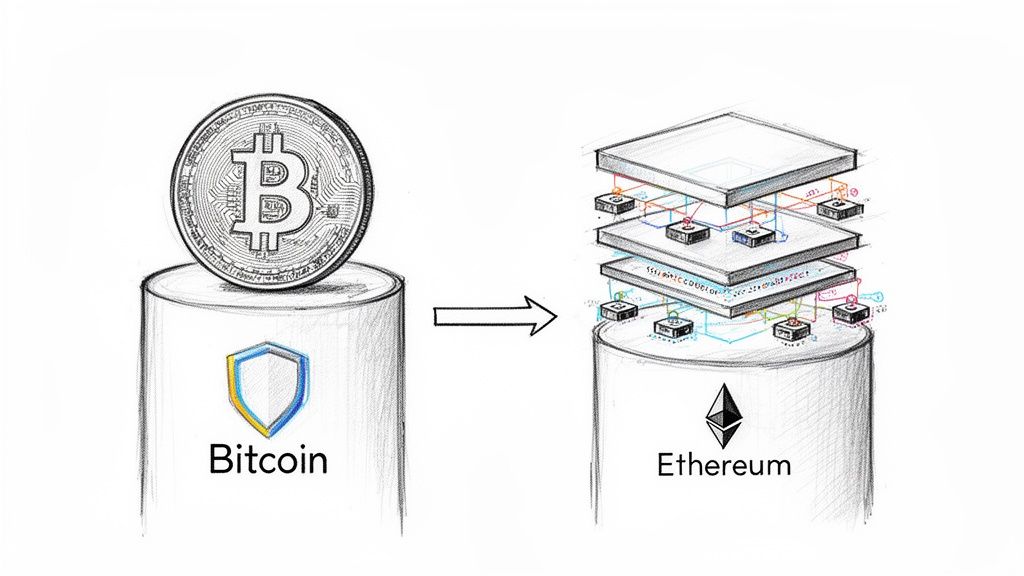
A useful way to think about it is that Bitcoin is the market's anchor, while Ethereum is its engine. Each serves a distinct purpose, and understanding that difference is the first step toward building a thoughtful allocation strategy.
Bitcoin: The Digital Gold Standard
Bitcoin’s value proposition is remarkably simple yet powerful: it’s a decentralized, secure, and scarce store of wealth. As the first and most dominant cryptocurrency, it is often called "digital gold." This isn't just a catchy phrase—it perfectly encapsulates the investment thesis.
Like physical gold, Bitcoin has a finite supply. It is capped at 21 million coins, a limit that is hard-coded into its protocol. This built-in scarcity is a compelling feature, especially in an economic environment where central banks can create new money at will, risking inflation and currency devaluation.
The key features supporting Bitcoin's "digital gold" narrative are:
- Fixed Supply: Unlike the U.S. dollar or the Euro, no central authority can decide to create more Bitcoin. The 21 million cap is absolute, guaranteeing its scarcity.
- Decentralization: The network is operated by thousands of independent participants worldwide, making it nearly impossible for any single entity to control or censor it.
- Proven Security: For over a decade, the Bitcoin network has operated continuously without a single successful hack. This is a track record of security and resilience that few systems can match. You can dive deeper into its origins in our article on the history of Bitcoin.
The investment case for Bitcoin is not about transaction speed or flashy features. It's about providing a reliable, sovereign store of value that exists entirely outside the traditional financial system. For investors, this makes it a compelling hedge against inflation and geopolitical instability.
Bitcoin remains the bedrock of the entire crypto ecosystem, holding significant market value and the trust of high-net-worth families and institutions. In fact, institutional adoption has become a major market driver, with a growing percentage of BTC now held by public companies, ETFs, and even some nations.
Ethereum: The World's Decentralized Computer
If Bitcoin is digital gold, then Ethereum is more like a global, decentralized operating system. It was not built merely to be money; it was designed as a platform for developers to build their own applications. This is all made possible by its key innovation: smart contracts.
Think of smart contracts as self-executing agreements with the terms written directly into code. They run on the Ethereum blockchain and allow for complex, automated applications to function without needing a bank, a lawyer, or any other traditional intermediary.
This functionality transforms Ethereum from a simple asset into a programmable foundation for a new digital economy. Its native currency, Ether (ETH), serves as the fuel for this system. It is used to pay for computations on the network, acting like "gas" to power the engine. This creates a direct link: the more useful the Ethereum platform becomes, the higher the demand for ETH.
Some of the key applications running on Ethereum today include:
- Decentralized Finance (DeFi): Entire platforms for lending, borrowing, and trading assets that operate without traditional banks.
- Non-Fungible Tokens (NFTs): Unique digital tokens that can prove ownership of anything from art and collectibles to real estate.
- Decentralized Autonomous Organizations (DAOs): New, internet-native organizations governed by their members through code and voting, not a traditional corporate structure.
This programmable nature gives Ethereum a very different investment profile from Bitcoin. Its value is less about scarcity and more about the adoption and growth of the applications built on top of it. As more developers and users flock to its ecosystem, the demand for ETH to pay transaction fees increases, which can, in turn, drive its price.
Where Stablecoins and Tokenized Assets Fit In
Beyond the marquee names of Bitcoin and Ethereum, a fascinating new layer of innovation is beginning to connect the digital world with traditional finance. For the savvy investor, this is where the practical, everyday utility of blockchain technology truly becomes apparent. We're moving beyond pure store-of-value concepts and into assets designed for stability and enhanced liquidity.
This movement is being driven by two key developments: stablecoins and the tokenization of real-world assets (RWAs). These tools directly address crypto's biggest challenge—volatility—making the digital ecosystem more useful for managing wealth, conducting transactions, and unlocking value in traditionally illiquid investments.
Stablecoins: An Anchor in Volatile Markets
Let's be candid: one of the most challenging aspects of adding crypto to a portfolio is the extreme price volatility. Stablecoins were created to solve this very problem. They are a specific type of digital asset designed to maintain a stable value by pegging their price to another asset, most commonly a fiat currency like the U.S. dollar.
You can think of a stablecoin as a digital dollar that exists on a blockchain. It offers the speed, global reach, and transparency of a cryptocurrency but without the rollercoaster price action. This unique combination makes them an indispensable tool in the digital economy.
Investors use stablecoins for several key reasons:
- A Safe Harbor: During periods of market turbulence, investors can move funds from volatile assets like Bitcoin or Ethereum into stablecoins to protect their capital without exiting the digital ecosystem entirely.
- Frictionless Transactions: They serve as a reliable medium of exchange for trading, lending, and other DeFi activities, eliminating the risk that the value of your capital will drop mid-transaction.
- Generating Yield: Many DeFi platforms allow you to lend or "stake" your stablecoins to earn a return, often at rates that are attractive compared to traditional fixed-income products.
To truly appreciate their role, it's worth understanding how central these assets have become. Learning about The Rise Of Stablecoins provides a clearer picture of their growing importance. They are, in essence, the plumbing that allows capital to move quickly and securely throughout the digital asset world.
Unlocking Value with Tokenized Assets
The next major frontier is the tokenization of real-world assets (RWAs). This is the process of creating a digital, blockchain-based token that represents ownership of an asset in the physical world. Nearly anything of value can be tokenized.
This process has the potential to completely transform the market for assets that have always been difficult to buy and sell.
Tokenization breaks down large, illiquid assets into smaller, digitally tradable units. This has the potential to unlock trillions of dollars in value currently trapped in markets with high friction and limited access.
Consider, for example, a $20 million commercial real estate building. In the traditional market, selling this property is a slow, expensive process involving brokers, lawyers, and a small pool of potential buyers.
By tokenizing the property, ownership could be divided into 20,000 digital tokens, each representing a 0.005% stake. This opens up a host of new possibilities:
- Fractional Ownership: Investors can now buy and sell small pieces of the property, dramatically lowering the barrier to entry for high-value real estate.
- Deeper Liquidity: These tokens can be traded on digital asset exchanges 24/7, creating a much more fluid market than the traditional one.
- Efficiency and Clarity: Ownership records are stored on an immutable blockchain, reducing paperwork and increasing transparency for all parties involved.
This concept extends beyond real estate to private equity, fine art, carbon credits, and more.
Building a More Resilient Financial Future
Ultimately, stablecoins and tokenized assets are not just niche products; they are the fundamental building blocks for a more connected and efficient financial system. They form the bridge between Wall Street and the crypto world, offering stability, yield, and new opportunities for discerning investors. For a high-net-worth portfolio, these tools provide a way to engage with digital assets while carefully managing risk and exploring new avenues for returns. They demonstrate a practical path forward, proving how blockchain technology can solve real-world financial challenges.
Developing a Sound Crypto Portfolio and Risk Strategy
Integrating a new and notoriously volatile asset like cryptocurrency into a carefully constructed portfolio is not a decision to be taken lightly. For any serious investor, the objective is not to chase short-term gains but to strategically position for potential long-term growth while maintaining a firm grip on risk. This requires moving beyond the hype and adopting a disciplined framework grounded in proven wealth management principles.
The most significant challenge is, of course, volatility. Any successful strategy must acknowledge this reality head-on. It should inform everything from your allocation size to your time horizon. Entering the crypto market without a plan is mere speculation; approaching it with one is strategic investing.
Adopting a Core-Satellite Allocation
One of the most effective methods for adding crypto exposure is through the core-satellite approach. The vast majority of your portfolio—the "core"—remains in stable, traditional assets like stocks, bonds, and real estate. Then, a small, carefully considered portion is allocated to a "satellite" position in digital assets.
This structure allows you to participate in crypto's potential upside while containing its volatility, ensuring that even a severe downturn in the digital asset market won't jeopardize your primary financial goals.
- Defining the Allocation: For most high-net-worth portfolios, a typical satellite allocation to cryptocurrency falls between 1% to 5%. This is enough to be meaningful if it performs well, but not so much that a major loss would be catastrophic.
- Purpose of the Satellite: This slice of your portfolio should be viewed as a long-term, high-growth component. It plays a different role than the stable, income-producing assets that form your portfolio's foundation.
- Regular Rebalancing: Periodically rebalancing is crucial. If your crypto satellite performs exceptionally well, you can trim those profits and reallocate them to your core holdings. This locks in gains and keeps your risk exposure aligned with your strategy.
This balanced method provides a disciplined entry point. To better understand how this fits into a broader financial plan, consider exploring our guide on what is strategic asset allocation, which details the principles of building a resilient portfolio.
Critical Risk Management Techniques
Beyond allocation size, managing risk in crypto involves a specific mindset and several practical techniques tailored to this unique asset class. The market is known for its dramatic boom-and-bust cycles, and emotional decision-making is the single greatest threat to long-term success.
A sound risk strategy is built on discipline, patience, and a genuine understanding of how these assets behave.
The key to navigating crypto volatility is to shift your perspective from short-term price movements to a long-term investment horizon. Successful investors in this space think in years, not weeks, allowing the fundamental value thesis to play out over time.
Diversifying Within The Crypto Asset Class
Finally, just as you would not invest all your money in a single stock, it is wise to diversify within your crypto satellite position. The crypto market is not a monolith; different assets serve different purposes and carry vastly different risk profiles.
A well-diversified crypto allocation might include:
- Foundational Assets: A significant position in established names like Bitcoin (often seen as a store of value) and Ethereum (the dominant utility platform). These are considered the "blue chips" of the crypto world.
- Specific Use Cases: Smaller allocations to assets with clear, real-world utility. This could include leading stablecoins or tokens from promising DeFi protocols that are gaining real traction.
- Professional Guidance: Navigating this complex landscape often requires expert help. Working with advisors who specialize in digital assets can provide the necessary due diligence and market insight to build a robust and appropriate strategy.
By combining a core-satellite approach, disciplined risk management, and thoughtful diversification, investors can strategically add cryptocurrency to their portfolios, positioning themselves for the future of finance while safeguarding their wealth.
Managing Custody, Security, and The Regulatory Environment
Once you have allocated capital to digital assets, the next critical step is to protect them. This is not like dealing with a bank or brokerage. Owning cryptocurrency comes with unique responsibilities for security and requires navigating a legal landscape that is still under construction. Getting this part right is fundamental to safeguarding your investment for the long term.
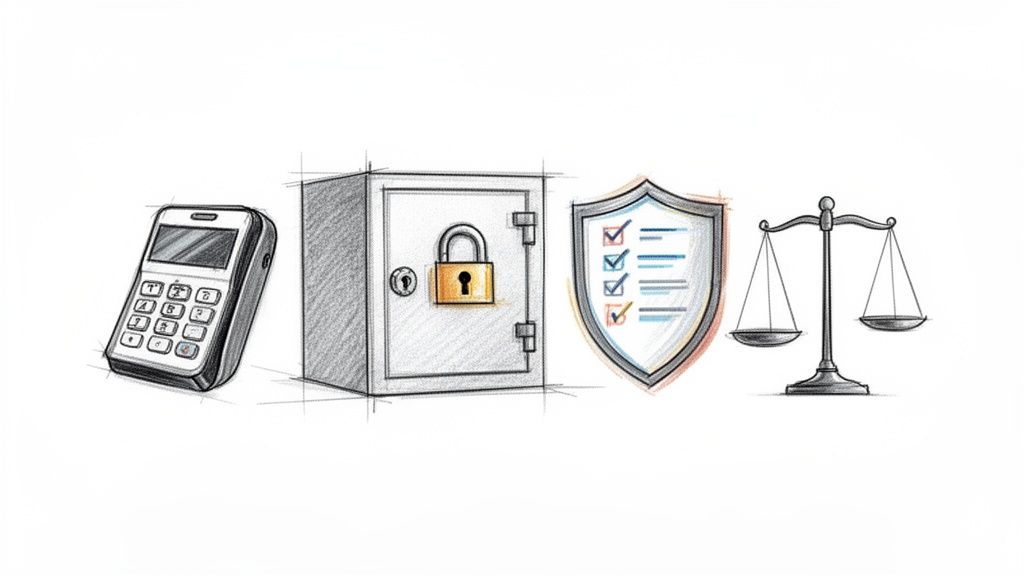
The core principle of cryptocurrency is direct ownership, famously captured by the phrase, "not your keys, not your coins." This refers to your private keys—long, cryptographic codes that grant access to your assets on the blockchain. How you manage these keys defines your entire security strategy, creating a spectrum of choices from full personal control to complete delegation to an institution.
Choosing Your Custody Solution
Selecting a custody model involves a direct trade-off between convenience, control, and security. For a high-net-worth portfolio, this decision must be driven by a clear assessment of your risk tolerance and operational capacity. Each option has distinct advantages and disadvantages.
- Self-Custody (Hardware Wallets): This approach offers the highest level of personal control. Your assets are stored offline on a physical device, often called a "hardware wallet" or "cold storage," which isolates them from the internet and protects them from online threats like hacking. The trade-off? You are solely responsible for securing the device and its backup recovery phrase.
- Third-Party Custodians: These are specialized, regulated firms that hold and secure digital assets for their clients. They provide institutional-grade security, insurance coverage, and regular audits, making them the preferred choice for family offices and large investors who prioritize top-tier security and simplicity over direct control.
- Exchange Wallets: Keeping assets on a cryptocurrency exchange provides maximum convenience for active trading. However, you are trusting the exchange with your private keys, which introduces counterparty risk. This is widely considered the least secure option for long-term storage.
For significant holdings, many find a hybrid approach works best. You might keep active trading capital on a reputable exchange, while the bulk of the portfolio is secured with an insured, institutional-grade custodian or in your own personal cold storage.
Navigating The Evolving Regulatory and Tax Environment
The legal framework for digital assets is still being written. Regulators worldwide are working to adapt existing financial laws to this new technology. Staying compliant means working proactively with legal and tax advisors who truly understand this specific asset class. In the United States, for example, several agencies, including the SEC, CFTC, and IRS, have asserted jurisdiction, creating a complex regulatory environment.
The Internal Revenue Service (IRS), for its part, treats cryptocurrency as property, not currency. This distinction has significant tax implications: nearly every transaction—selling, trading, or even using crypto to purchase something—is a taxable event subject to capital gains rules. According to the IRS, proper reporting is mandatory, regardless of whether you realized a profit or a loss.
Given this complexity, it is vital to work closely with advisors to ensure meticulous records are kept and all current regulations are met. Taking this proactive stance not only ensures compliance but also protects your assets from unforeseen legal and financial challenges as the regulatory landscape matures.
Common Questions About Investing in Cryptocurrency
As this guide concludes, it's natural for specific questions to arise. This final section addresses some of the most common inquiries we hear from sophisticated investors, offering direct answers that build upon the strategic concepts we've covered.
What is a Prudent Portfolio Allocation for Cryptocurrency?
For most high-net-worth investors beginning their crypto journey, a 1% to 5% allocation is a sensible starting point. This "satellite" position provides meaningful exposure to the asset class's growth potential without dramatically increasing your portfolio's overall volatility.
Ultimately, the right allocation depends entirely on your personal risk tolerance, time horizon, and broader financial goals. This is a crucial conversation to have with your financial advisor to ensure any investment aligns with your comprehensive wealth strategy.
Is It Too Late to Invest in Bitcoin?
The conversation around Bitcoin has matured significantly. It has shifted from pure speculation to strategic allocation. We are seeing growing institutional adoption, serious consideration of its role as a potential inflation hedge, and its gradual integration into the global financial system. These factors all point toward long-term value.
Instead of trying to perfectly time the market—an impossible task—astute investors are now evaluating Bitcoin's role within a diversified portfolio over a multi-year horizon.
The investment case has shifted from short-term market timing to long-term value. The focus now is on Bitcoin's role as a strategic asset in a world of increasing financial uncertainty.
For those just beginning, a practical guide to crypto investing can be an excellent resource for demystifying the initial steps.
How Can I Mitigate the Primary Security Risks?
The two biggest security threats are straightforward: digital theft from online exchanges and losing access to your self-custody wallets.
To counter these, you have a couple of solid options. Using institutional-grade custody solutions is often the preferred route, as they come with robust security protocols and, in many cases, insurance.
If you choose the self-custody path, a reputable hardware wallet (often called "cold storage") is non-negotiable. This keeps your assets offline and away from hackers. The golden rules are simple but critical: never share your private keys or recovery phrases with anyone, and be relentlessly vigilant against phishing scams designed to trick you out of your assets.
Navigating the complexities of digital assets requires expert guidance. The team at Commons Capital specializes in helping high-net-worth individuals and families integrate cryptocurrency into their broader wealth strategy with confidence. https://www.commonsllc.com