For generations, investors have leaned on the bond mutual fund as a bedrock for portfolio stability and a reliable source of income. But the market has a way of stress-testing old assumptions, and recent shocks have put some serious cracks in this conventional wisdom. While offering easy diversification, a bond mutual fund introduces significant pitfalls related to transparency, control, and costs. It’s leaving many high-net-worth investors asking a tough question: is my bond fund really giving me the safety and predictability I signed up for?
Is Your Bond Mutual Fund Built to Last?
The classic role for fixed income is simple: be the steady hand when the stock market gets choppy. Investors buy bonds to preserve their capital and generate predictable cash flow, counting on them to hold their ground when equities take a dive. The problem is, the very structure of a bond mutual fund can work against these goals — a reality that hit home for many in a big way.
This problem was on full display during the historic market meltdown of 2022. The bond market had its worst year on record, with the Bloomberg U.S. Aggregate Bond Index tumbling by roughly 13%. To make matters worse, taxable bond mutual funds saw a staggering $383 billion in outflows that year alone, the biggest wave of redemptions since tracking started back in 1993. A quick look at historical returns for different asset classes shows just how out-of-the-ordinary that period really was.
The Pitfall: Convenience vs. Control
So, what went wrong? A bond mutual fund makes diversification easy — one click and you're done. But that convenience comes with a hefty price tag. You’re giving up direct control, handing your capital to a fund manager who is also at the mercy of thousands of other investors. This introduces serious hidden risks.
- Forced Selling: When other investors get spooked and rush for the exits, the fund manager has to sell bonds to come up with the cash. This often means liquidating assets at fire-sale prices, locking in losses for everyone who stays put.
- Lack of Transparency: You don't actually own the bonds; you own a share of the fund. This makes it incredibly difficult to know what you’re truly holding or to accurately gauge your portfolio’s real risk.
- Perpetual Duration: A fund never "matures." Unlike an individual bond, which pays back your principal on a set date, a fund’s value is forever tied to the whims of the market.
This structure means you can still lose a significant chunk of your principal even if every single bond in the fund is of the highest quality and none of them default. Your investment is exposed to market forces completely beyond your control. That is the fundamental compromise of the bond fund model.
At Commons Capital, we construct individual bond portfolios because we feel strongly that sophisticated investors deserve a better solution. The inherent flaws of the typical bond mutual fund — the lack of transparency, higher fees, and total loss of control over your duration and tax outcomes — are simply not acceptable trade-offs anymore. A custom portfolio of individual bonds provides more transparency, direct control over duration, and a more cost-effective structure.
What's Really Inside a Bond Mutual Fund?
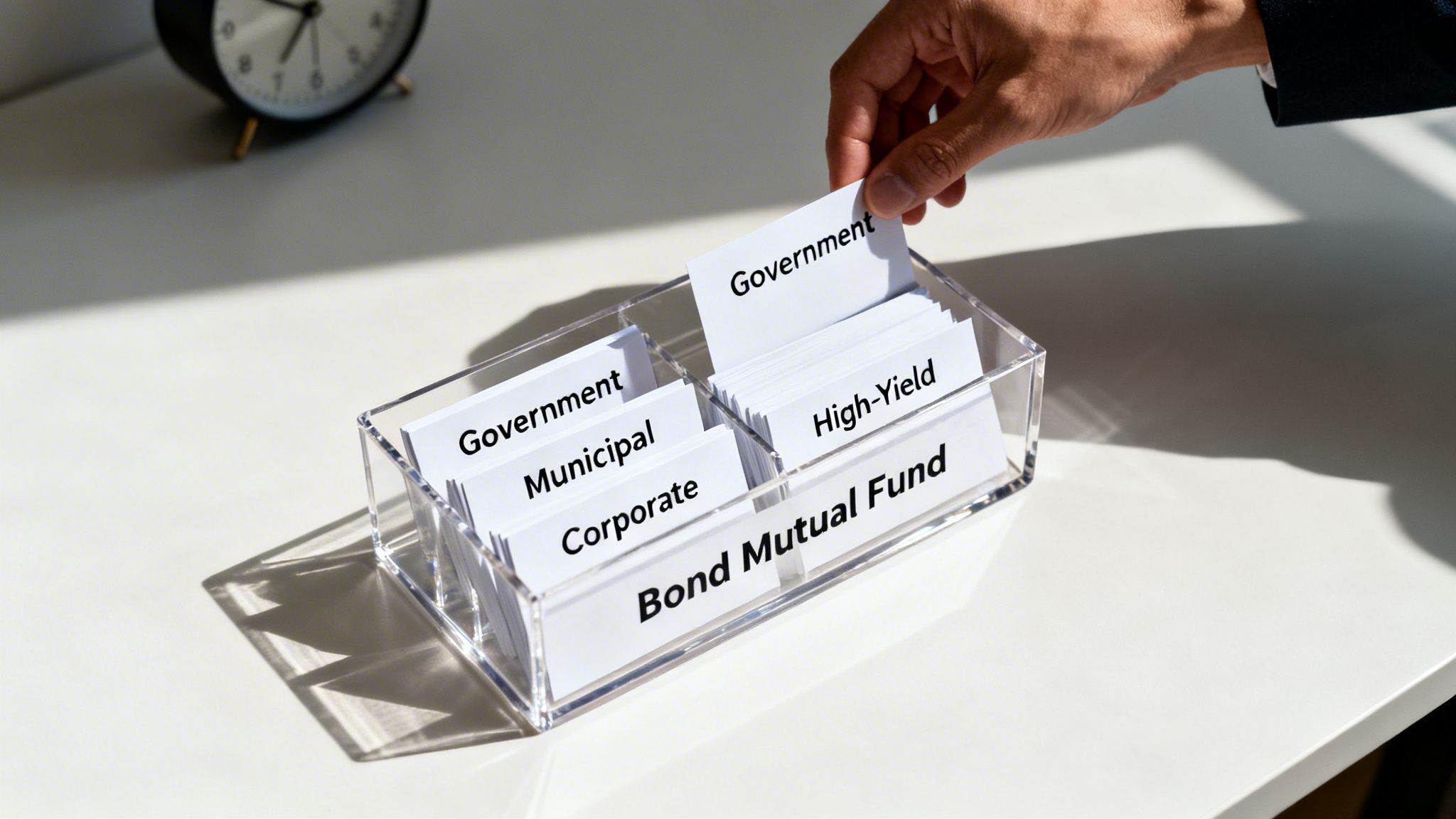
To really get a handle on bond funds, you have to pop the hood and see what’s running the engine. It’s a common misconception that you're buying a fixed basket of bonds. You're not.
Instead, you’re buying a share in a constantly churning pool of debt. You own a piece of the pool, not the individual bonds floating in it. This is a crucial distinction, as it’s what allows a fund manager to offer instant diversification across hundreds, or even thousands, of different bonds.
A Tour of the Different Bond Flavors
A bond mutual fund portfolio is a mix of different types of debt, and that mix is everything. The fund’s stated objective dictates what it can and can't hold, creating distinct risk and return profiles.
- Government Bonds: Think U.S. Treasuries. These are loans to the federal government and are widely considered the safest bonds you can buy from a default-risk perspective. They often serve as the bedrock of the fixed-income market.
- Municipal Bonds: These are issued by states, cities, and counties to fund public projects. For high-net-worth investors, their biggest draw is that the interest they pay is often exempt from federal income tax, and sometimes state and local taxes, too.
- Corporate Bonds: Just as the name implies, these are loans to companies. They carry more risk than government bonds, since a company can go bankrupt, but they typically pay a higher yield to compensate for that added risk.
- High-Yield Bonds: Often called "junk bonds," these come from companies with weaker credit ratings. They offer some of the highest potential income in the bond world but also carry the highest risk of default.
That blend of bonds has historically been a powerful stabilizer in a portfolio. From 1928 through 2023, U.S. Treasury bonds delivered average annual returns of around 4.8%. This was a lifeline during the turbulent decade from 2000-2011, when stocks went nowhere; bonds, by contrast, returned over 7.2% a year, providing critical ballast to portfolios.
The Pitfall of "Perpetual Maturity"
Beyond the mix of bonds, there's a structural issue that many investors miss: perpetual maturity. An individual bond has a clear end date — a day when you are contractually owed your principal back. A bond mutual fund, on the other hand, never matures.
A fund manager is in a constant state of buying and selling. As older bonds near maturity, they are sold off and replaced with new ones to keep the fund's average duration on target. This means your capital is perpetually exposed to the whims of the market.
If interest rates go up, the value of all those older, lower-yielding bonds in the fund drops, and your share price falls right along with it. You don't have the option to simply hold to maturity and get your principal back.
This constant churn is the fundamental trade-off. You get convenience and diversification, but you give up the certainty and control that comes with owning an individual bond with a defined end date. In other parts of the world, like South Africa, these funds are often known as unit trusts. For a closer look at how they function in that market, you can see this guide to Allan Gray Unit trusts.
Grasping this one concept — that you’re buying into a perpetually managed pool, not a finite asset — is the key to understanding why many investors seeking predictability and control ultimately find a better fit with a portfolio of individual bonds.
The Hidden Costs and Pitfalls of Bond Funds
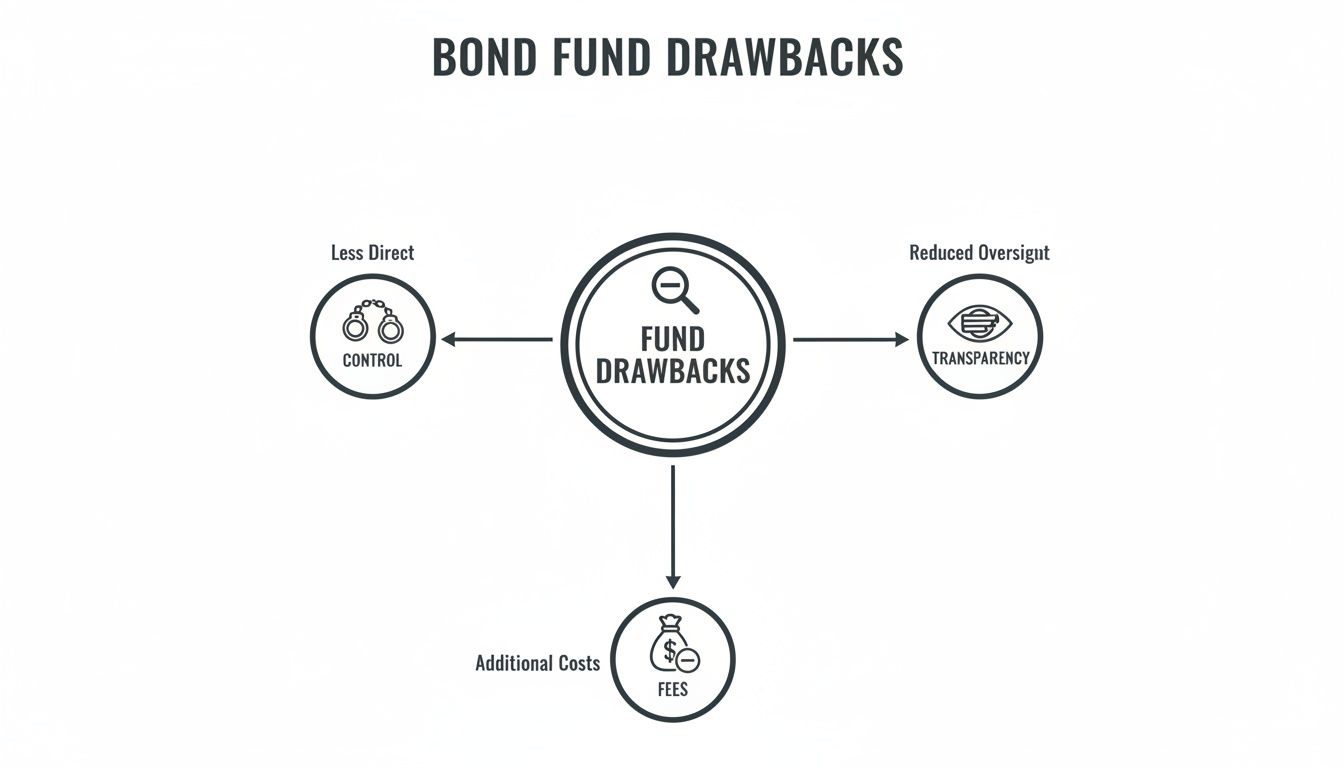
The one-click simplicity of a bond mutual fund is certainly appealing, but that convenience can mask some serious drawbacks. For savvy investors, particularly those with significant assets, these trade-offs can quietly eat away at returns and undermine an otherwise solid financial strategy.
Understanding these hidden pitfalls is the first step toward making a more informed decision for your fixed-income portfolio. True financial security comes from clarity and control — two things a mutual fund structure, by its very nature, limits.
Pitfall 1: Forced Selling and Loss of Control
Imagine you’re a passenger on a large ship. If a storm hits and a few people panic, demanding to get off, the captain might have to start jettisoning cargo to lighten the load. In a bond mutual fund, you’re one of those passengers, and the actions of others can directly harm your investment.
When markets get choppy and interest rates spike, nervous investors often rush to sell their fund shares. This can trigger a wave of redemptions, forcing the fund manager to sell bonds to raise cash. Often, they’re forced to liquidate the most stable, high-quality assets at depressed prices.
This forced selling locks in losses for everyone still in the fund, including disciplined, long-term investors. You have no say in the matter. Research even shows that investment funds often become the primary sellers during periods of bond market stress, amplifying volatility. Their need to meet redemptions can create a downward spiral, punishing the very investors who remain calm.
Pitfall 2: The Opacity Trap and Phantom Income
When you buy a bond fund, you don't actually own a specific set of bonds. You own a share in an ever-changing pool of thousands of securities, which makes true transparency nearly impossible. It’s like buying a mystery box; you know the general category of what's inside, but the exact contents change daily.
This lack of clarity can lead to a frustrating and costly tax surprise known as “phantom income.” Here’s how it works:
- The fund manager sells bonds within the portfolio for a profit, generating a capital gain.
- By law, the fund must distribute these gains to its shareholders, typically at year-end.
- You, as a shareholder, get this capital gains distribution and now have to pay taxes on it.
The catch? These are often gains you never personally saw in cash. The fund's share price might have even gone down for the year, yet you still get a tax bill for internal trading activity you had no control over. This is a significant tax inefficiency that can be a real drag on your net returns.
Pitfall 3: Perpetual Duration and Unrecoverable Losses
One of the biggest differences between a bond mutual fund and owning an individual bond is maturity. An individual bond has a specific date when your principal is contractually scheduled to be repaid. A fund, on the other hand, has a perpetual duration — it never matures.
This means there is no finish line. If rising interest rates cause the fund’s share price (its Net Asset Value or NAV) to fall, there is no guarantee it will ever recover. You can't simply "hold to maturity" to get your principal back because there isn't one.
Your only choices are to sell at a loss or wait and hope the market eventually turns in your favor. This perpetual exposure to interest rate risk is a critical flaw for investors who count on their fixed-income allocation for capital preservation.
Pitfall 4: The True Cost of Fees and Inefficiencies
A fund’s expense ratio is its most visible cost, but that’s often just the tip of the iceberg. The total cost is usually much higher once you account for hidden fees and structural issues that erode performance. Scrutinizing these underlying costs is critical, making it vital to understand how Hidden Mutual Fund Fees Are Eating Your Returns.
These other costs can include:
- Trading Costs: The fund’s constant buying and selling of bonds incurs brokerage commissions and other transaction fees. These aren't in the expense ratio but still reduce the fund's overall return.
- Tax Inefficiency: As we saw with phantom income, a fund's structure can create tax bills you didn't see coming, further shrinking your take-home profit.
- Cash Drag: To meet potential redemptions, funds have to hold cash. This cash earns very little, dragging down the portfolio's total return.
When you add them all up, these visible and hidden costs create a major hurdle for performance. To get a better handle on how these charges impact your portfolio, you can read our guide on understanding investment management fees and what to look for. An individual bond portfolio, by contrast, eliminates these layers of fees and offers a more direct, cost-effective path to your financial goals.
Why Individual Bonds Put You in Control
After walking through the hidden costs and structural problems of the typical bond mutual fund, it’s easy to see why so many high-net-worth investors are looking for a better way. The convenience of a fund often comes at a steep price: you give up control, transparency, and cost-efficiency.
Thankfully, there’s a powerful alternative that puts you right back in the driver’s seat — building a custom portfolio of individual bonds.
Owning bonds directly is a world away from owning shares in a fund. Instead of buying into a perpetual, ever-changing pool of assets, you become the direct lender. This simple distinction restores the very benefits fixed income was meant to provide in the first place: predictability and control.
Advantage 1: Total Transparency
One of the biggest upsides to an individual bond portfolio is absolute transparency. Unlike a bond mutual fund, where your money is spread across an opaque mix of thousands of securities, direct ownership is crystal clear. You know exactly what you own, full stop.
This clarity allows you and your advisor to make precise, informed decisions based on hard facts.
- You know the issuer: You can personally assess the creditworthiness of each company or municipality you lend to.
- You know the coupon: You know the exact interest rate you will be paid on a set schedule.
- You know the maturity date: You have a contractually guaranteed date when you get your principal back.
That level of detail is simply out of reach within a fund, where the manager is constantly buying and selling assets behind the scenes.
Advantage 2: Absolute Control Over Your Financial Future
With an individual bond portfolio, you’re the architect. This control goes far beyond just picking which bonds to buy; it lets you engineer a fixed-income strategy that perfectly matches your financial timeline and risk tolerance. Your capital is no longer subject to the whims of other investors in a fund.
You are completely insulated from the risk of forced selling. If other investors panic and rush for the exits, it has zero impact on your holdings. You can confidently hold your high-quality bonds to maturity, secure in the knowledge that your principal will be returned on a set date, regardless of what the market is doing.
This control also opens the door to sophisticated strategies like bond laddering. By purchasing a series of bonds with staggered maturity dates, you can create a predictable stream of cash flow to meet specific goals, like funding retirement or paying for an education. That’s something a perpetual-duration fund simply can’t do.
For a deeper dive into the core differences, you can explore our guide comparing a bond fund vs. individual bonds and see how they fit different needs.
Advantage 3: Superior Cost-Effectiveness and Tax Efficiency
Building your own bond portfolio is also a more cost-effective and tax-efficient way to manage your wealth. By sidestepping the fund structure, you eliminate layers of fees and gain strategic command over your tax bill.
Greater Cost-Effectiveness:
When you hold individual bonds to maturity, you avoid the recurring annual management fees that a bond mutual fund charges every single year. While you’ll have initial transaction costs, these are a one-time expense, not a perpetual drag on your portfolio’s growth. Over the long run, this direct ownership model can significantly boost your net returns.
Superior Tax Efficiency:
You, not a fund manager, decide when to realize gains or losses. This control is a powerful tool for tax management. You can strategically sell bonds at a loss to offset gains elsewhere in your portfolio, a technique known as tax-loss harvesting. Better yet, you’ll never be hit with a surprise “phantom income” tax bill generated by a fund’s internal trading activity.
The table below offers a clear, at-a-glance comparison, reinforcing why a custom bond portfolio is often the superior choice for investors who demand control, clarity, and efficiency.
Bond Mutual Fund vs. Individual Bond Portfolio
How to Build a Custom Bond Portfolio
Understanding the limits of a bond mutual fund is one thing. Actually building a better alternative with individual bonds is something else entirely. It’s not about just scooping up a random collection of debt; it's a careful, strategic process meant to align your fixed-income assets directly with your most important financial goals.
This isn’t the one-size-fits-all world of a fund. Building your own bond portfolio is a deliberate, hands-on exercise. The whole point is to create a structure that gives you exactly what you need — whether that's a steady paycheck in retirement, ironclad capital preservation, or cash for a major expense down the road.
Define Your Core Objectives First
Before you even think about buying a single bond, the first and most critical step is to get crystal clear on what you need this money to do. Are you a pre-retiree looking to replace your salary with a predictable monthly income? Or maybe you're a business owner who needs to protect capital for a future acquisition?
Your answer drives every decision that follows.
- Income Generation: If your main goal is generating regular cash flow, your entire focus will be on the coupon payments from the bonds you choose. The portfolio can be engineered to pay out interest on a schedule that perfectly matches your cash flow needs.
- Capital Preservation: For those who prioritize the safety of their principal above all else, the game shifts to credit quality and maturity dates. High-grade bonds with shorter time horizons can provide serious stability and give you a definite date when you'll get your money back.
- Funding a Specific Goal: Need a lump sum at a particular time in the future — say, for a real estate purchase or a child's wedding? You can simply buy a bond that matures right when you need the cash, making sure the funds are there.
This is a world away from a bond mutual fund, where your personal objectives always take a backseat to the fund manager’s broad strategy and the whims of thousands of other investors.
Constructing a Bond Ladder for Predictability
One of the most powerful tools you get with individual bonds is the bond ladder. The technique is straightforward: you build a portfolio of bonds with staggered maturity dates. For instance, you might buy bonds that mature in one, two, three, four, and five years.
As each bond matures, you can either spend the principal or, more commonly, reinvest it in a new, longer-term bond at the far end of your ladder. This creates a rolling, predictable stream of liquidity and helps you manage the risk of changing interest rates. For anyone trying to navigate different market cycles, a bond ladder provides a systematic way to adapt, which is a key part of the best investment strategies for rising interest rates.
A bond ladder gives you predictable access to your capital. You know exactly when and how much money is coming back to you, which allows for precise financial planning that is impossible to achieve with a perpetual-duration fund.
Diversify to Manage Credit Risk
A ladder helps manage interest rate risk, but you also have to manage credit risk. That means diversifying. You need to spread your investments across different issuers, sectors, and even geographic locations to avoid being too exposed if any single company or municipality runs into trouble.
Proper diversification in a custom bond portfolio might look like this:
- A healthy mix of corporate and municipal bonds.
- Exposure to a variety of industries, like utilities, financials, and consumer staples.
- A thoughtful range of credit ratings, balancing higher-yielding bonds with safer, investment-grade debt.
The rush into funds often masked these kinds of risks. The explosive growth of bond mutual funds saw global assets swell from $2.6 trillion in 2010 to $5.2 trillion by 2020. But that period of growth hid a critical vulnerability: rock-bottom starting yields offered almost no cushion when rates finally surged, crushing returns for investors in later years. You can find more analysis on these trends and what they mean for portfolios.
Case Study: A Pre-Retiree's Income Strategy
Take Sarah, a 60-year-old executive who plans to retire in two years. Her main goal is to generate $80,000 a year in predictable income to cover her living expenses, which will supplement her other retirement accounts. A generic bond mutual fund would leave her at the mercy of NAV swings and unpredictable distributions.
Instead, her advisor helps her build a $2 million portfolio of individual bonds with an average yield of 4%.
- Objective: Generate $80,000 in annual income.
- Strategy: Build a diversified bond ladder with staggered maturities.
- Execution: They purchase 20 different high-quality corporate and municipal bonds, each with a face value of $100,000. The bonds are specifically chosen so their coupon payments are spread evenly throughout the year, creating a consistent "paycheck" for Sarah. The maturities are laddered from one to ten years out.
The result? Sarah now has a predictable, contractually obligated income stream. She’s insulated from market panic and the kind of forced selling that plagues mutual funds. This custom-built strategy gives her the peace of mind and financial certainty that a one-size-fits-all fund simply cannot deliver.
Your Top Questions Answered
When you’re weighing the simplicity of a bond mutual fund against the control of owning individual bonds, some tough questions always come up. Here are some straight answers to help you decide what’s truly right for your portfolio.
Can I Lose Money In A Bond Fund Even If No Bonds Default?
Yes, you absolutely can. It’s one of the biggest — and most common — misunderstandings about bond mutual funds.
Unlike an individual bond, which you can hold until it matures to get your principal back, a fund's share price (its Net Asset Value, or NAV) goes up and down every single day.
When interest rates rise, the older, lower-paying bonds already inside the fund become less valuable. That drop in value hits the fund's NAV directly. If you need to sell your shares when the NAV is lower than what you paid, you will lock in a loss, even if not a single bond in the fund has defaulted.
Is A Bond Fund Safer Because It’s Diversified?
Diversification in a bond mutual fund is great for one thing: it reduces credit risk, which is the danger that a single company or government will fail to pay its debt. Spreading an investment across hundreds or thousands of bonds means that if one defaults, the damage is contained. That’s a clear win.
But that same diversification does nothing to protect you from market-wide problems, especially interest rate risk. When rates go up, the value of nearly all bonds goes down, and so will your fund’s NAV. With a portfolio of individual bonds, you have control over this risk by picking specific maturity dates. A fund, on the other hand, never "matures," leaving you permanently exposed to these market swings.
While a fund reduces the risk of a single default, it actually magnifies your exposure to risks you can't control, like forced selling by other investors and the endless fluctuation of its share price. For many investors, true safety comes from the certainty of a fixed maturity date.
Is Building An Individual Bond Portfolio Too Complicated?
It’s true that building a diversified portfolio of individual bonds takes more work upfront than buying a bond mutual fund. But for a high-net-worth investor, it’s not only accessible — it’s a powerful strategy when done right.
The secret is working with the right partner. A dedicated wealth management firm can manage the entire process for you:
- Defining Objectives: We align the portfolio with your specific income goals and how much risk you're comfortable taking.
- Bond Selection: We handle the sourcing and vetting of the right bonds across different sectors and credit qualities.
- Ongoing Management: The portfolio is actively monitored, and we make adjustments as market conditions or your needs change.
This turns a seemingly complex task into a streamlined and highly effective strategy, giving you direct control and full transparency.
What’s The Minimum Investment For An Individual Bond Portfolio?
To get the right level of diversification, building a portfolio of individual bonds does require a larger investment than simply buying shares in a mutual fund. This is exactly why it’s a strategy so well-suited for high-net-worth individuals and families.
Trying to build a bond-by-bond portfolio on a small scale can be inefficient and costly. This is where working with a specialized firm creates a huge advantage. At Commons Capital, we build professionally managed, diversified individual bond portfolios at an institutional level. This structure gives our clients the cost-efficiency and direct ownership benefits that are hard to get on your own.
By pooling assets for trade execution while keeping ownership of the bonds separate for each client, we make this superior strategy both powerful and accessible. It’s a core part of how we bring more control and predictability to our clients' fixed-income strategies.
At Commons Capital, we specialize in moving investors beyond the limitations of the standard bond mutual fund. We build custom, transparent, and cost-effective individual bond portfolios designed to meet your specific financial objectives with greater certainty and control. To learn how we can construct a more resilient fixed-income strategy for you, visit us at commonsllc.com.