Understanding how to calculate required minimum distributions (RMDs) is a crucial skill for anyone approaching retirement. At its core, the RMD calculation is surprisingly simple: divide your retirement account's value from the previous December 31st by a specific life expectancy factor provided by the IRS. This guide will walk you through each step, ensuring you have the clarity and confidence to manage your withdrawals correctly.
For example, if your account was worth $500,000 at the end of last year and your IRS life expectancy factor is 26.5, your RMD would be $18,867.92. The key is ensuring you use the correct numbers for this simple formula.
Your Starting Point for RMD Calculations
If you have a tax-deferred retirement account like a Traditional IRA or 401(k), getting a handle on RMDs is non-negotiable. This is the government’s method for collecting tax revenue on money that has grown tax-deferred, often for decades. Once you reach age 73, the IRS mandates that you begin taking these withdrawals annually.
These required withdrawals ensure that the tax deferral on your savings doesn't last indefinitely. For a great primer on the basics, this guide on What Is Required Minimum Distribution Explained Simply is a fantastic resource to check out before we get into the nitty-gritty.
Let's gather all the key pieces you'll need.
RMD Calculation At a Glance
Here’s a quick snapshot of the essential information you'll need before you start any calculations. Getting these three items right is the most important part of the process.
With these three pieces of information, you have everything you need to calculate your required minimum distribution.
Breaking Down the Core Formula
As you can see, the calculation itself is surprisingly straightforward. The real work lies in gathering two key numbers: your account balance from the previous December 31st and the correct life expectancy factor from the IRS.
Let's walk through a quick example. Say you're turning 73 this year. You'd look up your age on the IRS Uniform Lifetime Table and find the corresponding distribution factor, which is 26.5. If your IRA balance was $100,000 at the end of last year, your RMD would be $3,773.58 ($100,000 ÷ 26.5).
The most critical first step is simply identifying these two numbers. Everything else in the RMD process builds upon this foundation. Getting this right from the start prevents costly errors down the line.
Think of this as your quick-start guide. We've covered the basic mechanics of the calculation. Now, let's dive into how to find these values for your specific situation and tackle the more complex scenarios you might encounter.
Gathering the Right Financial Information
Before you can calculate your RMD, you need accurate numbers. This foundational step is crucial, as even a small mistake can ripple through the entire process, leading to an incorrect distribution amount and a significant penalty from the IRS.
The two most critical pieces of the puzzle are your retirement account balances and your age. While this sounds simple, people often trip up here. Using a balance from the wrong month's statement or overlooking a small 401(k) from a previous job are common errors. Let's walk through exactly what you need to collect.
Pinpointing Your Account Balances
First, you need the fair market value (FMV) of every single one of your RMD-eligible accounts as of December 31 of the previous year. This date is non-negotiable. A statement from November 30 or January 31 will not suffice.
You'll need to gather year-end statements for all of these accounts:
- Traditional IRAs
- SEP IRAs
- SIMPLE IRAs
- 401(k), 403(b), and 457(b) plans
Your financial institution or plan administrator typically makes these available in January. Review your files and ensure you have a statement for every account, no matter how small the balance.
The Role of Aggregation in Your RMD Strategy
Once you have all your balances, you need to understand the rules of aggregation. This concept dictates which accounts can be bundled for withdrawal purposes and which must be handled separately. Misunderstanding this is another frequent source of RMD errors.
You must calculate the RMD for each account separately. However, for certain account types, you can add up the individual RMD amounts and then take the total withdrawal from just one of those accounts.
For instance, if you have three different Traditional IRAs, you’ll calculate the RMD for each one based on its unique December 31 balance. But when it's time to take the money out, you can sum those three RMD amounts and withdraw the entire total from just one of the IRAs for convenience. The same logic applies to 403(b) accounts.
However—and this is a critical distinction—this flexibility does not apply across different account categories. The RMD calculated for your 401(k) must be withdrawn from that specific 401(k). You cannot use a withdrawal from your IRA to satisfy a 401(k) RMD, or vice versa. This is especially important if you're managing multiple old workplace plans. For a deeper dive, see our guide on what to do with a 401(k) after leaving a job.
Confirming Your Age for the Calculation
The second key piece of information is your age. The IRS isn't interested in your age today; they want to know the age you will turn during the calendar year for which you are calculating the RMD.
So, if you're calculating your 2024 RMD and your 75th birthday is in December 2024, you must use age 75 to find your life expectancy factor. It doesn't matter that you are technically 74 when you perform the calculation.
With your correct year-end balances and your age for the tax year in hand, you have the essential inputs to move on to the next step: finding your distribution factor.
Finding Your Correct IRS Life Expectancy Table
The RMD calculation hinges on one critical number pulled from an IRS life expectancy table. Selecting the correct table is essential for determining the right withdrawal amount and staying compliant.
While the IRS provides three different tables, the good news is that for most retirees, the choice is simple. The vast majority will use the Uniform Lifetime Table, making it the default for nearly everyone.
The Go-To Option: The Uniform Lifetime Table
The Uniform Lifetime Table is the workhorse for RMDs. If you are the account owner and are single or your spouse is not more than ten years younger than you, this is your table. It’s the one you’ll likely use every year.
Using it is a simple lookup process. You find your age for the distribution year, and the table provides the corresponding "distribution period," or factor.
For example, a retiree who turns 75 this year would scan the table for age 75 and find the factor is 24.6. If their account balance was $400,000 at the end of last year, they would divide that balance by 24.6 to calculate their RMD. It’s that direct.
Here’s a snapshot of a portion of the Uniform Lifetime Table:
As you can see, it’s a simple matching game. This single factor is the key to unlocking how to calculate required minimum distributions (RMDs) accurately.
The Spousal Exception: The Joint Life and Last Survivor Expectancy Table
While the Uniform Lifetime Table is standard, a valuable exception can help you keep more of your money growing tax-deferred. This special rule applies if your sole beneficiary is your spouse, and that spouse is more than 10 years younger than you are.
In this specific case, you can use the Joint Life and Last Survivor Expectancy Table. This table uses both of your ages to calculate a longer joint life expectancy, which results in a smaller distribution factor and, consequently, a smaller RMD. For couples with a significant age gap, this is a powerful planning tool.
Key Takeaway: Using the Joint Life table is an option, not a mandate. If you qualify, it's almost always financially advantageous because it reduces your immediate tax bill by lowering your RMD.
The Table for Beneficiaries: The Single Life Table
The third and final table is the Single Life Table. Its primary use, especially after the SECURE Act changed the rules, is for beneficiaries of inherited retirement accounts.
When a non-spouse beneficiary inherits an IRA, they often must use this table to calculate their own RMDs based on their personal life expectancy. The regulations for inherited IRAs are more complex now, but this table remains the central tool for any beneficiary eligible to stretch distributions over their lifetime.
To make things crystal clear, here is a quick guide to help you pinpoint exactly which table you should be using.
Which IRS RMD Table Should You Use?
This simple comparison will help you identify the correct life expectancy table based on your personal situation.
By checking your circumstances against this chart, you can be confident you're using the right factor for your calculation. For nearly everyone reading this, that will be the Uniform Lifetime Table.
Let's Calculate an RMD: A Real-World Walkthrough
You've got your account balance and you've found your life expectancy factor. The theory is done. Now it's time to put those numbers to work and see how this all plays out in a real-world scenario.
To make the RMD calculation process really click, let's follow a hypothetical retiree named Alex. He just turned 75 and has been a diligent saver his whole life.
Meet Alex, Our Example Retiree
Alex has two main retirement accounts subject to RMDs. He’s already pulled his year-end statements and knows his age for the distribution year, so he's ready to go.
Here's what Alex is working with:
- Age for the RMD year: 75
- Traditional IRA Balance (as of Dec. 31 last year): $450,000
- 401(k) Balance (as of Dec. 31 last year): $200,000
- Life Expectancy Factor: Alex looked up age 75 on the Uniform Lifetime Table and found his factor is 24.6.
With this info in hand, Alex is ready to figure out the RMD for each account. This is a critical first step—you always have to calculate each account's RMD separately.
Calculating the RMD for Each Account
Even if you plan on taking the withdrawal from a single account later (thanks to the aggregation rule), you can't skip this initial math. It's a non-negotiable part of the process that keeps everything accurate.
1. Alex's Traditional IRA Calculation:
- The Formula: Account Balance ÷ Distribution Period
- The Math: $450,000 ÷ 24.6 = $18,292.68
2. Alex's 401(k) Calculation:
- The Formula: Account Balance ÷ Distribution Period
- The Math: $200,000 ÷ 24.6 = $8,130.08
Simple as that. Alex now knows his exact RMD obligations for the year. His Traditional IRA needs a withdrawal of at least $18,292.68, and his 401(k) requires at least $8,130.08.
A little pro tip: It's common practice to round your final RMD amount up to the next dollar. Alex would likely round to $18,293 for his IRA and $8,131 for his 401(k). This just gives you a tiny buffer and ensures you’ve fully met the requirement.
Using Aggregation to Take the Withdrawal
Now that Alex has the numbers, he must decide how to take the money out. This is where those aggregation rules we discussed become incredibly useful. He knows he can't mix and match between his IRA and 401(k).
Here's how he'll handle it:
- The 401(k): The rules here are strict. The $8,130.08 RMD must come directly from that specific 401(k). He has no other choice for this one.
- The Traditional IRA: Alex actually has three separate Traditional IRAs that add up to the $450,000 total. The total RMD for all his IRAs is $18,292.68. He has the flexibility to take that entire amount from just one of his IRAs, or he can take smaller withdrawals from all three, as long as the grand total hits that RMD target.
This flexibility with his IRAs is great because it gives Alex more control. He can strategically decide which investments to sell to raise the cash for his withdrawal, potentially optimizing for taxes or performance.
Your Simple RMD Worksheet
Want to run your own numbers? You can follow the exact same process Alex did. Use this simple worksheet to plug in your figures and keep your calculations organized. It turns a confusing set of rules into a simple, repeatable task you can knock out every year.
By walking through a real-world scenario and using a tool like this, you can confidently figure out your own RMDs and make a smart plan for taking them. It demystifies the whole thing and makes it a manageable part of your annual financial routine.
Acing the Tricky Scenarios and Sidestepping Common Mistakes
The basic RMD math is straightforward, but retirement planning is rarely simple. Real life introduces complexities, making it crucial to understand special cases and common pitfalls.
Getting these nuanced rules right keeps you compliant and can even help fine-tune your withdrawal strategy. From inherited accounts to workplace plan exceptions, let’s unpack the situations that can easily trip people up.
At its core, the standard calculation is simple enough.
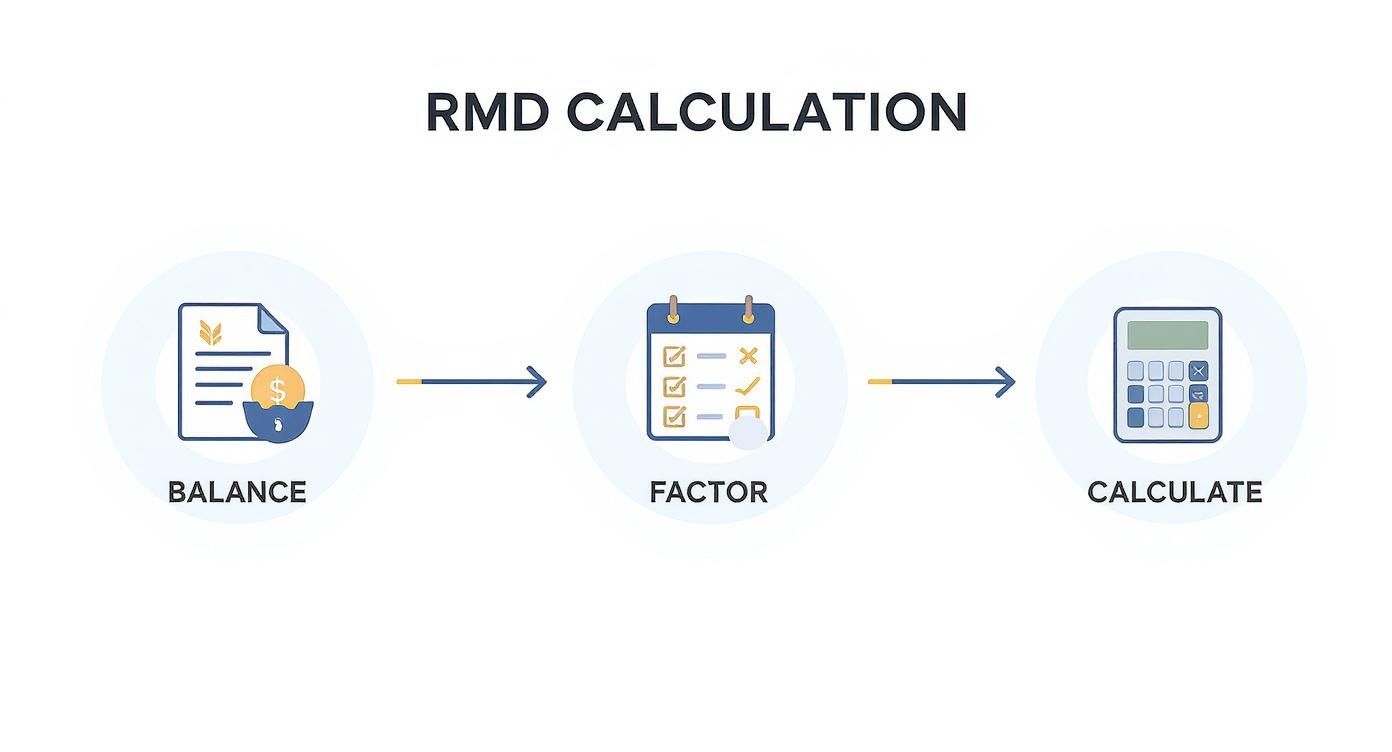
This illustrates the basic process: grab last year's balance, find your life expectancy factor, and do the division. Now for the tricky parts.
Handling Inherited Retirement Accounts
This area has become particularly tangled, especially since the SECURE Act rewrote the rulebook. Before the Act, many non-spouse beneficiaries could "stretch" RMDs over their entire lifetimes. That option is now unavailable for most.
Generally, if you’re a non-spouse beneficiary who inherited an IRA from someone who passed away in 2020 or later, you must empty the entire account within 10 years. There are a few key exceptions for what the IRS calls "eligible designated beneficiaries":
- The surviving spouse
- Minor children of the original owner
- Disabled or chronically ill individuals
- Anyone not more than 10 years younger than the person who passed away
If you fall into one of those categories, you may still be able to take distributions over your life expectancy. The tax implications are significant, so knowing where you stand is critical. For a deeper dive, check out our guide on the tax on an inherited 401(k).
Busting Common RMD Myths
Misinformation about RMDs is everywhere. Let's clear up two of the most persistent—and costly—myths.
- Myth #1: Roth IRAs have RMDs. This is false. For the original owner, a Roth IRA has no RMD requirement during their lifetime. The money can continue to grow tax-free for as long as you live.
- Myth #2: Inherited Roth IRAs are RMD-free. This is a common mistake. While the original owner gets a pass, a beneficiary who inherits a Roth IRA is subject to distribution rules, often the same 10-year rule as inherited Traditional IRAs. The good news? The distributions are usually tax-free.
The "Still-Working" Exception
Here’s one of the most valuable exceptions available. If you’re still working past age 73 and participating in your current employer's 401(k) or 403(b), you can usually delay RMDs from that specific plan until April 1 of the year after you finally retire.
Heads Up: This exception has a big catch. It doesn't apply if you own more than 5% of the company you work for. It also only covers the retirement plan of your current job. You still have to take RMDs from all your Traditional IRAs and any 401(k)s from previous employers.
Top Errors to Avoid (and How to Fix Them)
Even the most careful savers can make mistakes. Knowing the common pitfalls is the best way to avoid the steep 25% penalty for getting it wrong.
- Messing Up the First RMD Deadline: You have extra time for your very first RMD—until April 1 of the year after you turn 73. But be careful. If you delay, you’ll have to take two RMDs in that single year (your first and your second). That could easily push you into a higher tax bracket. Unless there is a specific strategic reason, it's often smarter to take that first RMD by December 31 of the year you turn 73.
- Mixing Up Aggregation Rules: This is a classic error. You must calculate the RMD for each IRA you own separately. The good news is you can add them all up and take the total withdrawal from just one of your IRAs. But this rule does not apply to 401(k)s. A 401(k) RMD must come from that specific 401(k). You cannot use an IRA withdrawal to satisfy it.
- Using the Wrong Account Balance: This is simple but critical. Always use the December 31 balance from the previous year. Using a current balance or a number from a different month's statement will guarantee your calculation is incorrect.
If you realize you've made a mistake, act quickly. Take out the shortfall immediately and file IRS Form 5329 to request a penalty waiver. The IRS is often reasonable about honest mistakes, especially if you can show you took steps to correct it as soon as you discovered it.
Your Top RMD Questions, Answered
Even after you get the hang of the RMD process, some specific questions always seem to pop up. Retirement finance is full of unique situations, after all, and knowing the finer points can make a real difference to your strategy and your tax bill.
Let's walk through some of the most common questions I hear from clients to help you manage your distributions with confidence.
Can I Take My RMD at the Start of the Year?
One of the first questions people ask is about timing. Do you have to wait until December 31st? Nope. You can take your RMD anytime during the calendar year.
There’s absolutely no requirement to wait until the last minute. In fact, many financial advisors often suggest taking it earlier in the year to avoid the end-of-year rush and provide more flexibility.
What Happens If I Take Out More Than My RMD?
It’s a pretty common scenario. You need some extra cash for a big purchase or an unexpected expense, so you withdraw more than your required minimum. Does that extra amount count toward next year's RMD?
Unfortunately, no. The IRS is crystal clear on this. Any amount you withdraw beyond your calculated RMD for the current year is simply considered an extra taxable distribution. It cannot be used to offset or reduce your RMD obligation in any future years.
Each year’s RMD is a completely new calculation based on the prior year-end balance and your age.
Does My RMD Have to Be in Cash?
Not at all! This is a great strategic question. Your RMD doesn’t have to be a cash withdrawal. You can satisfy the requirement with an in-kind distribution.
This means you transfer assets—like shares of a stock or a mutual fund—directly from your retirement account into a regular taxable brokerage account. The fair market value of those assets on the day of the transfer is what counts toward your RMD, and that's the amount you'll pay income tax on. This can be a brilliant move if you want to hold an investment you believe in for the long term while still meeting your RMD.
An in-kind transfer can be a strategic way to satisfy your RMD without selling investments you want to hold long-term. The transferred assets will then be subject to capital gains tax rules in your taxable account going forward.
So, I Definitely Pay Taxes on My RMD?
Yes, in almost every case. Distributions from traditional, pre-tax accounts like a Traditional IRA or a 401(k) are taxed as ordinary income.
This means the RMD amount is added to your other income for the year (like Social Security or a pension) and is taxed at your regular marginal tax rate. This is why planning is so critical. A large RMD could easily push you into a higher tax bracket. To get ahead of this, some retirees explore strategies like Roth conversions earlier in their retirement to shrink the balances that will eventually be subject to RMDs. For more on that, understanding Roth conversion tax implications is key for long-term planning.
What If My Account Value Tanks During the Year?
Market volatility is always stressful, especially when you rely on your portfolio for income. Here’s the key thing to remember: your RMD for the current year is based on your account's value on December 31 of the previous year.
So, even if the market takes a nosedive during the year, your RMD amount is already locked in. For example, your 2024 RMD is calculated using your balance from December 31, 2023—no matter what your portfolio has done since. This rule can be frustrating in a down market because you’re forced to sell more shares at a lower price to withdraw the required cash.
As people learn about RMDs, they often have related questions about the general safety of their retirement accounts. For more on that topic, you can find valuable information by understanding your 401k rights and IRS protections.
Navigating the complexities of RMDs and integrating them into your broader financial plan requires expertise. At Commons Capital, we specialize in helping high-net-worth individuals manage their wealth and achieve their retirement goals. If you have investable assets of $500,000 or more, let's discuss how we can create a personalized strategy for you. Contact us today to learn more.