Before you even think about interviewing a wealth manager, the first and most important step is an internal one. You need to get crystal clear on your own financial situation, goals, and just how much risk you’re truly comfortable with. Knowing how to choose a wealth manager starts with understanding yourself.
Think of it as creating a personal blueprint. This self-audit acts as a powerful filter, immediately weeding out advisors who aren't a good fit and saving you a ton of time.
Defining Your Financial Goals and Expectations
Trying to find the right wealth manager without knowing exactly what you want is like setting sail without a destination. You'll just drift. This isn't just about numbers on a spreadsheet; it's about translating your life's ambitions into a real, actionable financial strategy.
Too often, people start with vague goals like "I want to grow my money." That’s not a plan. A better approach is to get specific. Are you looking for aggressive growth to launch a new company in five years? Or is your main priority protecting your capital to ensure your family is taken care of for generations to come?
The answers to these questions will completely change the kind of advice you need.
Clarifying Your Core Objectives
The strategies an advisor recommends will flow directly from your goals. A simple way to bring them into focus is to sort them by timeline. I often tell clients to think about their financial life in distinct buckets:
- Short-Term Needs (1-3 years): This is for things like a down payment on a new property, funding a child's upcoming college tuition, or setting aside cash for a big tax bill. These goals usually call for lower-risk, more liquid investments.
- Mid-Term Ambitions (4-10 years): Maybe you're planning to retire early, expand your business, or get a family foundation off the ground. This timeline allows for a more balanced approach to risk and reward.
- Long-Term Legacy (10+ years): This bucket is all about the big picture — multi-generational wealth, complex estate planning, and significant charitable giving. Here, you can often take on more risk for potentially greater growth.
The needs of a tech founder who just had a major exit are worlds apart from those of a surgeon nearing retirement. The founder might need help managing a large, concentrated stock position and exploring venture capital deals. The surgeon, on the other hand, is probably focused on creating a reliable income stream that will last the rest of their life.
A recent study on advisor relationships found that three out of five clients felt that more frequent and personalized communication would boost their confidence. This really drives home the point that it's not just about aligning on goals, but also on how you'll work together from day one.
Gauging Your True Risk Tolerance
It’s easy to say you have a high tolerance for risk when the market is soaring. It's a different story when things get choppy. You have to be brutally honest with yourself about how you'd react in a serious downturn. A wealth manager needs to know your real comfort level to build a portfolio you can actually stick with.
Ask yourself a few hard questions:
- How would a 20% drop in my portfolio affect my sleep? My stress levels? My ability to cover my bills?
- Have I lived through a major market correction before? What did I do? Did I panic and sell at the bottom, or did I ride it out?
- Am I more worried about missing out on potential gains (FOMO) or losing the money I already have (loss aversion)?
Getting this right is critical. An advisor who pushes a high-growth strategy on a conservative investor is setting them both up for failure. In my experience, this kind of mismatch is one of the top reasons clients end up firing their advisors. Being upfront about your emotional response to risk is the foundation of a strong, lasting relationship.
Understanding Who You Are Hiring
Once you have a clear picture of your personal financial blueprint, it’s time to figure out exactly who you’re hiring. The world of financial advice isn't one-size-fits-all, and the differences between titles, legal duties, and fee structures can have a huge impact on the advice you get.
Hiring the wrong type of advisor can lead to some seriously costly conflicts of interest down the road.
The biggest distinction — the one that changes everything — is the legal standard an advisor is held to. It dictates the investments they recommend and how transparent they have to be about their fees. It's the difference between someone legally sworn to act in your best interest and someone who just has to offer something "suitable."
Fiduciary vs. Suitability: The Critical Difference
A fiduciary has a legal and ethical duty to put your best interests first, always. No exceptions. This is the highest standard of care in the financial world, and professionals like Registered Investment Advisors (RIAs) are bound by it.
On the other side of the coin, you have professionals like many traditional stockbrokers who operate under a suitability standard. This just means their recommendations have to be a reasonable fit for your general financial situation. While not necessarily a bad thing, this lower bar opens the door to potential conflicts.
Here's a real-world example: A broker working under the suitability standard might recommend Mutual Fund A over the nearly identical Mutual Fund B. Fund A is perfectly suitable for your goals, but it just so happens to pay the broker a higher commission. A fiduciary in that same situation would be legally required to recommend the option that is truly best for you, even if it means less money in their pocket.
It’s a subtle difference, but one with massive long-term implications for your portfolio.
This visual breaks down the core elements you need to nail down before you even start talking to advisors: your goals, your comfort with risk, and how hands-on you want to be.
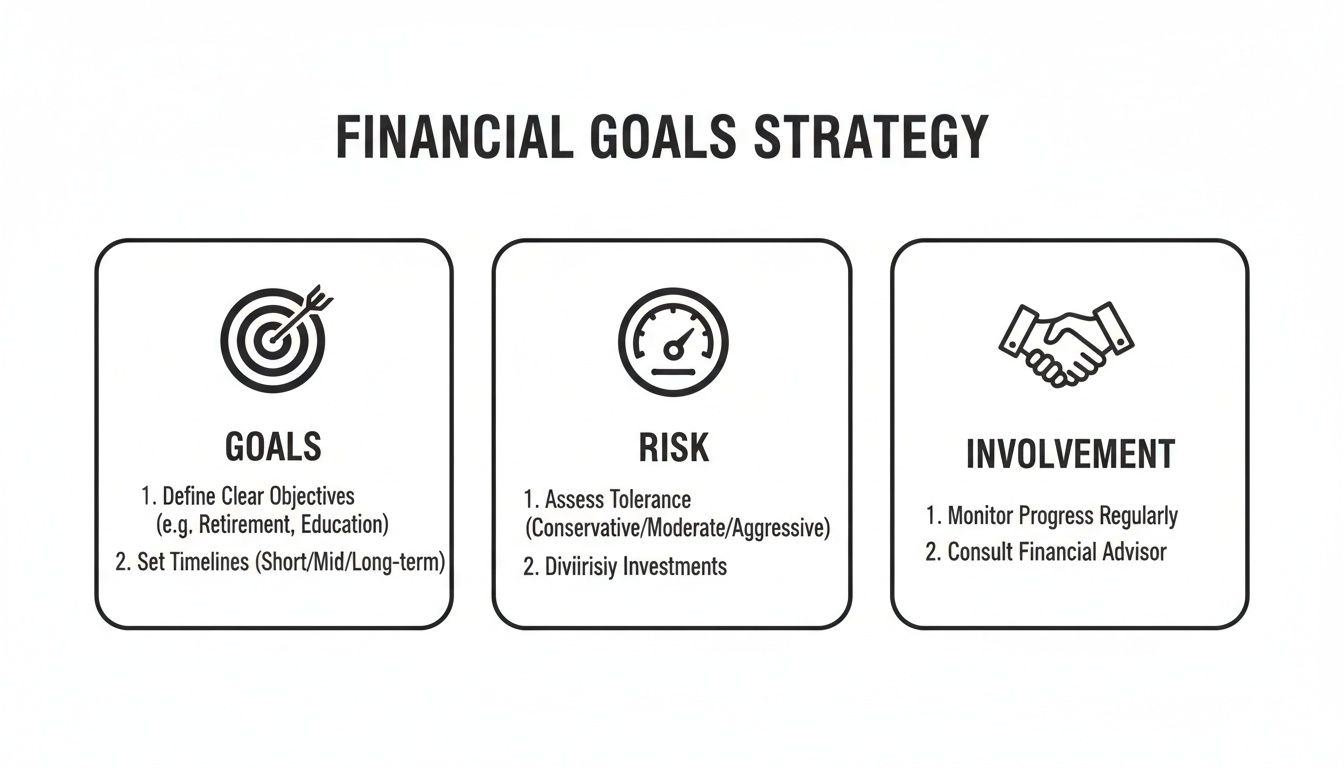
Getting clear on these three pillars ensures the strategy you build together reflects your vision, not just some generic market playbook.
Decoding Compensation Models
How your advisor gets paid tells you almost everything you need to know about their motivations. Digging into their compensation model is non-negotiable if you want to make sure their advice is aligned with your success. You'll generally run into three main setups.
- Fee-Only: These advisors are paid directly by you, the client. They don't take commissions, kickbacks, or referral fees for selling you specific products. Most in the industry agree this is the cleanest, most transparent model out there.
- Commission-Based: These advisors earn their living from commissions when they sell you a financial product, like a mutual fund or an insurance policy. This can create an obvious incentive to push products that pay them more, whether or not it’s the absolute best option for you.
- Fee-Based: This one is a hybrid, and frankly, it can be confusing. These advisors charge a fee (often a percentage of your assets) but can also earn commissions on certain products they sell. If you're considering a fee-based advisor, you absolutely have to ask for a full breakdown of every single way they might make money from your account.
The real issue isn't that one model is inherently "evil," but that you deserve total transparency. You have a right to know exactly how — and how much — your advisor is getting paid for their guidance.
As you start looking at candidates, it's a good idea to check out the full range of available financial consultancy services to see how different offerings and fee structures stack up.
Advisor Types and Fee Structures at a Glance
Navigating the world of financial advisors can feel like learning a new language. This table breaks down the common roles, their legal obligations, and how they get paid, helping you quickly spot the best fit for your needs.
Choosing the right advisor often comes down to aligning their incentives with your own. A fee-only RIA, for instance, is naturally focused on comprehensive planning because their revenue isn't tied to selling a product. A commission-based broker, on the other hand, lives and breathes transactions. It's all about finding the structure that fits your financial philosophy.
Verifying Credentials and Real-World Expertise
Once you have a good idea of the type of advisor you need, it's time to dig into their actual qualifications. Those letters after an advisor's name aren't just alphabet soup — they're critical clues about their specialized training, ethical promises, and depth of knowledge.
Looking past a fancy title is key. These designations represent years of tough exams and a real commitment to specific professional standards. That dedication almost always translates directly into the quality of advice you'll end up receiving.
Decoding the Most Common Designations
As you start vetting potential advisors, you’ll run into a few key certifications over and over again. Each one points to a different area of expertise, and knowing what they mean helps you line up their skills with your family’s specific needs.
Here are three of the most respected credentials you'll see in the wealth management world:
- CFP® (Certified Financial Planner™): This is one of the most recognized designations out there. A CFP® professional has been through the wringer on comprehensive financial planning — tackling everything from complex investments and insurance to retirement and estate planning. Crucially, they are held to a strict fiduciary standard, which means they are legally obligated to act in your best interest at all times.
- CFA® (Chartered Financial Analyst®): The CFA® charter is a global gold standard for investment analysis and portfolio management. To earn it, an individual has to pass three notoriously difficult exams and prove they have years of relevant work experience. An advisor with a CFA® likely has a deep, analytical understanding of security analysis, asset allocation, and market dynamics.
- CPWA® (Certified Private Wealth Advisor®): This one is built specifically for professionals working with high-net-worth clients like you. The curriculum zeroes in on the complex challenges that come with significant wealth, like sophisticated tax planning, multi-generational estate strategies, and managing concentrated stock positions or the sale of a family business.
While these are the big three, you might see other valuable credentials like the ChFC® (Chartered Financial Consultant) or PFS (Personal Financial Specialist). The main takeaway is that these designations signal a serious, career-long commitment to the profession.
The Power of Niche Experience
Credentials give you a solid baseline of knowledge, but an advisor’s real-world expertise in your specific situation is where the magic happens. A fantastic wealth manager for a professional athlete with unpredictable income streams probably isn't the right fit for a retiree laser-focused on preserving capital.
Think about your own unique circumstances. Are you in the middle of selling a business? Juggling complex executive stock options? Or maybe you’ve received a sudden inheritance and need a steady hand to guide you through managing it.
Finding an advisor with a proven track record in your niche is non-negotiable. Their experience means they’ve already seen and solved problems just like yours. They'll get the specific tax implications, legal structures, and investment opportunities that matter to your life, saving you from making incredibly expensive mistakes.
An advisor with specialized expertise doesn't just manage your money; they anticipate your needs. They've seen the financial roadmap for people in your shoes and can guide you around common pitfalls before you even see them coming.
Performing Your Own Due Diligence
Trust is everything in this relationship, but it has to be earned — and verified. Fortunately, regulatory bodies give you free, simple tools to run your own background check on any advisor you're seriously considering. Don't ever skip this step.
Your most important tool here is FINRA's BrokerCheck. This online database lets you see an advisor's entire employment history, licenses, certifications, and — most importantly — any customer complaints or disciplinary actions.
A clean record on BrokerCheck should be the bare minimum. A record with a few dings isn't an automatic dealbreaker, but it absolutely demands sharp scrutiny and direct questions when you sit down to interview them. It’s also vital to know the legal standard they operate under; you can learn more about the fiduciary financial advisor duty and why it's so critical for your financial security.
This simple check takes just a few minutes, but it provides incredible peace of mind and ensures you’re partnering with a professional who has a history of integrity.
Asking the Right Questions to Find Your Match
The glossy brochures have been read, the formal presentations are over. Now for the most important part of finding the right wealth manager: the actual conversation. This is your chance to get past the sales pitch and really understand an advisor’s core beliefs, their temperament, and how they would actually handle your money.
Think of this as a series of in-depth interviews, not just a casual chat. You’re not simply hiring someone to manage investments; you're choosing a strategic partner for your family's entire financial future. The quality of your questions will absolutely dictate the quality of the partner you find.
Probing Their Investment Philosophy
Every advisor operates on a guiding philosophy — a set of principles that shapes every single decision. Your job is to figure out if their approach truly lines up with yours. Any vague answers here should be a massive red flag.
Don't let them get away with generic lines like "we focus on long-term growth" or "we build diversified portfolios." That tells you nothing. Push them for specifics. A great way to do this is to ask them to walk you through how they'd construct a portfolio for someone with your exact financial profile and risk tolerance. This forces them to shift from abstract theory to concrete action.
Here are a few sharp questions to cut to the chase:
- What's your core investment philosophy, and how did it hold up during market stress tests like the 2008 financial crisis or the 2020 pandemic?
- How do you find new investment opportunities, especially in private markets or alternative assets?
- Walk me through your risk management process. What specific tools or strategies do you use to protect capital when the market turns sour?
Their answers should give you a clear picture of whether they are active or passive investors, if they lean toward value or growth stocks, and how they think about balancing domestic versus international exposure.
Demanding Full Fee Transparency
This part of the conversation is completely non-negotiable. Fees are one of the single biggest drags on your long-term returns, so you need to understand every dollar you'll be paying, both directly and indirectly. A trustworthy advisor will not just tolerate this discussion; they'll welcome it.
Start by asking for a complete, written fee schedule. But don’t stop there. You need to dig deeper to uncover any costs that might not be immediately obvious.
An advisor who gets defensive or evasive when you ask about compensation is telling you everything you need to know. True partners are upfront about the costs because they're confident in the value they deliver.
Make sure you get crystal-clear answers on these points:
- Advisory Fees: Is it a percentage of assets under management (AUM), a flat annual fee, or some kind of hybrid model? Ask if they have breakpoints where the AUM percentage drops as your assets grow.
- Underlying Fund Expenses: Beyond their direct fee, what are the expense ratios on the ETFs, mutual funds, or other investment products they plan to use?
- Ancillary Costs: Are there separate charges for financial planning services, trading commissions, asset custody, or even performance reporting?
Getting this clarity right from the start prevents nasty surprises down the road and builds the relationship on a solid foundation of trust. For an even more exhaustive list, check out our guide on essential questions to ask a potential wealth manager.
Assessing the Client Service Model
Finally, you need to understand what the day-to-day relationship will feel like. The most brilliant investment strategy in the world is useless if you can't get your advisor on the phone or feel like you’re just another account number in their system.
Ask who your primary point of contact will be. Will you be working directly with the senior partner you're meeting now, or will your account be passed to a junior associate? There's no single right answer, but you deserve to know the team structure from day one.
Recent research shows what's top-of-mind for today's investors. The Thinking Ahead Institute's Global Wealth Study 2025 found that 70% of wealthy investors generated their wealth from business ownership. This means you should ask about their experience with entrepreneurs, business succession, and managing geopolitical risks — which 47% of investors now see as a top threat.
To get a real sense of their commitment to service, ask these questions:
- How often will we formally sit down to review my portfolio and financial plan?
- What's your preferred way to communicate — phone calls, email, video meetings?
- Tell me about a time you had to deliver bad news to a client. How did you handle that conversation?
This last line of questioning is all about chemistry and communication. You’re looking for someone who is proactive, accessible, and can provide a steady hand to guide you through both calm and turbulent markets.
How to Analyze Fees and Understand Total Cost
Even a brilliant investment strategy can get kneecapped if it’s being eaten away by excessive fees. Fees are the silent, relentless drag on your portfolio's growth. Getting a handle on every single dollar you’re paying isn’t just good practice — it’s one of the most powerful levers you can pull to maximize your long-term wealth.
Learning to peel back the layers and see the total cost of working with a wealth manager is a crucial skill. You have to look past the headline number and uncover all the costs that can get buried in the fine print.
Unpacking the Common Fee Structures
How an advisor gets paid directly shapes their advice and business model. While the details can vary, compensation generally falls into a few buckets, each with its own trade-offs for you as the client.
- Assets Under Management (AUM): This is the most common setup by far. The advisor charges an annual percentage of the total assets they manage for you, often hovering around 1%. The fee is automatically pulled from your account, which is convenient but also makes it easy to overlook. The big advantage is that the advisor’s paycheck grows as your portfolio does, which helps align your interests.
- Flat Retainer Fee: Some advisors, particularly those who focus heavily on comprehensive financial planning, charge a fixed annual fee. This fee is totally transparent and isn't tied to the market's wild swings, which can be a relief during volatile times. It’s a great fit for clients who need complex, ongoing strategic advice that goes way beyond just picking investments.
- Performance-Based Fees: You don't see this as often in traditional wealth management. Here, the advisor takes a cut of the profits they generate. While it’s a powerful incentive for them to perform well, it can also tempt them to take on too much risk to chase those bigger returns.
The single most important thing is transparency. A good advisor will be more than happy to give you a clear, written fee schedule and walk you through every single charge. They should want you to understand exactly what you're paying for and the value you're getting in return.
Identifying the Hidden Costs
That main advisory fee is just the tip of the iceberg. The total cost of wealth management often includes several other layers of expenses that can seriously ding your bottom line if you don't watch them. A proper search for a wealth manager means asking pointed questions about these easy-to-miss costs.
You need to ask about:
- Underlying Fund Expenses: Your advisor will probably use mutual funds or ETFs, and those funds have their own internal management fees, known as expense ratios. These are completely separate from the advisory fee and can range from next-to-nothing for passive index funds to over 1% for some actively managed funds.
- Trading and Transaction Fees: Buying and selling securities can rack up brokerage commissions or other transaction costs. Ask them how often they plan to trade in your account and what those costs typically look like.
- Custodial and Administrative Fees: The custodian that actually holds your assets (think Fidelity or Charles Schwab) might charge its own administrative fees. Find out if these are covered by the advisor’s fee or if they’re an extra charge you'll have to pay.
Recent industry analysis shows just how critical this focus on cost has become. According to PwC's Asset and Wealth Management Revolution 2025 report, fee pressure is a huge market force, with 57% of institutional investors saying they'd switch managers over cost alone. With operational costs expected to rise, it's vital to pick a manager with a transparent and efficient fee structure. To get a deeper look, you can explore the full PwC report on wealth management trends.
The Long-Term Impact of Small Differences
It’s easy to shrug off a small difference in fees, like 0.5%, and think it won't matter much. But over decades of compounding, that tiny percentage can bleed hundreds of thousands, or even millions, of dollars from your portfolio.
Look at this simple example:
Let's say you have a $2 million portfolio that grows at an average of 7% a year for 25 years.
In this scenario, that seemingly small 0.5% difference in annual fees ends up costing you over $1.2 million in final portfolio value. This is exactly why scrutinizing and negotiating fees is one of the most important things you can do when choosing a wealth manager. You can read more about how investment management fees affect your portfolio in our detailed guide.
Evaluating a Manager's Approach to Modern Investing
A great wealth manager can't just rely on yesterday's playbook. You need someone who understands where the market is headed, and that means looking well beyond traditional stocks and bonds.
Their comfort level and expertise with alternative investments is a huge differentiator. I'm talking about asset classes like private equity, private credit, venture capital, and real estate. You need to gauge not just their experience here, but more importantly, how they actually source and vet these complex opportunities.
Sourcing and Vetting Alternative Investments
Access to high-quality alternatives isn't something everyone has; it really comes down to the firm’s network and reputation. Don't be shy about asking direct questions about their process for identifying these deals and what their due diligence looks like. As you dig in, having a solid grasp of how assets are valued, including understanding fair market value, becomes essential.
This isn't just a niche interest anymore — it's a core component of sophisticated wealth management. A recent Mercer survey on alternative investments found that a staggering 92% of advisors now allocate to alternatives. On top of that, 91% plan to increase those allocations. The fact that private debt (89%) and private equity (86%) are leading the charge shows that a manager's skill in this area is a must-have, not a nice-to-have.
But it's not just about getting access. A good advisor should be able to clearly explain the risks, the liquidity constraints, and exactly what role each alternative investment will play in your bigger financial picture. They need to articulate why a specific private equity fund or real estate deal is a good fit for your goals and timeline.
Aligning Your Portfolio with Your Values
Another critical piece of modern investing is the ability to align your money with your personal values. This is often done through ESG (Environmental, Social, and Governance) investing, but a manager’s approach has to be more than just marketing fluff.
You need to figure out if they can genuinely build a strategy that reflects what you believe in, or if they're just slapping a generic ESG screen on a standard portfolio.
A truly aligned portfolio is built from the ground up with your values in mind, not as an afterthought. Ask for specific examples of how they have helped other clients achieve this, including the metrics they use to measure non-financial impact.
To see if they're the real deal, try asking these questions:
- How do you define and measure ESG impact within a portfolio?
- Can you give me examples of specific investments you've made for clients based on their values?
- What's your process for avoiding "greenwashing" and making sure investments are truly doing what they claim?
Their answers will tell you everything you need to know. You'll quickly see whether they have a deep, integrated process for values-based investing or are just paying it lip service. This is how you find a partner who can navigate an evolving market and build a portfolio that truly represents you.