For any high-net-worth investor, the biggest question on the table right now is whether the AI ‘supercycle’ is finally turning into a bubble. It's a real concern, as sky-high valuations certainly feel like past manias. However, today’s AI giants are backed by enormous earnings and genuinely game-changing technology, which makes the answer anything but simple. This isn’t just a replay of the dot-com era; it’s a far more complex picture that calls for a smarter, more nuanced strategy.
The Trillion-Dollar Question: Is AI a Bubble or a Breakthrough?
The debate over the AI market’s health is getting louder every day. On one hand, the argument for an AI investment bubble is compelling. You have extreme capital spending and stock prices for key players like Nvidia that have gone vertical. These are signals that any prudent investor simply can't afford to ignore.
But the counterargument is just as strong. Unlike the flimsy, speculative ventures of the late 1990s, today's AI boom is being bankrolled by some of the most profitable companies the world has ever seen. Their massive investments come from deep cash reserves, not risky debt, and they’re pouring it into tech that has immediate, practical uses.
Conflicting Signals for Investors
For anyone managing significant wealth, the market is sending a very confusing set of messages. Making sense of these mixed signals is the first step toward building a portfolio that can handle the inevitable volatility while still capturing the incredible upside of this technological shift.
You really have to weigh the evidence on AI stock valuations and market health:
- Valuations vs. Earnings: Are today’s valuations justified by truly historic earnings growth, or have we entered the realm of speculative excess, completely detached from business fundamentals?
- Infrastructure Spending: Is the flood of capital spending the sign of a durable, long-term buildout, or is it a classic case of overinvestment driven by market euphoria?
- Market Concentration: Does the dominance of a few mega-cap tech firms create a systemic risk, or is it a sign of a stable foundation built by established, profitable leaders?
To get a real feel for the forces driving this debate, it’s worth looking at the funding landscape, especially the activity of the leading Generative AI investors in the United States. Where the big money is flowing is a critical tell for market sentiment and where things might be headed.
The sheer scale of investment highlights the core tension. Major tech firms have plowed nearly $400 billion into AI infrastructure—a figure that absolutely dwarfs previous tech cycles. And yet, this has created a stark disconnect: enterprise AI revenue is only sitting at about $100 billion. That’s a 4-to-1 spending-to-revenue ratio, and it’s raising some very valid questions among sharp-eyed analysts.
AI Bubble Indicators Versus Sustainable Growth Realities
To put this all in perspective, it helps to line up the classic signs of a market bubble against what we’re actually seeing in the AI space today. The differences between the AI supercycle vs dot com bubble are telling.
This table doesn't give us a final answer, but it does show that while some froth exists, the foundation of the AI supercycle is far more solid than what we saw crumble in the past. The key takeaway is that this isn't a simple binary choice between "bubble" and "breakthrough"—the reality is somewhere in between.
Understanding the Sheer Scale of the AI Supercycle
To figure out if we’re in an AI bubble, we first have to get our heads around the massive scale of this AI ‘supercycle.’ This isn’t just the latest tech trend; it’s a fundamental economic shift, the kind we haven’t seen since the dawn of the internet or even the adoption of electricity. We’re talking about a sustained, rapid-growth era driven by artificial intelligence that is completely rewriting the rules for how industries operate.
The term supercycle itself points to a long-term wave of investment and innovation that reshapes the economy for a decade, maybe more. Unlike a typical market cycle that ebbs and flows, a supercycle is fueled by a genuine technological breakthrough with applications so broad it creates a powerful, self-feeding loop of progress and investment.
The Three Forces Driving This Moment
The current momentum didn’t come out of nowhere. It’s the result of three powerful forces hitting their stride at the exact same time, each one making the others stronger. Think of it as a three-legged stool—without all three, the whole thing would wobble.
These AI growth drivers are:
- Massive Data Sets: The digital world has created an ocean of data. Every click, purchase, and online interaction generates the raw fuel needed to train today's advanced AI models.
- Advanced AI Algorithms: Breakthroughs in generative AI and large language models (LLMs) have given us the "engines" that can actually process all this data, spot patterns, and produce incredibly valuable insights.
- High-Performance Computing: Companies like Nvidia have built the specialized chips (GPUs) that deliver the brute-force computational power required to run these complex algorithms on a global scale.
This trio creates a flywheel. More data leads to smarter algorithms, which in turn creates huge demand for more powerful computing gear. This cycle is what's pushing the market forward at such a breathtaking speed, creating both incredible opportunities and real fears about a market getting ahead of itself.
Following the Money: The Investment Wave
The amount of capital pouring into AI is just staggering, and it’s a critical piece of the bubble debate. We're watching an investment boom where the lines between revenue and equity are blurring among a handful of tech giants, creating a tangled web of partnerships and capital commitments.
For example, the big tech firms are collectively dropping hundreds of billions of dollars annually on data centers and AI hardware. OpenAI's plan to invest $300 billion in computing power with a single partner over five years really shows the mind-boggling sums at play. This isn't just money thrown at future promises; it’s the tangible buildout of the infrastructure that will power the next phase of the economy. You can explore the broader landscape of artificial intelligence and machine learning to see how these investments are already being put to work.
This level of capital expenditure is so significant that it has been cited as a primary driver of U.S. GDP growth, with AI-related stocks accounting for the majority of S&P 500 returns since late 2022.
This massive financial commitment shows just how much conviction the industry has in AI's potential. We're seeing its impact everywhere, and a great example is AI's transformative role in healthcare, which shows just how widespread this supercycle has become. Understanding this foundation is the only way we can accurately start to look for the warning signs of a potential bubble.
Reading the Warning Signs of a Potential AI Bubble
Just like an old sea captain can read the sky for an approaching storm, experienced investors learn to spot the signs of a market bubble. While the AI boom is driven by very real innovation, some of the market’s behavior is starting to look awfully familiar—a lot like past speculative manias, actually. Ignoring these AI bubble indicators could be a painful mistake for any portfolio.
One of the oldest tells of a bubble is simply extreme valuations. When stock prices get completely unmoored from their underlying earnings, it's a good sign that hype has taken over from rational analysis. Right now, some AI-related companies are trading at price-to-earnings (P/E) multiples that are tough to stomach, even if you’re wildly optimistic about their future growth.
These sky-high valuations aren't happening in a vacuum. They're being propped up by a powerful story: that AI will unlock productivity gains we've never seen before. The problem is, a pretty big gap is opening up between that story and what’s actually happening on the ground.
This chart breaks down the engine of the AI supercycle—from the raw data that fuels it, to the algorithms that learn from it, and the sheer computing power that makes it all possible.
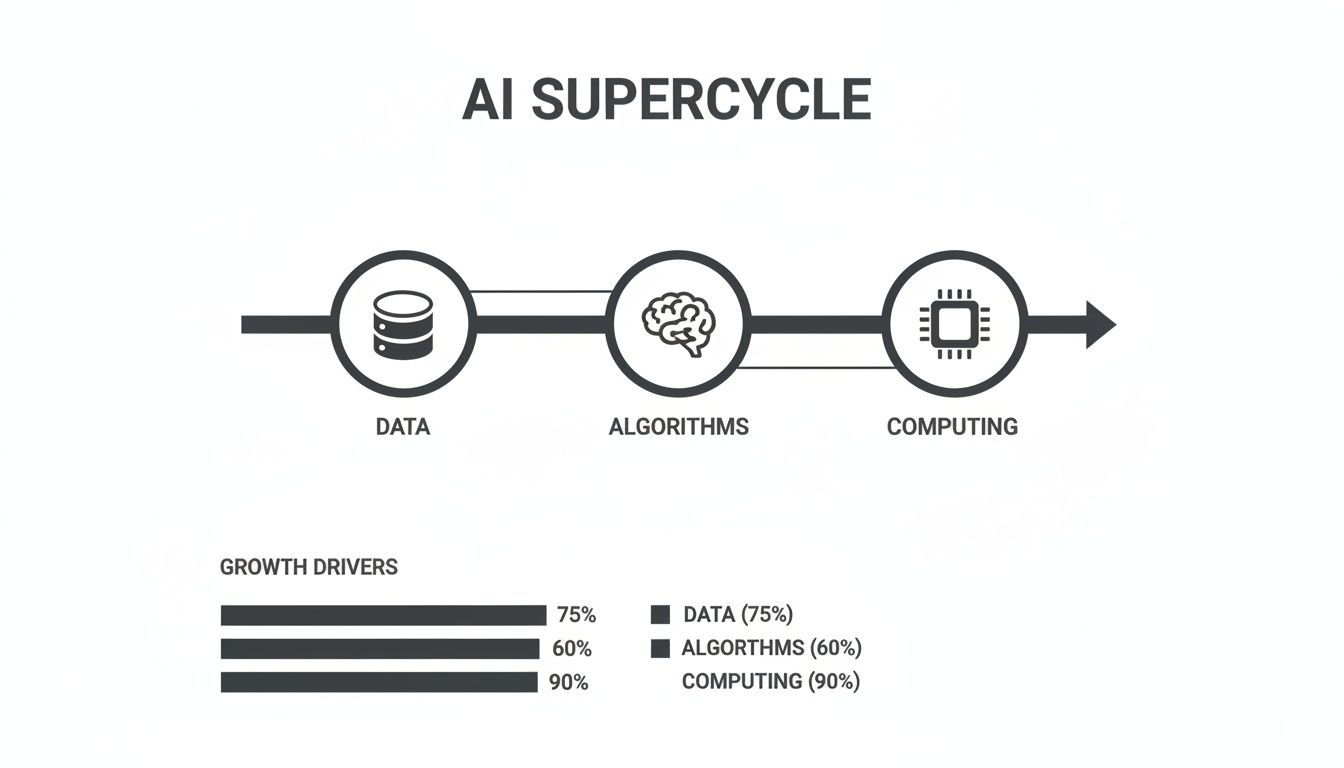
It shows a self-feeding loop where more data leads to better algorithms, which in turn demands more computing muscle. But the whole cycle falls apart if it doesn’t eventually spit out real-world revenue.
Market Concentration and Systemic Risk
Another flashing red light is the intense concentration of market value in just a handful of "AI champion" stocks. A massive chunk of the S&P 500's recent performance has been carried on the backs of a few mega-cap tech names at the center of the AI gold rush.
This creates a serious systemic risk. If just one of these giants stumbles or misses an earnings forecast, the shockwave could rattle the entire market, not just the tech sector. This is classic bubble behavior, a far cry from a healthy, broad-based rally. We've seen this movie before, where a few hot stocks drag the market to heights it can't sustain. You can dive deeper into the mechanics of market peaks in our detailed guide on how to spot a stock market bubble.
This narrow leadership is concerning. When the market's health becomes dependent on the performance of a few select companies, it introduces a level of fragility that can lead to sharp, sudden corrections if sentiment shifts.
This setup creates a dangerous feedback loop. As these stocks climb, they suck in more capital, pushing their valuations even higher and increasing their weight in the major indexes. That forces index funds to buy more, which inflates prices even further—a cycle driven by momentum, not a sober look at what these companies are actually worth.
The Disconnect Between Spending and Revenue
Maybe the most concrete warning sign is the growing chasm between the colossal spending on AI infrastructure and the actual business revenue it’s generating so far. Companies are plowing hundreds of billions into GPUs, data centers, and talent, but for many, the return on that investment is still a question mark.
This spending-to-revenue gap is a critical number to watch. In a healthy growth phase, investment leads to corresponding revenue. In a bubble, investment—often driven by a fear of missing out (FOMO)—can wildly outpace real monetization.
Several things could pop this valuation balloon. MIT Sloan, for instance, predicts the AI bubble will deflate, perhaps triggered by something as simple as one bad earnings report from a key player, the arrival of cheaper AI models, or just a general pullback in corporate spending. Researchers there point out that many of today's generative AI tools offer only minor productivity bumps—hardly enough to justify their Wall Street price tags.
The takeaway here is that while the AI revolution is undoubtedly real, the market's current price for that revolution might be getting ahead of itself. The journey from world-changing tech to widespread, profitable adoption is almost never a straight line, and investors need to be ready for the inevitable reality checks along the way.
So, Why Is This AI Boom Any Different?
It's easy to look at the warning signs and get a sense of déjà vu. But there's a powerful counterargument here, and it deserves a serious look. This isn't just a speculative frenzy built on flimsy promises; we're talking about a foundational technology shift with tangible, real-world value. The AI boom of today is a fundamentally different beast from the dot-com era, which was famous for its "vaporware" and profitless business plans.
The biggest difference is who's leading the charge. This AI supercycle is being driven by some of the most profitable, cash-flush, and dominant companies on the planet. These aren't speculative startups burning through venture capital. They are mega-cap giants with established, diversified business models, using their enormous cash flows to fund the AI infrastructure buildout.
That financial stability provides a much stronger foundation than what we saw in the late 1990s. These are strategic, long-term plays made by companies with the resources to weather market storms and see their vision through. This feels less like chasing a trend and more like building the essential plumbing for the next generation of the economy.
From Hype to Real-World Productivity
Another key differentiator is the immediate, measurable usefulness of AI. While the dot-com bubble was fueled by promises of what online commerce could be, today’s AI tools are already being rolled out across industries to solve real problems and generate real value. Right now, companies are using AI to streamline operations, get smarter with customer service, accelerate research, and untangle supply chains.
The productivity gains aren't just theoretical; they are starting to show up on the bottom line. This boom is less about selling a dream and more about selling a powerful tool that offers a clear return on investment. That focus on practical application grounds the whole thing in economic reality.
The core of the bullish argument rests on a simple premise: AI is not just a new product, but a new factor of production. It’s a general-purpose technology, much like electricity or the internet, with the power to boost productivity across the entire economy.
And this isn't a niche technology for a specific sector. Its applications are broad, touching everything from healthcare and finance to manufacturing and logistics. That widespread utility creates a durable, long-term demand that could sustain growth far beyond a typical hype cycle.
The Trillion-Dollar Economic Impact
Perhaps the most compelling reason to believe this boom is different is the sheer economic scale of its potential. We aren't just talking about incremental improvements. We're talking about automating tasks on a massive scale and unlocking efficiencies that could fundamentally reshape labor markets and boost national GDP. The numbers are staggering, and they provide a solid underpinning for current market valuations.
For instance, new research counters many bubble fears by putting a number on this impact. It estimates AI could perform tasks worth $4.5 trillion across the U.S. economy alone. This massive automation capability could add as much as $1 trillion to the nation's GDP and directly influence another $4.4 trillion in consumer spending. You can dive deeper into the findings that show AI's value creation is accelerating faster than previous forecasts.
This analysis, which covered 18,000 tasks across 1,000 different job roles, suggests AI is automating work at a pace 30% faster than experts predicted just a few years ago. That acceleration shows just how quickly the technology is maturing from a promising concept into a powerful economic engine.
Ultimately, while market sentiment can be fickle, the underlying value proposition of AI is concrete. It is a technology that is already delivering tangible benefits, backed by the world’s most successful companies, and poised to unlock trillions of dollars in economic value. This combination of real earnings, practical utility, and massive economic potential makes a strong case that we are witnessing a sustained technological revolution, not just another speculative bubble.
Building a Resilient AI Investment Portfolio
Smart investors know that navigating the AI market is about more than a simple "bubble or no bubble" debate. The real work lies in building a durable, intelligent portfolio that can withstand market volatility.
For high-net-worth clients, the goal isn't to make an all-or-nothing bet on the AI revolution. The smarter play is to construct a strategy that captures the massive upside potential while insulating your capital from the inevitable volatility and corrections that lie ahead.
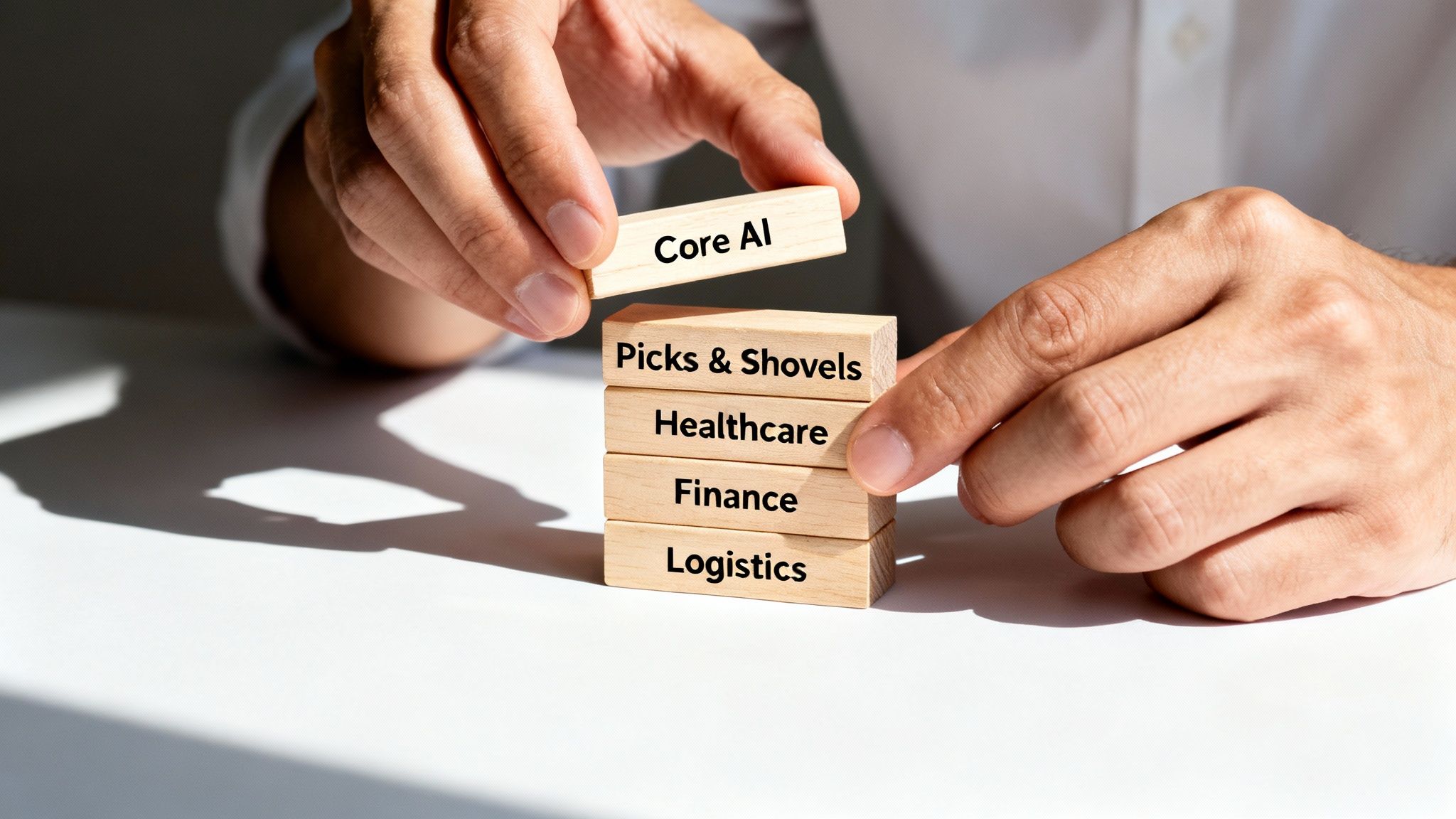
That requires discipline. It means resisting the herd mentality to chase the most hyped-up names and, instead, focusing on quality, profitability, and clear paths to making money. A good way to think about this is in layers—from the essential infrastructure up to the real-world applications.
The Picks-and-Shovels Foundation
During any gold rush, one of the most reliable strategies is to invest in the companies selling the picks and shovels. In the AI gold rush, that means putting capital into the foundational businesses that provide the essential tools the entire ecosystem relies on.
These companies are the bedrock of the AI supercycle. We're talking about:
- Semiconductor and Chip Designers: The brains of the operation. These are the businesses creating the high-performance GPUs and processors that power AI.
- Cloud Computing Providers: The hyperscalers offering the immense data center capacity and computing power needed to train and run AI models.
- Cybersecurity Firms: Companies developing advanced security to protect AI systems and the oceans of data they process.
Buying into these foundational leaders gives you broad exposure to AI's growth without trying to predict which hot startup will win the application war. As long as the AI buildout continues, these companies are set to benefit, no matter who comes out on top.
Diversifying into Second-Order Beneficiaries
Beyond the core tech providers, a truly resilient portfolio has to look at the second-order beneficiaries. These are established companies in traditional sectors—think healthcare or finance—that are using AI to build a competitive moat, boost productivity, and pad their profit margins. This is a much more defensive way to play the AI theme.
This is where AI stops being just a tech story and becomes an economic one. We're looking for businesses that aren't just dropping "AI" into their earnings calls but are actually deploying it to solve real problems and generate tangible returns.
The smartest AI investments may not be in AI companies at all, but in great companies that are using AI to become even better. This approach grounds AI exposure in businesses with proven models and existing revenue streams.
Look for leaders in sectors like:
- Healthcare: Companies leveraging AI for drug discovery, diagnostic imaging, and personalized medicine.
- Finance: Firms applying AI for algorithmic trading, fraud detection, and sophisticated risk management.
- Logistics: Businesses using AI to optimize supply chains, automate warehouses, and perfect delivery routes.
This approach pulls risk away from the highly concentrated tech sector. Looking at different asset allocation strategies for a volatile market can give you a solid framework for weaving these plays into a balanced portfolio.
Focusing on Quality and Real Earnings
No matter the category, the unifying principle must be a relentless focus on quality. When hype can easily obscure weak fundamentals, it's critical to anchor your decisions in real metrics. A company’s ability to actually make money from its AI investments is the ultimate acid test.
Your quality checklist should include:
- Strong Balance Sheets: Companies with plenty of cash and low debt are simply better equipped to weather downturns and keep investing in innovation.
- Real, Growing Earnings: Forget speculative revenue projections. Focus on businesses that are already profitable and can show a clear path to growing their bottom line.
- Clear Path to AI Monetization: Management needs to be able to explain exactly how their AI spend is translating into new products, better efficiency, and more revenue.
To organize these concepts, here’s a framework for thinking about portfolio construction.
Portfolio Allocation Strategies for AI Exposure
This table offers a guide for diversifying AI investments across different risk profiles and market segments.
A disciplined focus on fundamentals acts as a crucial filter, helping you separate companies with sustainable growth from those just riding a temporary wave. By combining exposure to foundational AI leaders with a diversified slate of AI adopters—all screened for quality—you can build a resilient strategy designed to thrive through the next phase of the AI supercycle.
Don't Bet on a Collapse—but a Correction Is Coming
After sizing up the arguments for and against an AI bubble, the most likely path forward is neither a straight shot up nor a dot-com-style catastrophe. What we're really looking at is a significant, and frankly healthy, market correction. This next phase will be all about a much-needed reality check, one that finally separates the true innovators from the speculative hype.
Make no mistake, the AI revolution is the real deal. Its long-term impact will be massive. But the current feeding frenzy has pushed valuations to levels that demand flawless execution, and that’s just not realistic. As the market gets its sea legs, investors will inevitably start caring less about flashy stories and more about cold, hard results.
A Flight to Quality
The next chapter in the AI supercycle will be a flight to quality. The market will reward companies that can actually show how they're using AI to make money. Those with flimsy fundamentals or pie-in-the-sky business models? They're in for a rough ride. Investor discipline, something we haven’t seen much of lately, will be paramount.
This shakeout will probably happen in a few predictable ways:
- Earnings Disappointments: Some of today's high-flying AI darlings are bound to miss their sky-high earnings targets. When that happens, expect a swift exit from momentum traders and a sharp drop in their stock prices.
- Consolidation: Weaker companies will get bought out or just fade into obscurity. This will leave a more concentrated field of durable, profitable leaders standing.
- Sector Rotation: Smart money will start moving out of overvalued, pure-play AI stocks. Instead, it will flow toward "second-order beneficiaries"—solid, established companies in traditional sectors that are quietly using AI to fatten their margins and run a tighter ship.
The big takeaway here is this: while the fundamental AI story is still rock solid, the days of throwing money at anything with 'AI' in its name are coming to an end. The market is getting ready to distinguish between companies that talk about AI and companies that profit from it.
This isn't a crisis; it's a natural part of any game-changing technological shift. The initial wide-eyed excitement always gives way to a more discerning period where actual value creation is what drives returns.
The AI supercycle is far from over; it’s just growing up. The period ahead will be less about chasing moonshots in a handful of stocks and more about identifying quality businesses with resilient models and a proven ability to make their AI investments pay off. It might be a bumpy ride in the short term, but this shift will build a much stronger, more sustainable foundation for the future of AI investing.
Got Questions About AI Investing?
Riding the AI supercycle brings up a lot of questions, especially for investors trying to find the right balance between grabbing a huge opportunity and not getting burned. Market sentiment can turn on a dime, but a few core principles always hold true. Staying informed is your best defense against both irrational exuberance and the fear of missing out.
Below, we tackle some of the most common questions high-net-worth investors are asking us as the market evolves and the shadow of a potential AI investment bubble looms.
How Do I Spot the AI Companies That Will Actually Last?
Finding the durable winners means tuning out the daily market chatter and getting back to basics: business quality. The companies that will still be standing strong years from now will be the ones that can prove they’re turning massive AI spending into real, growing profits.
Keep an eye out for companies with:
- A Serious Economic Moat: This isn't just about cool tech. It's about proprietary data, a stranglehold on the market, or a brand that’s almost impossible for a competitor to knock off.
- A History of Profitability: You want to see businesses with a track record of actual earnings and healthy cash flow, not just pie-in-the-sky growth stories.
- A Clear Plan to Make Money: Management needs to be able to explain, in plain English, exactly how AI is making their products better, their operations leaner, and their revenues bigger.
Where Do Private Markets Fit into an AI Strategy?
Private markets can be another way to get in on the AI action, often giving you a shot at early-stage companies long before they ever see a stock exchange. For qualified investors, putting a small slice of a portfolio into AI-focused venture capital or private equity funds can offer some serious growth potential.
But let's be clear: this route is riskier and your money will be tied up for a while. It's absolutely critical to partner with seasoned fund managers who have deep technical know-how and a proven nose for sniffing out promising tech. Think of it as a satellite to your core strategy, which should still be anchored in solid, established public companies.
At the end of the day, whether you're looking at a public stock or a private deal, the big question is the same: is this a fundamentally sound business using AI to create value that will last?
At Commons Capital, we live and breathe this stuff. We specialize in helping high-net-worth investors and family offices build tough portfolios that capture technological shifts while keeping risk in check. If you’re trying to sharpen your investment strategy for the AI era, we can help you cut through the complexity and make decisions that line up with your long-term goals.