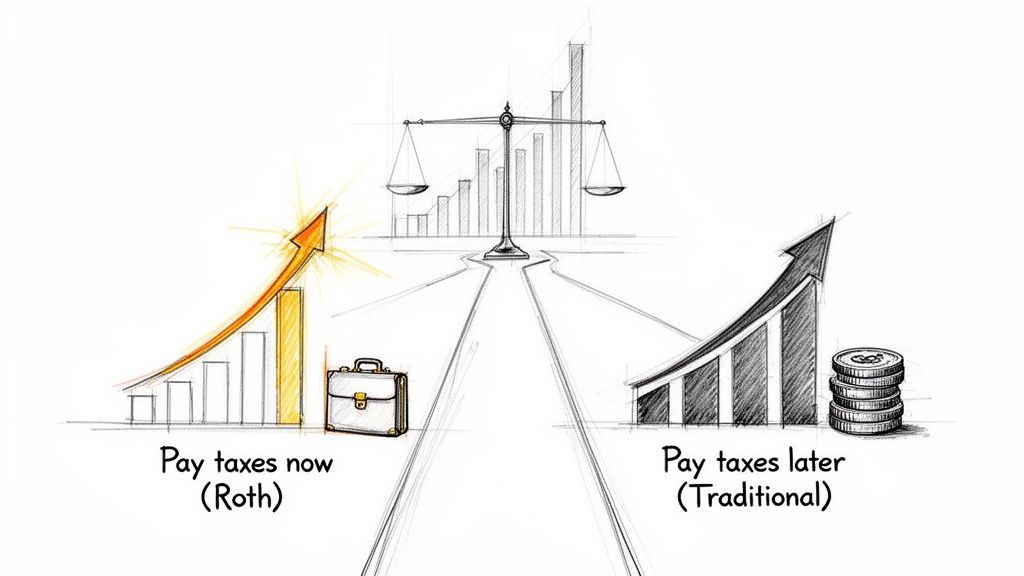
The Roth vs Traditional 401k debate boils down to a pivotal question: Do you want to pay taxes on your retirement savings now or later? For high-net-worth individuals, this isn't just a casual choice — it's a critical financial decision that can shape your wealth for decades. The right answer hinges on a strategic calculation: your tax bracket today versus where you expect it to be in retirement.
A Strategic Overview for High Earners
Choosing between a Roth and a Traditional 401(k) is far more than a simple tax filing decision; it's a long-term strategic play that directly impacts your future net worth. When you're dealing with larger account balances and higher income brackets, the tax implications are magnified, raising the stakes considerably. Understanding the fundamentals is the first step toward optimizing your retirement savings strategy.
This decision is also your entry point into tax diversification — a crucial hedging strategy for affluent families. You wouldn't put all your money in one stock, so why put it all in one type of tax account? Spreading your retirement savings across different tax treatments gives you invaluable flexibility and control over your taxable income down the road.
Comparing the Core Mechanics
The primary distinction between these two powerful retirement accounts is the timing of the tax hit. A Traditional 401(k) gives you an immediate benefit by lowering your taxable income today, which can be a huge advantage during your peak earning years. On the flip side, a Roth 401(k) makes you pay those taxes upfront. The reward for that upfront payment is that all qualified withdrawals in retirement — both your contributions and all the earnings — are completely tax-free.
To make it even clearer, let's break down the main differences side-by-side in this comprehensive comparison table.
Core Differences Between Roth and Traditional 401k Plans
This table provides a high-level view, but a few details are key for high-income investors.
One unifying factor is that the contribution limits are shared between both account types. For 2026, you can contribute up to $24,500 as an employee, plus an extra $8,000 "catch-up" contribution if you're age 50 or over. Critically, unlike Roth IRAs, the Roth 401(k) has no income restrictions, making it a powerful and accessible tool for building a pot of tax-free money, no matter how much you earn. You can dig deeper into these contribution rules at Shepherd Financial Partners.
This initial choice is just the beginning. It sets the stage for a much deeper analysis of how each account type plays into long-term wealth accumulation, sophisticated distribution strategies, and even your estate plan.
Comparing Tax Treatment on Contributions and Growth
At its core, the Roth vs Traditional 401k decision boils down to a simple trade-off: pay taxes now or pay them later. For high-income earners, this isn't just an administrative choice; it's a strategic bet on your future tax situation that will shape how your wealth compounds and what you ultimately get to keep in retirement.
A Traditional 401(k) gives you an immediate, tangible win. Every dollar you contribute is pre-tax, meaning it reduces your taxable income before the IRS gets its cut. This directly lowers your Adjusted Gross Income (AGI), providing serious tax relief today when you're likely in your highest earning years and facing your steepest marginal tax rates.
The Roth 401(k), on the other hand, works on an after-tax basis. Your contributions are made from your take-home pay, so there's no upfront tax break. The powerful trade-off? All the investment growth that follows is completely tax-free.
Unpacking the Tax Journey of Your Money
To truly see the difference, let’s follow a dollar through its entire life cycle in each account. The path it takes determines its real, after-tax value down the road.
- Traditional 401(k) Path:
- Contribution: Reduces your taxable income right now.
- Growth: Your investments — all earnings and dividends — compound without any tax drag year after year.
- Withdrawal: The bill comes due in retirement. Both your original contributions and all that growth are taxed as ordinary income.
- Contribution: You pay income tax on your contribution dollars today, getting it out of the way.
- Growth: All earnings and dividends compound completely tax-free.
- Withdrawal: Qualified distributions in retirement are 100% tax-free, providing a predictable, tax-immune stream of income when you need it most.
A Critical Nuance: The Employer Match
One of the most frequently overlooked details when comparing 401(k) options is how the company match is handled. This is a crucial piece of the puzzle because it automatically introduces a tax-deferred component to your plan, no matter which option you choose for your own contributions.
Key Takeaway: All employer matching contributions are made on a pre-tax basis. Even if you contribute exclusively to a Roth 401(k), your employer’s match will land in a separate, traditional pre-tax bucket inside your 401(k).
This creates a "mixed" tax profile for anyone contributing to a Roth 401(k). You'll have a pool of tax-free Roth assets from your own money and a separate pool of tax-deferred assets from the company match. This reality automatically builds a degree of tax diversification right into your plan.
Interestingly, when companies first started offering Roth 401(k) options between 2006 and 2010, total employee contribution rates didn't significantly change. This suggests that while high-net-worth families see the employer match as a key benefit, having a Roth option didn't suddenly spur an overall increase in savings, a finding you can explore in more detail in these retirement savings trends. It underscores that the real decision isn't just how much to save, but how to save in the most tax-efficient way possible.
Analyzing Withdrawals and Distribution Rules
The real test of any retirement strategy isn’t what you put in, but what you get to take out. For high-net-worth families, the rules governing distributions are everything — it’s the moment the true after-tax value of an account becomes reality. The core difference in the Roth vs Traditional 401k debate has never been clearer than at this stage.
Qualified distributions from a Roth 401(k) are completely tax-free. That means decades of growth and all your contributions come back to you, not the IRS. In sharp contrast, every single dollar pulled from a Traditional 401(k) is taxed as ordinary income, which can take a serious bite out of your withdrawal.
The Impact of Required Minimum Distributions
A critical factor for affluent retirees is the looming reality of Required Minimum Distributions (RMDs). These are government-mandated withdrawals you must start taking from your tax-deferred accounts once you reach a certain age, currently 73. The purpose of RMDs is to ensure the IRS eventually collects tax revenue on all that deferred money.
For anyone with a substantial Traditional 401(k), these forced withdrawals can create a massive, and frankly, unwelcome tax bill every year. A large RMD can easily push you into a higher marginal tax bracket, triggering higher taxes not just on the withdrawal itself but also on other income like Social Security or capital gains.
Strategic RMD Avoidance with a Roth Account
This is where the Roth 401(k) reveals one of its most powerful long-term advantages. While a Roth 401(k) itself is subject to RMDs, a simple (and brilliant) workaround exists. Once you retire or leave your job, you can roll your Roth 401(k) assets directly into a Roth IRA.
Roth IRAs have no RMDs for the original account owner. This strategic rollover allows your tax-free money to keep growing, completely untouched, for as long as you live. It puts you in total control of when — or even if — you take distributions.
This maneuver effectively transforms the Roth 401(k) from a retirement account into a formidable estate planning tool. By eliminating RMDs, you can preserve a much larger tax-free inheritance for your children or grandchildren. While heirs who inherit a Roth account still get tax-free withdrawals, they are typically required to empty the account within 10 years under current rules. You can dig into the specifics of these forced withdrawals by reading our guide on how to calculate Required Minimum Distributions (RMDs).
A Tale of Two Retirees: An RMD Scenario
To see the real-world impact, let's look at two retirees, each with a $3 million 401(k) balance at age 75.
- Retiree A (Traditional 401(k)): Their first RMD would be roughly $122,950. This huge chunk of cash is added directly to their other income for the year, almost certainly pushing them into one of the highest tax brackets and immediately eroding the value of their nest egg.
- Retiree B (Roth 401(k) Rolled to Roth IRA): Their RMD is $0. They have full control. Their entire $3 million stays invested, compounding tax-free. They can pull money out as needed for their lifestyle without any mandatory tax hit, preserving the principal for their own future or for their heirs.
This contrast gets to the heart of the matter. The Traditional 401(k) comes with a mandatory — and often costly — annual tax bill in retirement. The Roth 401(k), with the right planning, offers complete tax freedom and lifetime control over your assets.
Advanced 401k Strategies For High-Net-Worth Investors
Standard retirement advice often misses the mark for high-net-worth investors. When you’re managing significant wealth, the basic decision between a Roth vs Traditional 401k is really just the starting point. To truly move the needle, you have to look beyond simple contributions and explore more powerful, specialized maneuvers.
These advanced strategies are all about leveraging unique provisions in the tax code. They allow high earners to build substantial tax-free retirement assets and gain far greater control over their long-term financial picture. It's about playing a different game — one focused on tax efficiency and legacy planning.
The Mega Backdoor Roth Strategy
One of the most potent tools in the arsenal for high earners is the Mega Backdoor Roth maneuver. This strategy lets you funnel significantly more into a Roth account than the standard employee contribution limits would ever permit. It all hinges on a specific feature available in some — but not all — 401(k) plans: the ability to make after-tax, non-Roth contributions.
The process itself is fairly straightforward and works in a few key steps:
- Step 1: Max Out Pre-Tax/Roth Contributions. First, you hit the maximum amount allowed as an employee, which is $24,500 in 2026, or $32,500 if you're age 50 or over.
- Step 2: Make After-Tax Contributions. If your plan allows it, you then make additional contributions with after-tax dollars. You can contribute up to the overall IRS limit for all 401(k) sources (employer and employee combined), which stands at $72,000 in 2026.
- Step 3: Execute a Conversion. Immediately after making the after-tax contribution, you convert those funds into a Roth account. This can be done either within your 401(k) plan (an in-plan conversion) or by rolling them over to a Roth IRA.
Executing this conversion quickly is absolutely critical. By doing so, you minimize any investment gains that could accrue in the after-tax account, which would become taxable upon conversion. This move effectively shifts a large sum of money into a Roth vehicle where it can grow tax-free for decades.
Strategic Roth Conversions In Gap Years
Another key strategy involves timing your Roth conversions to coincide with periods of lower income. For many high earners — think entrepreneurs between ventures, consultants taking a sabbatical, or those entering early retirement — there are "gap years" where taxable income is temporarily lower. These years present a golden opportunity.
By converting funds from a Traditional 401(k) or IRA to a Roth account during these lulls, you can strategically "fill up" the lower tax brackets. You'll pay income tax on the converted amount, but you're doing so at a much lower marginal rate than you would during your peak earning years. You can learn more about the mechanics in our guide on how to convert a 401(k) to a Roth IRA.
This decision tree visualizes the simple yet powerful tax outcomes when withdrawing from either a Roth or Traditional account.
As the flowchart clearly shows, the Traditional 401(k) path leads to a tax bill in retirement. The Roth path, however, results in tax-free income.
Broader Impacts On Your Financial Plan
Your 401(k) choices don't exist in a vacuum. They create ripple effects across your entire financial life, especially in retirement, and large withdrawals from a Traditional 401(k) can have some nasty unintended consequences.
By increasing your provisional income, large Traditional 401(k) distributions can trigger higher taxes on your Social Security benefits and lead to increased Medicare Part B and Part D premiums through the Income-Related Monthly Adjustment Amount (IRMAA).
This is where a well-funded Roth account provides a strategic release valve. You can draw from it to supplement your lifestyle without pushing up your taxable income, helping you manage your tax bracket and sidestep those costly surcharges. This level of control is indispensable for crafting a truly tax-efficient retirement income stream.
Modeling Long-Term Outcomes with Real-World Scenarios
Abstract tax theories are one thing, but seeing the numbers play out is the only way to truly understand the massive impact of the Roth vs Traditional 401k decision. When we project outcomes based on real-world situations, this choice stops being a simple tax preference and becomes a core part of your wealth-building strategy.
By modeling a few distinct high-earner profiles, we can see exactly how a seemingly small decision today can lead to profoundly different financial realities decades down the road.
Scenario 1: The Peak-Income Corporate Executive
Let's start with a 50-year-old executive earning $750,000 a year. They're at the apex of their career, sitting squarely in the top federal tax bracket. Their main goal is simple: slash their current tax bill while aggressively saving for a comfortable retirement just 15 years away.
- The Traditional 401(k) Play: By maxing out their Traditional 401(k) at $30,500 (including catch-up contributions), they get an immediate and significant reduction in their taxable income. The whole game here is betting that their income — and therefore their tax bracket — will be lower in retirement.
- The Roth 401(k) Play: Going with the Roth means they forgo that immediate tax deduction. They pay taxes on the full $30,500 contribution at their current high marginal rate, but in exchange, they get a massive, completely tax-free account waiting for them in retirement.
For this executive, the Traditional 401(k) often wins on paper. The upfront tax savings are substantial and can be reinvested immediately, giving compound growth a powerful boost. Unless one predicts a truly astronomical hike in future tax rates, that immediate deduction is incredibly hard to beat.
Scenario 2: The Entrepreneur Planning a Liquidity Event
Now, picture a 40-year-old founder. Her salary is modest right now, but she's anticipating a massive windfall from selling her business in about ten years. Her income is about to spike dramatically before settling down into a more normal retirement lifestyle.
- Strategy Before the Sale: In the years leading up to the sale, her income is relatively low. This is the perfect window to lean into the Roth 401(k). She can pay taxes on her contributions at a lower marginal rate now, essentially pre-paying the tax bill before her income statement explodes.
- Strategy After the Sale: Once the business is sold, her income will be exceptionally high. At that point, any new contributions would be better off in a Traditional 401(k) to help offset the massive tax liability from the sale proceeds.
This scenario shows why a dynamic strategy is so crucial. The Roth 401(k) builds a tax-free war chest during the leaner years, while the Traditional 401(k) becomes a tactical tool for damage control during a peak income event. You can play with these kinds of numbers yourself using our Roth conversion calculator to model the tax impact of moving funds around major life events.
Scenario 3: The Professional Athlete
Finally, think about a 28-year-old professional athlete with an eye-watering income of $5 million+ per year. The catch? His career is a short, intense sprint that will likely be over by age 35. His post-career income will be a fraction of what it is today.
This profile is almost always a slam dunk for the Traditional 401(k) during the playing years. The ability to defer income while sitting in the highest possible tax bracket provides an immediate benefit that’s simply unmatched.
The smart move comes after they retire from their sport. During their new, lower-income years, they can strategically convert portions of that massive Traditional 401(k) into a Roth IRA. This lets them pay taxes on the converted amounts at a much more favorable rate, giving them the best of both worlds.
History tends to back this up. Over the last 107 years, U.S. effective federal income tax rates have rarely hit the breakeven point where a Roth would have been the clear winner for a top earner from the start. The power of tax deferral is a time-tested strategy for those with compressed, high-earning careers.
Answering Your Top 401(k) Questions
When you're dealing with a complex financial picture, the standard Roth vs Traditional 401k advice often falls short. High-net-worth investors face a different set of challenges and opportunities. Here are some direct answers to the most critical questions that come up when designing a sophisticated retirement strategy.
Can I Split My Contributions Between a Roth and Traditional 401(k)?
Absolutely. In fact, for many successful individuals, this isn't just an option — it’s a core strategy. Most 401(k) plans let you divide your contributions between Roth and Traditional buckets, giving you hands-on control over your tax planning.
This hybrid approach is really about tax diversification. By contributing to both, you’re hedging your bets against whatever tax rates the future holds. You don't have to go all-in on a single guess about your financial situation decades from now.
A popular way to structure this is:
- First, contribute to the Traditional 401(k) enough to maximize your tax deduction for the current year. This can be a smart move to drop you out of a higher marginal tax bracket.
- Then, funnel any remaining contributions into the Roth 401(k). This builds up your reservoir of tax-free money for retirement.
This setup gives you incredible flexibility down the road. In retirement, you can pull from your Traditional account to fill up those lower tax brackets, then seamlessly switch to tax-free Roth withdrawals for any spending above that level. Just keep in mind that your total contributions to both accounts can't go over the annual IRS limit, which is $24,500 in 2026 (or $32,500 if you're age 50 or over).
How Does My 401(k) Choice Impact My Estate Plan?
The decision has a massive, lasting impact on your estate and the legacy you pass on. When we're talking about multi-generational wealth transfer for high-net-worth families, the Roth account is, without question, the superior vehicle.
When a Roth 401(k) is rolled into a Roth IRA after retirement, your beneficiaries inherit a substantial asset that is completely free from income tax. That’s a powerful way to preserve the full value of what you've built.
Compare that to a Traditional 401(k) or IRA. Your heirs don't just get the assets; they also inherit a big tax liability. Every dollar they take out is taxed as their own ordinary income.
Under the current SECURE 2.0 Act, most non-spouse beneficiaries have to drain an inherited IRA within 10 years of the original owner's death. For a large Traditional account, this can force huge withdrawals over a short period, triggering a massive tax bill and seriously eroding the inheritance.
By pre-paying those taxes yourself with Roth contributions or conversions, you’re essentially giving your heirs a tax-free gift that can keep growing and providing value long after you're gone. If you intend for your retirement accounts to be a key part of your legacy, the Roth is the clear strategic move.
What if I Pick the Wrong One? Can I Change It Later?
Yes. While you can't undo past contributions, your initial choice isn't a life sentence. You have a lot of flexibility to pivot your strategy as your circumstances change, and there are powerful tools available to help you adjust course.
First, you can change where your future contributions go at any time. This is a simple administrative tweak you can usually make right on your plan administrator's website. If you started out contributing to a Traditional 401(k) when your income was lower but now you're in a high tax bracket, you can switch future paychecks to the Roth with just a few clicks.
Second, a growing number of 401(k) plans offer what’s called an "in-plan Roth conversion." This lets you move some or all of your existing Traditional 401(k) money over to your Roth 401(k).
This does trigger a taxable event — the amount you convert gets added to your income for the year. But it's an incredibly useful lever for strategic tax planning. The best time to pull it is often during a year when your income is unusually low, like during a sabbatical, a career change, or just before you officially retire, to soften the tax blow.
Should High Earners and "Supersavers" Prioritize the Roth 401(k)?
It might sound backward, but for those with very high incomes (think over $500,000) and disciplined "supersavers" who consistently sock away more than 20% of their pay, prioritizing Roth contributions often makes a lot of sense. The old rule of thumb — that high earners should always take the immediate tax break — starts to fall apart at these levels.
Two big reasons why:
- The Tax Bracket Argument Fades: If you're going to have significant taxable income in retirement from pensions, real estate, or other investments, your Traditional 401(k) withdrawals won't be filling up the "lower tax brackets." They'll be piled right on top of your other income, getting taxed at your highest marginal rates anyway. In that case, the benefit of tax deferral is pretty much wiped out.
- You Get More After-Tax Money in the Account: When you're maxing out your contributions, a Roth lets you cram more real, after-tax money into a tax-sheltered account. A $23,000 Roth contribution is truly $23,000 of your money. A $23,000 Traditional contribution, if you're in a 37% tax bracket, is really only equivalent to putting $14,490 of your own after-tax dollars to work.
For savers who are on track to build so much wealth that they'll stay in the top tax brackets in retirement, paying the tax now with a Roth is the logical move. They're locking in today's tax rates on a bigger chunk of after-tax money, which then has decades to grow into a much larger tax-free asset.
The 401(k) decisions you make today can shape your financial freedom for decades to come. At Commons Capital, we specialize in helping high-net-worth families navigate these complex choices with strategies designed for optimal tax efficiency and long-term growth. To see how a tailored approach can enhance your financial future, visit us at https://www.commonsllc.com.