Modern Portfolio Theory, or MPT, is a strategic framework for building an investment portfolio. At its core, it's about maximizing potential returns for a given level of risk. This groundbreaking approach shifted the focus from picking individual "winner" stocks to understanding how different assets perform together as a cohesive team.
The goal of this guide is to explain what is modern portfolio theory in a clear and accessible way. By grasping its principles, investors can better understand how to construct portfolios built for long-term growth and resilience.
The Architect of Modern Investing
Imagine building a championship sports team. You wouldn't just recruit the league's top scorers. You would assemble a mix of players with complementary skills — a strong defense, a clever offense, and specialists who thrive under pressure. This balanced approach creates a team that can win in various situations. This is the essence of Modern Portfolio Theory. It transformed investing from a game of hunches into a disciplined science based on mathematics and logic.
Before MPT, investors were primarily focused on the merits of individual stocks or bonds. However, Harry Markowitz's pioneering work demonstrated that the real power lies not in the individual pieces, but in how they are combined. He introduced a structured method for diversification, proving that combining assets that do not all move in the same direction can significantly lower a portfolio's overall volatility without necessarily sacrificing returns.
The Foundational Shift in Thinking
MPT introduced several core concepts that remain the bedrock of professional portfolio management today. It provides a structured, logical way to approach building and managing wealth that goes beyond simple speculation.
Here are the key ideas it brought to the forefront:
- Focus on the Entire Portfolio: An asset’s risk should not be judged in isolation but by how it affects the volatility of your entire portfolio. A seemingly risky asset can actually enhance a portfolio's safety if it performs well when other assets are down.
- The Risk-Return Trade-Off: The theory makes the link between risk and return explicit. To achieve higher potential returns, an investor must be willing to accept a higher level of risk.
- Correlation is Key: The relationship between how your assets move in relation to one another (their correlation) is often more critical than their individual risk profiles. The secret to effective diversification lies in combining assets with low or even negative correlation.
This Nobel Prize-winning theory completely changed the investment conversation. It compelled investors to view their holdings not as a random collection of bets, but as a single, interconnected system. It serves as the blueprint for building portfolios that are both efficient and tailored to an investor's specific risk tolerance.
This approach offers a logical roadmap for making smarter, more deliberate investment decisions. Understanding these principles helps clarify the "why" behind a well-constructed portfolio and the careful choices a financial advisor makes. Its influence is evident everywhere, from 401(k) fund options to sophisticated high-net-worth investment strategies used to protect and grow capital for generations.
To simplify, let's break down the core tenets in a table.
Modern Portfolio Theory at a Glance
This table breaks down MPT's big ideas and why they represented a significant departure from traditional investment thinking.
Ultimately, MPT provided the first truly scientific framework for building a portfolio, giving advisors and investors the tools to move beyond guesswork and toward intentional, goal-oriented design.
The Origins of Portfolio Theory
Before the 1950s, the investing landscape was vastly different. Building a portfolio was largely a matter of instinct and anecdotal advice. The primary goal was to pick individual stocks that seemed poised for growth. A structured, mathematical framework to guide these critical decisions was largely absent. Investing was more of an art form, driven by subjective judgment rather than rigorous analysis.
This all changed with the work of economist Harry Markowitz. In a seminal paper published in 1952, he laid out the concepts that would become the foundation of Modern Portfolio Theory. In doing so, Markowitz fundamentally rewired how investors think about risk and reward.
A New Way of Thinking About Risk
Markowitz's central idea was both simple and profound: an asset's risk should not be judged in isolation but by its contribution to a portfolio's overall volatility. He demonstrated that by combining assets that do not move in perfect unison, an investor could construct a portfolio that was stronger than the sum of its parts.
This marked the birth of true, quantifiable diversification. He proved that it was possible to lower a portfolio's total risk without sacrificing potential returns—an idea often referred to as the only "free lunch" in investing.
Markowitz’s work wasn't just a new idea; it was a complete paradigm shift. He provided the financial world with a mathematical language to describe the trade-off between risk and return, moving portfolio management from the realm of guesswork into the world of strategic science.
This quantitative approach, also known as mean-variance analysis, was a monumental leap forward. While investors previously relied on intuition, Markowitz showed that intentionally selecting securities that counter-correlate—meaning they tend to move in opposite directions—could lead to a far more stable portfolio. His insight paved the way for a powerful mathematical approach where vast variance/covariance matrices could analyze the performance of hundreds of securities. You can dive deeper into the history of MPT for a more detailed look.
Building on the Foundation
While Markowitz laid the essential groundwork, his initial models were computationally intensive and not easily accessible to the average investor. This is where other financial thinkers stepped in, building on his ideas to make them more practical.
One of the most significant contributions came from William Sharpe, who later won a Nobel prize for his work. He developed the Capital Asset Pricing Model (CAPM), a model that brilliantly simplified Markowitz’s concepts. CAPM provided investors with a more straightforward method to determine an asset's expected return based on its sensitivity to overall market risk.
Several key developments evolved from MPT, turning theory into practice:
- The Capital Asset Pricing Model (CAPM): Created a simpler method for pricing securities and calculating expected returns based on their systematic risk (or beta).
- The Sharpe Ratio: Also developed by William Sharpe, this metric distills a portfolio's risk-adjusted return into a single, easy-to-understand number. It quickly became a universal standard for comparing different investment strategies.
- The Efficient Frontier: This core MPT concept visually maps the set of optimal portfolios—those offering the highest expected return for a given level of risk.
Together, these developments transformed the powerful, academic principles of MPT into actionable tools. They built the bridge from complex theory to practical application, giving financial advisors and investors the instruments they needed to construct more intelligent, risk-aware portfolios. This set the stage for the sophisticated financial planning and asset allocation strategies that are standard practice today.
Understanding The Core Principles Of MPT
To truly understand what modern portfolio theory is, it's essential to look under the hood. It’s not about memorizing complex formulas but about grasping the four pillars that support the entire structure: expected return, risk, correlation, and diversification. By balancing these four concepts, MPT provides a framework for building portfolios that are genuinely stronger than the sum of their individual parts.
Here’s a simple analogy. Imagine you own an ice cream stand on a boardwalk. Business is fantastic on hot, sunny days, but a week of rain could decimate your profits. Now, what if you also opened an umbrella shop right next door?
On sunny days, the umbrella shop remains quiet while the ice cream stand thrives. When it rains, the roles reverse. By owning both, you’ve created a much more stable, all-weather income stream, smoothing out the unpredictable peaks and valleys. This is the essence of how MPT works.
The journey from this kind of basic intuition to a more rigorous financial framework was pioneered by Harry Markowitz, as the diagram below illustrates.
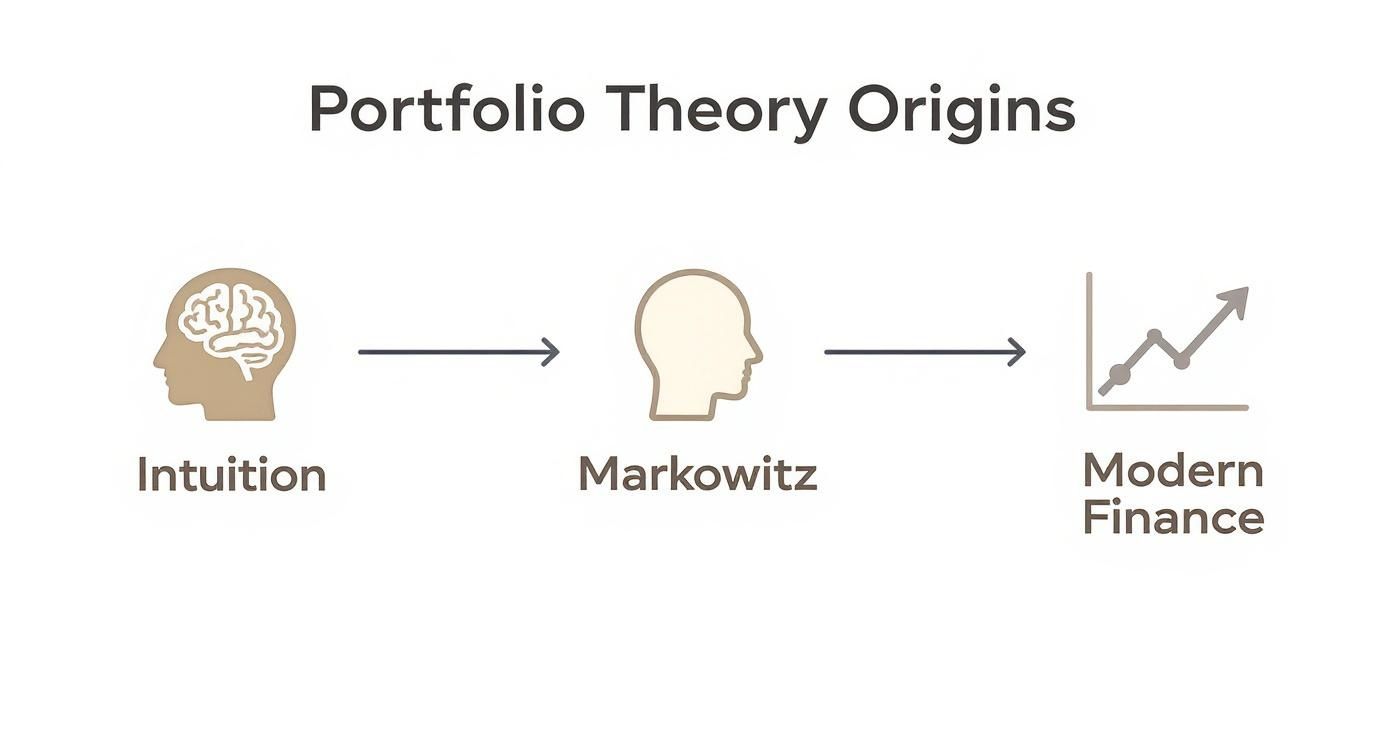
Markowitz’s breakthrough was transforming these abstract ideas about risk and reward into a quantifiable, scientific approach to building portfolios.
The Building Blocks: Risk And Return
At its heart, MPT is about navigating the timeless trade-off between risk and return. Every investor understands this intuitively: to achieve higher potential returns, you typically have to accept more risk. MPT does not try to eliminate this reality; instead, it provides the tools to measure and manage it.
- Expected Return: This is the anticipated profit an investment will generate. MPT expands on this by calculating the weighted average expected return of all assets in the portfolio, not just one.
- Risk (Volatility): MPT defines risk as volatility, which is measured statistically by standard deviation. An asset with a higher standard deviation has historically experienced larger price swings, making it "riskier."
The theory forces a disciplined conversation: how much potential volatility are you truly willing to accept in pursuit of your return goals? Answering this question is the first step toward building a portfolio that truly fits your needs.
The Power Of Correlation
This is where the theory becomes truly powerful. Markowitz’s key insight was that an individual asset’s risk is far less important than how its price moves in relation to the other assets in the portfolio. This relationship is measured by a single number: correlation.
Correlation is a statistical metric on a scale from -1 to +1:
- +1 (Perfect Positive Correlation): The assets move in perfect lockstep. When one goes up, so does the other. Think of two major U.S. technology stocks.
- 0 (No Correlation): The movements are completely random and unrelated. One asset’s price provides no information about the other’s.
- -1 (Perfect Negative Correlation): The assets are perfect opposites. When one zigs, the other zags. This is the ideal for diversification, but it is incredibly rare in the real world.
By combining assets with low or even negative correlation—like our ice cream and umbrella shops—you can construct a portfolio where a dip in one area is potentially offset by a gain elsewhere. This concept leads directly to the most famous principle in MPT.
Diversification: The Only “Free Lunch”
Diversification is the practice of spreading your investments across various assets to reduce overall risk. MPT mathematically proved why this is not just a good idea but a strategic imperative. By combining assets that do not move in lockstep, you can lower a portfolio’s total volatility without necessarily having to sacrifice expected returns.
This is what economists famously call the "free lunch" in investing. You gain the benefit of lower risk without having to "pay" for it with lower returns. For a deeper dive, you can explore our guide on how to diversify a portfolio. A core part of this is the sophisticated analysis involved in predicting portfolio performance, which helps investors make more informed decisions about risk-return trade-offs.
The goal of diversification isn't just to own a lot of different things. The goal is to own different things that behave differently under various market conditions.
The table below breaks down these core concepts and their role within the MPT framework.
MPT Core Concepts Explained
These concepts do not work in isolation. They are the inputs that allow us to visualize the universe of possible portfolios and identify the optimal ones.
The Efficient Frontier: The Optimal Portfolio Curve
When you combine risk, return, and correlation, you can plot every possible combination of assets on a graph. The Efficient Frontier is the resulting curve that represents the set of the "best" possible portfolios.
This means that for any given level of risk, a portfolio on the Efficient Frontier offers the absolute highest possible expected return. Any portfolio below the curve is considered inefficient because you could achieve a better return for the same amount of risk (or the same return for less risk) by moving to a portfolio on the curve.
This powerful visual tool transforms abstract theory into something concrete. It allows an advisor to show a client the clear trade-offs involved and help them find the single point on that frontier that best matches their unique comfort with risk and their long-term financial goals.
Practical Tools That Came From MPT
A brilliant theory is one thing, but making it useful in the real world is another. Modern Portfolio Theory provided the intellectual blueprint, but its true genius lies in how its complex ideas were translated into practical, everyday tools. These innovations pulled MPT out of academic journals and placed it on the desks of financial advisors, giving us tangible ways to measure and manage risk.
Suddenly, a common language existed to compare different investment strategies, along with a concrete framework for building better portfolios.
One of the most powerful tools to emerge from this era is the Sharpe Ratio. It’s a single, elegant number that cuts straight to the heart of the matter, answering the critical question: "Am I being adequately compensated for the risk I'm taking?"
The Sharpe Ratio Unpacked
Think of it this way: you're comparing two sports cars. One might have a higher top speed (raw return), but if it consumes a tank of gas every 50 miles (high risk), it's not a very efficient machine. The Sharpe Ratio is the investment world’s miles-per-gallon rating. It measures the efficiency of your returns relative to the volatility you endured to achieve them.
Introduced by Nobel laureate William Sharpe in 1966, this metric quickly became one of the most important applications of MPT. The formula is straightforward: take an investment's return, subtract the return of a "risk-free" asset (like a U.S. Treasury bill), and divide that by the investment's standard deviation (our measure of volatility).
A higher Sharpe Ratio indicates better risk-adjusted performance. It provides a foundational tool for comparing different funds, managers, and entire portfolios on an even playing field.
A higher Sharpe Ratio means a more efficient investment. It provides a straightforward, apples-to-apples method for evaluating whether a portfolio's returns are justifying its risk.
This single number allows advisors and their clients to cut through the noise. Instead of just chasing the highest returns, we can identify strategies that work smarter—not just harder—to generate wealth.
From Theory To Actionable Plans
Beyond just measuring performance, MPT's core principles are now integral to the financial planning software that advisors rely on daily. The theory provides the "why," while technology — like advanced portfolio management software—delivers the "how."
This is where the theory becomes practical. This technology brings MPT to life in several key ways:
- Automated Asset Allocation: The software crunches the numbers, running MPT's mean-variance optimization to generate model portfolios for different risk appetites, from the most conservative client to the most aggressive.
- Visualizing the Efficient Frontier: We can now plot a client's current portfolio against the Efficient Frontier on a screen. In an instant, they can see where their portfolio stands and how we can improve it, making the concept tangible.
- Stress Testing and Projections: These programs can simulate how a proposed asset mix might perform in various market scenarios, making abstract concepts like "risk" and "return" feel more real and immediate.
By automating these complex calculations, technology has made the core insights of what is modern portfolio theory accessible to everyone. It allows for the creation of customized, data-driven asset allocation strategies for a volatile market that are grounded in decades of financial science.
This is what turns a powerful theory into a personalized, actionable roadmap for investors.
The Good, the Bad, and the Reality of Modern Portfolio Theory
No single theory is a silver bullet, and Modern Portfolio Theory is no exception. While its core ideas transformed portfolio management into a disciplined science, it is crucial to understand both its strengths and where its foundational assumptions can falter. Recognizing these realities is key to using MPT as intended: as a powerful framework, not an infallible crystal ball.
MPT’s greatest contribution was providing a mathematical backbone to the intuitive concept of diversification. It offered a clear, logical process for building a portfolio based on an investor's actual risk tolerance, shifting the industry’s focus from speculative stock-picking toward strategic, goal-oriented asset allocation.
The Problem with a Rear-View Mirror
However, the theory’s elegance is also the source of its biggest limitations. MPT is built on assumptions that do not always hold up in the messy, unpredictable real world. Its models rely on historical data—past returns, volatility, and correlations—to forecast the future. This "rear-view mirror" approach can be a significant blind spot.
History is filled with events that no one saw coming, from sudden geopolitical shocks to full-blown financial crises. A model built on the relatively calm market behavior of the 1990s would have been completely unprepared for the dot-com bust or the global financial crisis of 2008.
The central critique of MPT is its reliance on the past to predict the future. While history is a valuable guide, it's not a perfect blueprint, especially when markets are under extreme stress.
This dependence on historical inputs is a critical consideration for any advisor or investor putting the theory into practice.
When Diversification Disappears
One of MPT’s most critical assumptions is that investment returns follow a neat "bell curve" distribution, implying that extreme market swings are rare. However, market crashes—so-called "black swan" events—happen more frequently than a perfect bell curve would suggest.
During these moments of intense market panic, a dangerous phenomenon occurs: correlations converge toward one. In plain English, assets that were supposed to zig while others zag suddenly all decline together. This was painfully evident during the 2008 financial crisis when everything from stocks to real estate and even some commodities plummeted simultaneously. The diversification benefits that MPT promised simply vanished when investors needed them most.
This is a key reason why good advisors now stress-test portfolios against these worst-case scenarios, deliberately looking beyond MPT's standard assumptions.
The Human Factor
Finally, Modern Portfolio Theory operates in a world of perfectly rational investors who always make logical decisions to maximize their returns for a given level of risk. This simply isn't how people behave. The entire field of behavioral finance exists largely to address this one glaring shortcoming.
MPT’s models, which rely heavily on historical data, can be disrupted by real-world events. Research shows that investors are not the rational actors the theory assumes; psychological biases like herd mentality and irrational exuberance can inflate asset bubbles and create market chaos. To learn more, you can discover more insights about MPT's origins and its challenges on graftoncourt.co.uk.
This is precisely why a skilled advisor is so critical. An advisor's role is to bridge the gap between MPT's cold, logical framework and the hot, emotional reality of being an investor. They provide the discipline to help clients stick with a long-term strategy when fear or greed threatens to take control. MPT provides an exceptional map, but it takes forward-looking judgment and a deep understanding of human psychology to navigate the territory successfully.
Applying MPT to High-Net-Worth Portfolios
For high-net-worth investors, a portfolio is more than just a collection of stocks and bonds; it's a complex engine designed to preserve and grow wealth across generations. This is where the principles of Modern Portfolio Theory move beyond the textbook and become highly customized. A standard 60/40 portfolio simply cannot address the unique challenges and opportunities these investors face.
The core ideas of diversification and risk management remain central, but their application is entirely different. MPT provides a flexible yet disciplined framework to build a financial plan that truly aligns with sophisticated, long-term goals, rather than a one-size-fits-all allocation.
Beyond Traditional Assets
One of the biggest shifts is moving beyond the universe of public stocks and bonds. High-net-worth portfolios often include holdings that do not trade on an exchange, each with its own unique risk and return profile.
A skilled advisor uses the MPT framework to weave these diverse assets into a single, cohesive strategy. The real work lies in understanding how they correlate—or, more importantly, don't correlate—with the broader market.
- Private Equity: These investments promise high growth potential but come with long lock-up periods and no liquidity. Viewed through an MPT lens, they can serve as a powerful buffer against public market volatility.
- Real Estate: Direct property ownership can provide a steady cash flow and a hedge against inflation. Crucially, its value often moves independently of the stock market.
- Hedge Funds and Private Credit: These strategies are designed to offer non-correlated returns, aiming to perform well even when traditional markets are struggling.
By carefully adding these asset classes, we can effectively push the Efficient Frontier outward. This means we can either target higher returns for the same level of risk or significantly reduce the portfolio's overall volatility.
Managing Unique Financial Challenges
High-net-worth individuals often face situations that demand a more tailored application of MPT. The theory provides a structured way to manage these complex—and often concentrated—risks.
A classic example is a large concentrated stock position, perhaps from a company IPO, an executive compensation package, or the sale of a family business. MPT provides the mathematical discipline to systematically unwind this position over time, carefully balancing tax implications with the urgent need to reduce single-stock risk. It is a methodical process that protects wealth that may have taken a lifetime to build. You can see more sophisticated approaches in our guide to high-net-worth investment strategies.
For affluent families, MPT is about much more than just maximizing returns. It’s a crucial tool for risk management, legacy planning, and tax optimization. It turns a powerful theory into a personalized financial roadmap.
Customization Is Everything
Ultimately, applying MPT to high-net-worth portfolios boils down to one word: customization. We use the theory’s core principles to build a plan that reflects deeply personal goals, such as:
- Tax Efficiency: Asset location—placing tax-inefficient assets in tax-advantaged accounts—becomes a critical layer of optimization that can add significant value over time.
- Wealth Transfer and Legacy Planning: The portfolio is structured not just for one person's lifetime but to support philanthropic ambitions and provide for future generations.
- Custom Risk Budgets: The advisor and client work together to define a precise level of acceptable risk, creating a portfolio that allows the client to stay invested and confident through all market cycles.
This approach transforms MPT from a theoretical model into a practical, living strategy—a plan that evolves with a client’s needs, ensuring their financial life is as resilient as it is rewarding.
Answering Common Questions About Modern Portfolio Theory
Even with a solid grasp of the main ideas, people often have lingering questions about how Modern Portfolio Theory actually works in the real world. Let's address some of the most common ones.
Think of MPT less as a rigid instruction manual and more as the foundational grammar of investing. It provides the essential structure, but it takes a skilled advisor to bring the nuance and real-world context needed to build a compelling financial plan.
Is Modern Portfolio Theory Still Relevant Today?
Absolutely. While it is not perfect, MPT remains the bedrock framework for professional asset allocation. Its core principles—the relationship between risk and return, and the power of diversification—are timeless.
However, no serious advisor today uses MPT in a vacuum. The classic model is enhanced with forward-looking assumptions, rigorous stress testing, and critical insights from behavioral finance. This combination creates strategies that are far more robust and realistic, built to handle the complexities of modern markets.
MPT is the starting point, not the finish line. Its principles are the bedrock upon which sophisticated, personalized portfolio strategies are built.
By understanding its shortcomings and augmenting its strengths, advisors can use MPT to build disciplined, long-term plans that help clients avoid emotional, knee-jerk decisions.
What Is the Biggest Criticism of MPT?
The most significant critique targets its heavy reliance on historical data and, more specifically, its assumption that investment returns follow a neat "bell curve." This statistical model can seriously fail investors by underestimating both the frequency and severity of extreme market events—often called "fat tails" or "black swans."
Worse, during a true crisis, asset correlations tend to spike. This means investments that are supposed to provide balance by moving in opposite directions all start declining together. The very diversification benefits the model promises can evaporate right when they are needed most. This is precisely why forward-looking analysis and stress testing have become non-negotiable additions to the classic MPT framework.
How Does an Advisor Use the Efficient Frontier?
An advisor uses the Efficient Frontier as a powerful conversation starter—a visual tool to make the abstract concepts of risk and reward tangible.
By plotting various portfolio mixes on a graph, they can show a client the optimal set of available portfolios in a way that is easy to understand. This process makes the trade-offs crystal clear. For instance, it illustrates exactly how much more risk one might have to accept to target a higher potential return. It turns complex theory into a straightforward choice, helping clients select a portfolio that truly aligns with their comfort level and financial ambitions.
At Commons Capital, we use the time-tested principles of Modern Portfolio Theory as the foundation for building sophisticated, customized investment strategies. But we don't stop there. We go beyond the standard models, incorporating your unique financial situation—from concentrated positions to legacy goals—to build a portfolio that is both disciplined and dynamic. To see how we can apply these principles to your wealth, explore our services at https://www.commonsllc.com.