Institutional investment management solutions are a world apart from the advice you'd get at a typical brokerage firm. They are specifically engineered for the unique, perpetual needs of organizations like foundations, endowments, and corporate retirement plans, which must balance a long-term mission with the hard realities of the market. Working with a dedicated fiduciary advisor ensures every decision serves that mission.
The Unique Financial Demands of Institutions: The Institutional Investment Challenge
Managing money for a university endowment or a charitable foundation is nothing like managing a personal retirement fund. The timeline isn't one person's life; it's forever. This single difference creates a whole new set of challenges that a standard wealth management playbook can't solve, demanding specialized institutional investment management solutions.
An individual invests to pay for retirement, buy a house, or leave something for their kids. The goals are personal and, ultimately, finite. But an institution invests to fund research, serve a community, or advance a cause for generations—even centuries. That requires a constant, delicate balancing act.
The Perpetual Balancing Act
At its core, the job is a financial tug-of-war between two equally critical goals:
- Generating Stable Returns: The portfolio has to churn out enough consistent income to cover the organization's yearly budget, whether that's for grants, scholarships, or operating costs.
- Preserving Long-Term Capital: The original nest egg—the principal—has to be shielded from inflation and market swings to ensure the mission can continue far into the future.
This dual mandate means every investment decision has enormous weight. A bad strategy doesn't just ding someone's retirement account; it can cripple an organization's ability to do its work, permanently. This is where an independent advisor adds tremendous value.
The map below gives you a sense of just how different the ecosystems are for institutional versus individual investors, from the goals to the partners involved.
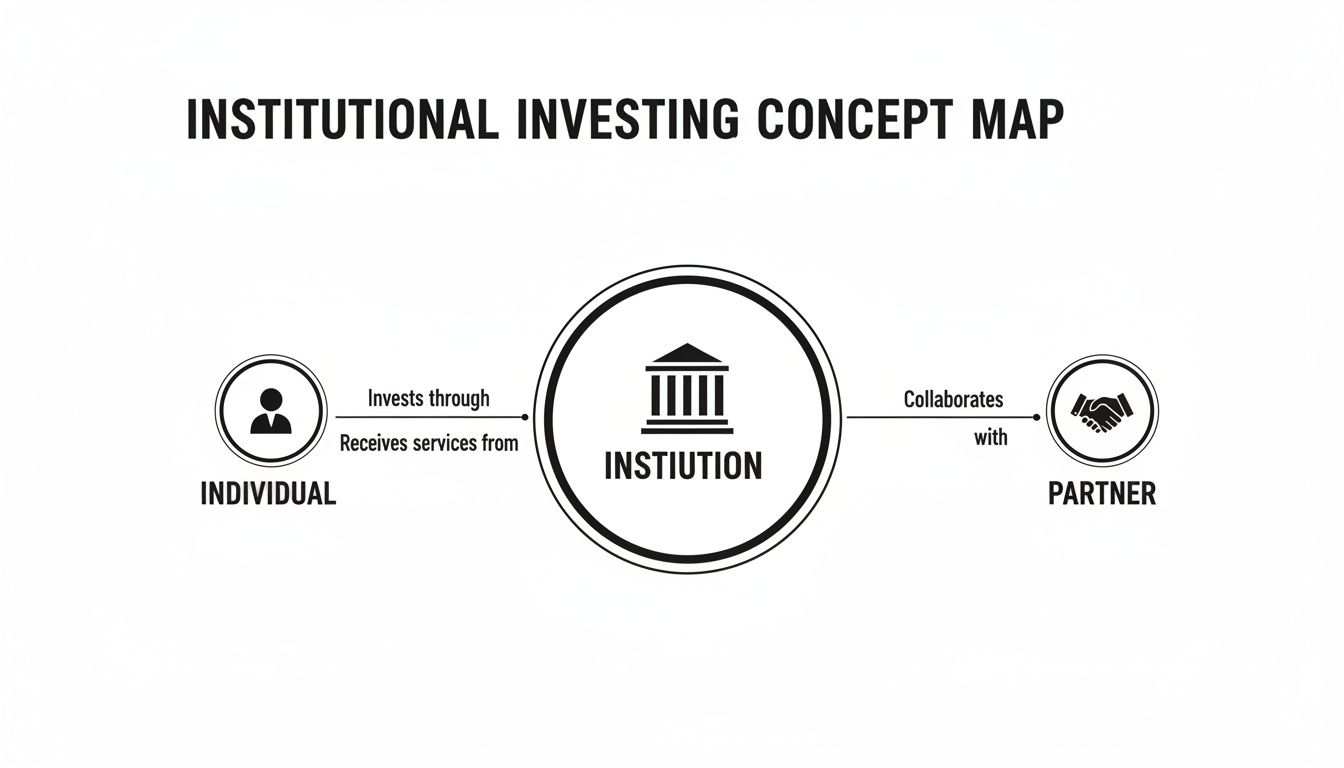
As you can see, while individuals are often focused on personal accumulation, institutions need a strategic partner to help them navigate a much more complex, mission-driven world.
Institutional vs. Individual Investing at a Glance
To put it simply, the two disciplines operate under entirely different rules. This table breaks down some of the fundamental distinctions.
FactorInstitutional Investor (e.g., Foundation)High-Net-Worth Individual InvestorTime HorizonPerpetual; multi-generationalFinite; typically 10-40 yearsPrimary GoalFulfill a mission while preserving capital foreverFund personal goals (e.g., retirement, legacy)Key ChallengeBalancing current spending needs with long-term growthMaximizing returns within personal risk toleranceGovernanceBoard or investment committee oversightIndividual or spousal decisionsFiduciary DutyLegal obligation to the institution's beneficiariesMoral obligation to self and family
While both are serious undertakings, the institutional framework adds layers of legal, ethical, and operational complexity that demand a dedicated approach.
Navigating Complexity with a Unified Approach
On top of the perpetual timeline, institutional leaders are juggling other complexities. Governance often involves committees and boards, which means clear communication and consensus are paramount. They also operate under strict fiduciary duties—a legal requirement to act solely in the best interest of the institution they serve. You can see how our team puts this into practice by looking at our institutional client solutions.
The goal is to create a financial engine that not only powers the institution's day-to-day work but also guarantees its permanence. This requires more than just stock picking; it requires a strategic, holistic partnership.
To get their arms around all this, many organizations turn to a unified platform that acts as a central command center. A modern fund management solution can integrate everything from accounting and donor management to investment oversight. This gives board members the clarity they need to make smart, strategic decisions and turns messy financial data into a clear roadmap, ensuring every dollar is working toward the mission. This is exactly why finding the right fiduciary partner is so critical.
Why Fiduciary Duty Is the Bedrock of Trust in Institutional Contexts
Imagine you’re climbing a treacherous mountain. Would you want a guide who is allowed to suggest a “suitable” path, or one who is legally and ethically sworn to find you the safest, most effective route to the summit?
In the world of institutional investment management solutions, that distinction is everything.
That sworn guide is a fiduciary. This isn't just a fancy title; it's a legal and ethical mandate to act solely in your best interest. For endowments, foundations, and corporate retirement plans, this commitment is the absolute bedrock of any trustworthy partnership, distinguishing them from brokerage-model institutions.

This is a world away from the "suitability" standard that governs many traditional brokerage relationships. Under that rule, a recommendation just needs to be appropriate—but it doesn't have to be the best one. A broker could suggest a proprietary mutual fund that pays them a higher commission, even if a lower-cost, better-performing alternative exists.
It’s a subtle but critical difference with massive implications. For an institution with a perpetual timeline and a vital mission, "good enough" is never actually good enough.
The Fiduciary vs. Suitability Standard
The difference really boils down to one question: Whose interests come first? A fiduciary advisor for institutions must always put the client's interests ahead of their own.
AspectFiduciary StandardSuitability StandardPrimary DutyMust act in the client's best interest.Must make recommendations that are "suitable."Conflict of InterestMust avoid all conflicts of interest or disclose them fully.Conflicts are permitted if the investment is suitable.CompensationTypically fee-only, removing commission-based incentives.Often commission-based, creating potential conflicts.Legal ObligationThe highest legal standard of care.A lower regulatory standard.
This isn't just about ethics; it's about better governance. We break this down further in our article on the key differences between a fiduciary vs. a typical financial advisor. When your board is responsible for stewarding assets for generations, the fiduciary standard provides the assurance that every single decision is objective and mission-aligned.
How Fiduciary Oversight Strengthens Your Institution
Working with a true fiduciary empowers your board and investment committee. It changes the relationship from a simple transaction to a genuine strategic partnership. This commitment to placing your interests first brings several powerful, practical benefits to the table.
- Objective Advice: A fiduciary’s recommendations aren't tainted by commissions or pressure to sell in-house products. This leads to strategies built around what is truly best for your organization.
- Complete Transparency: All fees and potential conflicts must be laid out in black and white. This transparency builds trust and ensures the board can make fully informed decisions.
- Prudent Process: A fiduciary helps establish and stick to a disciplined investment process. This is crucial for fulfilling the board's own legal duties and protecting the institution from unnecessary risk.
This is a cornerstone of trust in institutional investing. For a closer look at these responsibilities, this guide on nonprofit board fiduciary duties is an excellent resource.
Fiduciary duty is more than a legal term—it is a promise. It is the assurance that your advisor is sitting on the same side of the table as you, working toward the same goals with undivided loyalty.
For any endowment management advisor in Boston or nonprofit investment advisor in Massachusetts, this commitment is simply non-negotiable. It’s what allows institutional leaders to confidently delegate investment oversight, knowing their partner is legally bound to protect and advance their mission above all else. That clarity and alignment are essential for building a financial strategy that can endure for decades to come.
Asset Allocation for Endowments vs. Family Wealth
An endowment's investment portfolio shouldn't look anything like a personal retirement account. It's a fundamental mismatch. While an individual invests for a finite period—their own lifetime—an institution invests for perpetuity.
This one difference changes everything. It demands a completely different approach to asset allocation, one built to outlast market cycles and fuel a mission for generations. The core challenge is building a portfolio that can spin off consistent returns for annual spending while also growing the principal faster than inflation. For many of the world’s most successful institutions, the answer has been the "endowment model" of investing.
The Endowment Model Unpacked
Pioneered by university endowments at places like Yale and Harvard, this strategy goes far beyond a simple 60/40 mix of public stocks and bonds. Instead, it leans heavily into diversification across a broad range of alternative asset classes. The goal is to build a more resilient portfolio that isn't so dependent on the day-to-day mood swings of the public markets.
What does that look like in practice? Key components often include:
- Private Equity: Investing in private companies not listed on public exchanges, which offers high growth potential over a long-term horizon.
- Venture Capital: Funding early-stage startups with big ideas. It's high-risk, but the wins can be exponential.
- Real Assets: Tangible assets like real estate, infrastructure (think toll roads or airports), and timberland that can provide stable cash flow and act as a hedge against inflation.
- Hedge Funds: Using complex strategies designed to generate returns that don't just follow the broader stock or bond markets.
This isn't just diversification for its own sake. The idea is to smooth out returns over the long haul. When public stocks are struggling, well-chosen private assets or real estate might be performing strongly, creating a more stable financial foundation.

This shift toward alternatives is a significant trend in institutional investment management solutions. One recent survey showed that 66% of institutional investors plan to increase their private asset allocations. In fact, over 90% now hold both private equity and private credit—a huge jump from just 45% in 2021 as they hunt for higher yields and better diversification.
Aligning Investments with Your Mission
For today’s institutions, strong returns are only half the story. There's a growing conviction that an organization's investment portfolio should be an extension of its core values. This is where Environmental, Social, and Governance (ESG) principles come into the picture.
Integrating ESG criteria into the investment process isn't about sacrificing returns. It’s about adding another layer of sophisticated risk management.
ESG integration is about identifying companies that are not only financially sound but also well-managed from a sustainability and ethical standpoint. These companies are often better positioned for long-term success in a changing world.
For example, a foundation focused on public health might screen out investments in tobacco companies. An environmental nonprofit might actively seek out investments in renewable energy. An experienced advisor can help structure a portfolio that reflects these values without compromising financial goals. We believe this is so important that it is a central part of creating an Investment Policy Statement for our clients.
By thoughtfully combining the endowment model's diversification with a mission-aligned ESG framework, institutions can build a truly powerful financial engine—one that's not only built for decades but also actively reflects the change the organization wishes to see in the world.
Spending Policies and Long-Term Planning
How much can we actually spend? It’s the single most important question every foundation and endowment board will face. Get it right, and you fund your mission for generations. Get it wrong, and you risk the entire enterprise.
The answer isn't found in a crystal ball, but in a spending policy. This isn't just another document in the governance binder; it's the critical link connecting your long-term investment goals to your immediate, real-world spending needs.
Without a formal policy, decisions are made on a whim. A great year in the market might tempt a board to spend more, while a down year could trigger a panic and lead to drastic cuts. A spending policy gets you off this rollercoaster. It creates a clear, disciplined framework for making distributions, letting you support your mission today without selling out the future.
The Balancing Act: Spending vs. Preservation
At its core, a spending policy is trying to thread a very difficult needle. It has to create a steady, predictable stream of cash while balancing two goals that are constantly in tension:
- Fund the Mission Now: The policy has to generate enough cash to write the checks for grants, programs, and all the other operating costs that keep the lights on.
- Protect Tomorrow's Buying Power: It also has to make sure the endowment’s principal grows faster than inflation. If it doesn't, you’re essentially liquidating the portfolio in slow motion.
Any endowment management advisor in Boston will confirm this is no simple task. If you pull too much money out, you start eating into the principal—a fatal mistake known as "invading the corpus." But if you’re too conservative and pull out too little, are you truly maximizing your impact right now?
A spending policy does more than just calculate a number. It's a strategic promise. It takes the lofty goal of "perpetuity" and turns it into a concrete, actionable plan that guides your board, year after year.
Common Spending Policy Formulas
There’s no one-size-fits-all answer here. The right spending formula depends entirely on an institution’s specific mission, appetite for risk, and timeline. A good nonprofit investment advisor in Massachusetts will run the numbers on several different models to find the perfect fit.
Here are a few of the most common frameworks you’ll see:
- Simple Percentage Rule: This is as straightforward as it gets. You spend a fixed percentage—say, 5%—of the portfolio’s value at the start of the year. It's easy to calculate, but it can create a wild ride. Your spending budget will swing directly with the market's ups and downs, making long-term planning a nightmare.
- Moving-Average Rule: This is a very popular way to smooth out the volatility. Instead of using one point in time, it calculates the spending draw based on the portfolio's average value over a longer period, like the last 12 or 20 quarters. This approach muffles the noise of any single year’s performance and delivers a much more predictable cash flow.
- Hybrid or "Banded" Rule: This model tries to get the best of both worlds. It usually starts with a moving-average formula but adds a ceiling and a floor. For instance, the policy might say the annual payout must be between 4% and 6% of the portfolio's current value. This provides a guardrail, preventing you from overspending in a bubble or slashing your budget after a market dip.
Finding the right formula is absolutely essential for long-term stability. A seasoned advisor will stress-test these models against all kinds of market weather. This process gives the committee a clear-eyed view of the trade-offs, helping them build a policy that aligns with their mission and is a cornerstone of their institutional investment management solutions.
How Commons Capital Serves Institutional Clients
It’s one thing to understand the theory of fiduciary duty, asset allocation, or spending policies. It’s another thing entirely to turn that theory into a financial strategy that actually works for your mission.
That’s what we do at Commons Capital. We offer dedicated institutional investment management solutions that take your organization’s goals and build them into a disciplined, effective financial plan. We’re not just a vendor; we’re an extension of your team.
As an independent fiduciary advisor for institutions, our focus is singular and absolute: your mission comes first. We work alongside foundations, endowments, and corporate retirement plans, designing our entire process around objective, straightforward guidance that empowers your board and leadership.
How We Work Together
A successful partnership starts with listening. We don’t believe in one-size-fits-all models or pushing our own products. Instead, our process is built on a foundation of transparency, ensuring every decision is made with your objectives in mind.
Here’s what that looks like in practice:
- Discovery and Mission Alignment: First, we dive deep. We take the time to learn about your organization's specific mission, how you make decisions, your comfort with risk, and your long-term financial needs.
- Crafting the Investment Policy Statement (IPS): Think of the IPS as the constitution for your portfolio. We work directly with your committee to build this critical document from the ground up, clearly defining your goals, constraints, and the strategic map for every decision we make together.
- Strategic Implementation: With the IPS as our guide, we build and implement a globally diversified portfolio. We use a mix of sophisticated analytics and our access to top-tier managers to construct an asset allocation built for resilient, long-term growth.
- Continuous Oversight and Reporting: Our work doesn't stop once the portfolio is built. We provide ongoing, transparent oversight and clear reporting, giving your board the confidence that its fiduciary duties are being met.
An institutional investment partner does more than just manage assets; they manage complexity. They bring the clarity and discipline needed to free up your organization to do what it does best: fulfill its mission.
Your Advocate in a Complex Market
As a leading endowment management advisor in Boston, we have a firsthand understanding of the unique challenges and opportunities that institutions face. We act as your advocate, navigating the fine print of manager selection, fee negotiation, and risk management.
This proactive approach ensures your portfolio isn’t just well-built, but also cost-effective. For example, the published fees for asset managers are often just a starting point. The actual negotiated fees for institutional portfolios can be, and should be, significantly lower.
By partnering with a dedicated nonprofit investment advisor in Massachusetts like Commons Capital, you’re getting more than an investment expert. You are gaining a partner who is legally and ethically bound to your success. We provide the structure and support needed to empower your team, so you can focus on the future with confidence.
At Commons Capital, we are dedicated to providing the fiduciary guidance and strategic partnership that institutions need to thrive for generations.