It’s one of the most common questions in all of finance: "Is my inheritance taxable?" For most people in the U.S., the quick answer is no, you won't owe federal taxes on the assets you directly receive. But stopping there is a dangerous oversimplification.
The tax you really need to watch is the federal estate tax — a levy that hits the deceased's estate before you ever see a dime.
Understanding the True Cost of Your Inheritance
When someone asks about inheritance tax, they’re really worried about one thing: the IRS taking a slice of the pie. And while the IRS rarely taxes the heir directly at the federal level, the estate itself faces a major hurdle first.
Think of it this way: the estate is a massive cargo ship loaded with valuable goods (your inheritance). Before that ship can unload its cargo to you at the port, the port authority (the IRS) steps in to collect a fee based on the ship’s total value. If the fee is big enough, it directly reduces the amount of cargo left for you.

This isn't just a technicality; it's the entire foundation of wealth preservation strategy. The tax is paid by the estate, not you, but its impact lands squarely on your bottom line. For high-net-worth families, this “toll” can be absolutely massive.
The Federal Estate Tax Explained
The federal estate tax is a tax on the transfer of a person's property after they die. It only kicks in, however, once an estate’s value crosses a very high threshold.
Here’s what you need to know:
- Who Pays the Tax: The deceased's estate is on the hook. The tax is paid out of its assets before any money or property is distributed to the heirs.
- Who is Affected: This tax hits only a tiny fraction of estates. We're talking about the wealthiest 0.2% of Americans, whose estates are large enough to even trigger it.
- The Upcoming Cliff: A massive change is set for 2026. The exemption amount is scheduled to be cut dramatically, pulling many more families into the estate tax net.
The federal estate tax is no joke. It comes with a staggering top rate of 40% on assets above the exemption limit. For 2025, that exemption is an estimated $13.99 million per person, which effectively doubles to nearly $28 million for a married couple.
But here’s the critical part: this generous exemption is temporary.
Unless Congress acts, it's scheduled to be slashed by about half in 2026, dropping to somewhere around $7 million per person. This looming change is an urgent call to action for families with assets in this range. Waiting could mean losing millions in potential tax savings. For a closer look at what’s coming, Farrell Fritz's 2025 estate planning updates offer a detailed breakdown.
The impending drop in the federal estate tax exemption is a game-changer for many families. This table puts the stark reality of the 2026 "tax cliff" into perspective.
Federal Estate Tax Exemption at a Glance (2025 vs. 2026 Projection)
The takeaway is clear: the window to leverage the current high exemption is closing fast. Families who might not have worried about federal estate tax before will suddenly find themselves in its crosshairs.
This pending "tax cliff" isn't some distant problem — it's a critical planning deadline. For high-net-worth individuals, the strategies put in place between now and 2026 will be the deciding factor in how much of their legacy is preserved for the next generation versus how much is lost to taxes.
Understanding the Three Key Wealth Transfer Taxes
Navigating the world of wealth transfer can feel like learning a new language. To get a real handle on whether an inheritance is taxable, you first have to get clear on three related — but very different — taxes: the estate tax, the inheritance tax, and the gift tax.
Each one plays a unique role in how money and assets move from one person to another. Let's break them down.
Think of the estate tax as a federal "exit tax" on a person's total net worth when they pass away. It's calculated based on the entire value of the deceased's assets — cash, real estate, investments, you name it — before anything gets passed on to their heirs. For a deeper dive, this estate tax explained guide is a great resource.
The crucial point here is that the estate itself pays this tax. This, in turn, reduces the total pot of money available for the beneficiaries. For high-net-worth families, this is the primary tax they need to plan for at the federal level.
The Inheritance Tax: A Direct Tax on the Heir
Unlike the estate tax, the inheritance tax is paid directly by you, the person receiving the inheritance. And here's the kicker: there is no federal inheritance tax. It only exists at the state level, and only a handful of states even have one.
So, you can think of it as a "recipient tax." The amount you might owe usually comes down to two things:
- The value of your inheritance: The more you receive, the more you may owe.
- Your relationship to the deceased: Spouses are almost always exempt. Close relatives like children tend to pay a much lower rate than, say, a cousin or a non-family friend.
For instance, a child inheriting $100,000 might pay a 1% tax. In that same state, a cousin inheriting the same amount could be on the hook for a 10% tax. Because it’s so state-specific, your liability depends entirely on local laws. People often use "inheritance tax" and "estate tax" interchangeably, but they are fundamentally different.
Key Difference: The estate tax is paid by the deceased's estate before you get your inheritance. The inheritance tax is paid by you after you receive it, and only if you live in or inherit from someone in one of the few states that has it.
The Gift Tax: The Guardian of the Estate Tax
The third piece of the puzzle is the gift tax. This federal tax mainly exists to stop people from simply giving away all their money while they're alive to dodge the estate tax later on. It essentially works hand-in-hand with the estate tax.
In 2025, you can give up to $19,000 to as many people as you want every year without any tax headaches or paperwork. This is called the annual gift tax exclusion. A married couple can even team up and combine their exclusions to give up to $38,000 to each person.
What happens if you give someone more than that $19,000 annual limit in a single year? You'll have to file a gift tax return, but you probably won't pay any tax out-of-pocket. Instead, the amount over the limit just gets subtracted from your lifetime estate tax exemption — that massive $13.99 million figure for 2025.
Strategic lifetime gifting is a cornerstone of smart estate planning. By making annual gifts that stay under the exclusion limit, you can steadily shrink the size of your taxable estate over time. This effectively reduces your future estate tax bill without ever touching your lifetime exemption. When unique assets like retirement accounts are involved, it's also crucial to know the specific rules. To learn more, check out our guide on the tax on an inherited 401(k).
Navigating State-Level Inheritance and Estate Taxes
Just because your estate ducks under the massive federal tax exemption doesn't mean you're in the clear. State-level taxes are a critical, and often overlooked, part of the puzzle. The answer to "is inheritance taxable?" can change dramatically based on where you live and own property.
The state tax landscape is a real patchwork. Some states have their own estate tax, often with much lower exemption thresholds than the federal government. Others hit beneficiaries directly with an inheritance tax. And thankfully, most states have neither.
This creates a complicated situation for families, especially those with property or relatives scattered across different states.
State Estate Taxes: A Lower Bar to Clear
While only a tiny fraction of estates ever owe the federal estate tax, state estate taxes cast a much wider net. As of 2025, a dozen states plus the District of Columbia levy their own estate tax.
The real kicker is the exemption amount. While Uncle Sam lets nearly $14 million pass tax-free, state exemptions are dramatically smaller.
- Oregon and Massachusetts have the lowest thresholds, at just $1 million and $2 million, respectively.
- Other states like Illinois ($4 million) and Washington ($2.193 million) also have exemptions that can easily impact families who wouldn't be considered "ultra-wealthy."
- Maryland is in a class of its own — it's the only state to impose both an estate tax and an inheritance tax. This creates a potential double-whammy of tax liability.
What this means is that an estate worth $6 million would owe absolutely nothing in federal estate tax. But depending on where the owner lived, it could trigger a hefty state tax bill. It’s a stark reminder that local laws are essential to understand.
The State Inheritance Tax: A Tax on the Recipient
A handful of states take a completely different route with an inheritance tax. This tax isn't paid by the estate itself; it's paid by the person who receives the assets. The amount they owe almost always hinges on two things: the size of their inheritance and their relationship to the person who passed away.
As you might expect, close family members usually get the best deal, paying the lowest rates or being completely exempt.
Example Scenario: In a state with an inheritance tax, a son or daughter inheriting $500,000 might pay a small tax of 1-2%, or even nothing. But if a cousin or a close friend inherits that very same $500,000, they could be looking at a tax rate of 15% or more.
This system is designed to reward passing wealth to immediate family while placing a heavier burden on bequests to more distant relatives or non-family members. The states that currently have an inheritance tax are:
- Iowa
- Kentucky
- Maryland
- Nebraska
- New Jersey
- Pennsylvania
Each of these states has its own unique rate structure and exemption rules. You absolutely have to check the laws for the specific state involved. Nebraska, for example, has some of the country's highest inheritance tax rates for distant relatives, climbing as high as 18%.
2026 State Inheritance & Estate Tax Overview
To give you a quick way to see where potential liability might lie, here is a simplified table of states with these taxes. Keep in mind that specific exemption amounts and tax rates can and do change.
The difference that geography makes is staggering. A family with a $6 million estate in a no-tax state like Florida or Texas would have a $0 state tax bill. That same family in Oregon could face a state estate tax bill of hundreds of thousands of dollars. This underscores why your location is a cornerstone of modern, effective estate planning.
Advanced Wealth Transfer Strategies Before 2026
With the 2026 tax exemption cliff fast approaching, high-net-worth families need to shift their thinking. The conversation is no longer just about "is inheritance taxable?" but rather, "how can we legally and ethically minimize that tax?" The time to get serious about planning is now, not later.
For those with significant assets, simply waiting to see what happens in 2026 is a passive, and potentially very costly, strategy. A proactive approach using well-established financial tools can secure that wealth for the next generation. These advanced strategies are the pillars of modern estate planning, designed to place assets beyond the reach of estate taxes long before they become a problem.
The map below gives you a clear visual of how different states handle these taxes. It really drives home why your location is a critical piece of any wealth transfer puzzle.
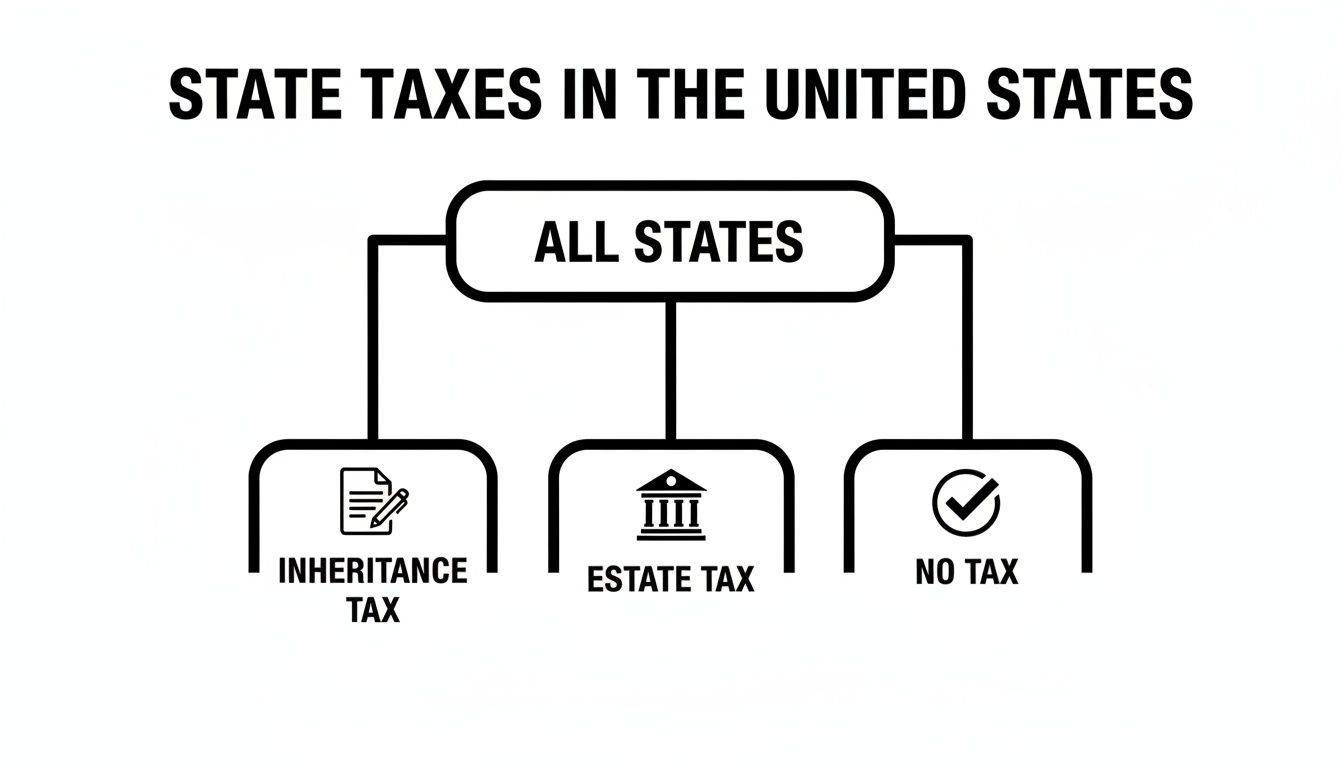
As you can see, while most states have no direct estate or inheritance tax, a handful do. This patchwork of state-level rules creates a complex national picture for anyone planning to pass on wealth.
Securing Assets with Strategic Trusts
Trusts aren't just for the ultra-wealthy. They are powerful tools for anyone looking to control how their assets are managed and reduce tax exposure. Certain irrevocable trusts are specifically built to move assets completely outside of your taxable estate, effectively shielding them from the 40% federal estate tax.
Two of the most popular and effective trusts for this purpose are ILITs and SLATs.
- Best for: Families who need cash on hand to cover estate taxes and want to pass on a significant, tax-free sum.
- Best for: Married couples who want to lock in today's large exemption but are hesitant to completely give up access to the gifted assets.
These trust-based strategies are fundamental for anyone hoping to make a serious dent in their taxable estate before the 2026 exemption drops. You can learn more about how to minimize estate taxes by exploring our detailed guide on the topic.
Advanced Gifting Techniques
Most people have heard of the $19,000 annual gift exclusion (for 2025), but high-net-worth individuals can take gifting much further. The goal is always the same: shrink your taxable estate now to avoid a bigger tax bill down the road. This becomes especially powerful when you combine it with the current high lifetime exemption.
One popular method is "front-loading" a 529 education savings plan.
Under a special rule, you can make five years' worth of annual exclusion gifts to a 529 plan at one time. This means an individual can contribute up to $95,000 (5 x $19,000) per beneficiary in a single year, and a married couple can contribute $190,000, without touching their lifetime exemption.
This strategy quickly moves a substantial amount of money out of your estate and into a tax-advantaged growth vehicle for a child's or grandchild's education. You can also gift other assets, like real estate, though the valuation gets a bit more complicated. For a deeper look at the tax nuances of inherited real estate, especially during probate, check out this resource on the impact of federal and state taxes on Texas real estate in probate.
Aligning Philanthropy with Tax Planning
Charitable giving is another smart way to reduce the size of your taxable estate while supporting causes you believe in. When structured correctly, philanthropic strategies can offer major tax benefits for you and your heirs.
A Donor-Advised Fund (DAF) is an incredibly popular and flexible tool for this.
Think of a DAF as a personal charitable investment account. You contribute assets — cash, stocks, or other property — to the fund and get an immediate, maximum tax deduction. Those assets can then be invested to grow tax-free, and you can recommend grants to your favorite charities whenever you want.
- Key Benefit: By donating highly appreciated assets like stocks, you can avoid paying capital gains tax on the growth, and the full market value of the donation is removed from your taxable estate. It's a double win.
- Best for: Individuals who want a big, immediate tax deduction and the flexibility to support multiple charities over many years without the administrative headache.
These advanced strategies — trusts, gifting, and charitable planning — aren't mutually exclusive. In fact, the most robust estate plans often weave together elements of all three, creating a customized defense against unnecessary taxes and ensuring your legacy is preserved exactly as you wish.
A Global Look at Inheritance Taxes
For high-net-worth families with international ties, a U.S.-only view on wealth transfer is dangerously incomplete. The answer to "is inheritance taxable?" shifts dramatically once you cross a border, as countries have vastly different ways of taxing the wealth passed from one generation to the next.
Understanding these global models is crucial for anyone holding assets abroad. The American system, which focuses on taxing the deceased's estate, is just one approach. Failing to account for international rules can lead to shocking tax bills and throw a wrench into the best-laid cross-border estate plans.
The UK's High-Rate Inheritance Tax
The United Kingdom stands out with one of the world's most talked-about inheritance tax (IHT) systems. It hits estates with a steep, flat 40% tax on assets above a certain threshold, a structure that should serve as a wake-up call for any family with UK-based property or investments.
This isn't like the multi-million dollar federal exemption in the U.S. The UK's main "nil-rate band" is just £325,000. While you can get an extra "residence nil-rate band" of £175,000 for a home passed to direct descendants, any value above these combined allowances gets hit hard. As asset values have climbed, more and more estates are getting pulled into this tax net.
The numbers tell the story. The UK's 40% IHT rate is one of the steepest globally, and even though the tax-free threshold of £325,000 hasn't budged, tax receipts are soaring. They hit £3.7 billion just from April to August 2023, a 5.7% jump from the year before, proving how frozen thresholds can quietly ensnare more families. You can explore global inheritance tax statistics on in-accountancy.co.uk to see more on these worldwide differences.
European Models Based on Relationship
Many European countries take a different tack. Instead of taxing the estate, they tax the person who inherits the money. In places like Germany and France, the tax rate and any tax-free amounts hinge on how closely related the heir is to the person who died.
- Direct Descendants: Children or a surviving spouse will often face much lower tax rates and get generous allowances.
- Distant Relatives & Non-Family: Cousins, friends, or other unrelated heirs typically get slapped with the highest tax rates, which can climb to a staggering 45-60% in some situations.
This system is built to favor keeping wealth inside the immediate family. It creates a completely different planning puzzle compared to the UK's flat-rate system or the U.S. estate-focused model. If you have assets in these countries, knowing who will inherit is just as important as knowing what they will inherit.
Countries with No Direct Inheritance Tax
Finally, you'll find a handful of countries with no direct inheritance or estate tax at all. Places like Canada and Australia are often pointed to as tax-friendly havens in this respect. But that doesn't mean wealth transfers are entirely tax-free.
These countries often use something called a "deemed disposition."
Here's how it works: at the time of death, the government treats it as if the deceased sold all their major assets — like stocks and real estate — at fair market value that day. This move triggers a capital gains tax on any growth in value, which the estate then has to pay. While it's not technically an "inheritance tax," it acts as a stand-in and can still result in a hefty tax bill. This global maze of rules just reinforces the need for specialized, international-minded advice to protect a family's legacy across borders.
Taking Control of Your Legacy Today
Simply understanding the answer to "is inheritance taxable?" is a great first step. But taking real action is what actually shields your wealth and protects the next generation. It’s time to move from theory to practice, and thankfully, the path forward is clearer than you might think.
Let’s boil it down. For high-net-worth families, the federal estate tax is the big one. State laws add another layer of complexity that you just can't afford to ignore. And most importantly, with the 2026 exemption cliff looming, proactive planning has become an absolute necessity — it's no longer just an option.
Your Simple Starting Checklist
Getting started is often the hardest part. This simple checklist gives you a clear, manageable starting point for taking control and making sure your legacy is preserved.
- Calculate Your Net Worth: First things first. Get an honest, detailed picture of your total assets and liabilities. This number is the bedrock of any real estate plan.
- Review Your State’s Tax Rules: Find out if your state has its own estate or inheritance tax. This immediately tells you about your potential tax exposure beyond the federal level.
- Gather Existing Documents: Pull together all of your current planning documents — wills, trusts, beneficiary designations, the works. You have to know what you’ve already got in place.
- Schedule a Consultation: This is the most critical step. Talk to a trusted financial advisor who can turn your goals into a concrete, tax-efficient strategy.
Knowledge only becomes power when you apply it. By taking these first steps, you shift from being a passive observer of tax law changes to an active architect of your family’s financial future.
These actions get right to the heart of what we do at Commons Capital. We specialize in helping families navigate these exact challenges, turning complicated rules into clear opportunities.
Whether you're just starting to explore if a trust is right for you, or you need help building a comprehensive plan from the ground up, our team is here. Understanding whether you need a trust is often the next logical step in this journey. We’re ready to be the expert partner you need to secure your family's future with confidence.
Answering Your Top Questions About Inheritance
When you're dealing with a loved one's estate, the details matter. Wealth transfer can get complicated quickly, so let's tackle some of the most common — and critical — questions we hear from clients about how inheritance really works.
If I Inherit a 401(k) or IRA Is It Taxable?
Yes, and this is a huge point of confusion for many beneficiaries. It's where the worlds of inheritance and income tax collide. While you won't pay a separate "inheritance tax" on the account itself, every dollar you withdraw from a traditional (pre-tax) 401(k) or IRA is considered ordinary income and taxed accordingly.
To make things more complex, recent laws changed the game for most non-spouse beneficiaries. You're now often required to empty the entire account within 10 years. That can trigger a massive tax bill if you don't plan your withdrawals carefully. On the flip side, inherited Roth accounts are generally tax-free, which really underscores how important it is to know exactly what kind of asset you’re receiving.
What Is the Cost Basis of Inherited Property?
This is where heirs get a major tax break. Inherited assets like real estate or stocks benefit from what’s called a “step-up in basis.” In simple terms, the asset’s cost basis is reset to whatever its fair market value was on the day the original owner passed away.
For example: Let's say your parents bought their home decades ago for $200,000. By the time you inherit it, the house is worth $1.2 million. That $1.2 million becomes your new cost basis. If you turn around and sell it for that price, you owe absolutely nothing in capital gains tax. This is a powerful advantage over gifted assets, which usually keep the original owner's much lower cost basis.
Does a Life Insurance Payout Count Toward the Taxable Estate?
The answer hinges on one simple question: who owned the policy? If the person who passed away owned their own life insurance policy, the death benefit gets lumped into their gross estate. This can easily push an estate’s total value over the federal exemption limit, making a chunk of that payout subject to estate tax.
Fortunately, there’s a smart way to avoid this. If the policy is owned by someone else — or, even better, held within an Irrevocable Life Insurance Trust (ILIT) — the proceeds can go directly to the beneficiaries without ever touching the taxable estate. This makes an ILIT a foundational strategy for providing heirs with tax-free cash when they need it most.
How Long Do I Have to Pay State Inheritance Tax?
While the rules differ from state to state, you typically have about nine months from the date of death to pay up. This deadline is often set to match the filing deadline for the estate's tax return. A couple of states will even give you a small discount for paying early.
But be careful. Each of the six states with an inheritance tax — Iowa, Kentucky, Maryland, Nebraska, New Jersey, and Pennsylvania — has its own forms, rates, and exemption rules. Getting professional advice from someone who knows the specific laws in that state is the only way to stay compliant and avoid expensive mistakes.
Trying to figure out estate and inheritance taxes on your own can be overwhelming. At Commons Capital, we specialize in creating clear, effective strategies for high-net-worth families, making sure your legacy is protected for generations to come. Contact us today to schedule a consultation.