True wealth management is far more than just investment advice. Think of it as hiring a chief financial officer for your family — a single point of contact dedicated to making sure every financial decision, big and small, works together to achieve your long-term goals. This guide explores the key facets of a comprehensive wealth management plan, from strategic investing to legacy planning.
What Is Modern Wealth Management?
Imagine you decided to build your dream home. You wouldn't hire a master architect and expect them to only give you a sketch of the living room. They create a master blueprint, then coordinate the engineers, landscapers, interior designers, and builders to make sure every single element works in harmony.
Modern wealth management operates the exact same way for your financial future. It goes way beyond simple stock picking to build a financial structure that's meant to last a lifetime. This approach is designed to withstand market volatility and adapt as your life changes, ensuring everything from your investments to your tax strategy is perfectly aligned.
The Architect Analogy for Your Finances
A real wealth management strategy coordinates multiple complex areas into one unified plan. The entire goal is to eliminate financial fragmentation — that all-too-common scenario where your investment advisor, accountant, and estate lawyer all operate in their own little silos. It’s a disconnected approach that almost always leads to missed opportunities and costly mistakes.
A wealth manager’s role is to serve as the architect of your financial blueprint, ensuring every specialist and every strategy is working from the same set of plans to build a lasting legacy.
Instead of juggling different professionals who don't talk to each other, a cohesive plan brings all those key functions under one roof. This proactive coordination is what separates basic financial advice from genuine wealth management.
Moving Beyond Simple Investing
While investing is obviously a huge piece of the puzzle, it's still just one piece. For anyone just getting their feet wet, understanding the fundamentals is critical. Resources like a guide on How to Start Investing as a Beginner can offer a solid foundation for that.
But a truly comprehensive strategy builds on that foundation by weaving in other essential services.
Key components of an integrated plan include:
- Strategic Investment Management: This means crafting a portfolio that’s built around your specific risk tolerance, timeline, and life goals — not just chasing the latest market trends.
- Proactive Tax Planning: It’s about more than just filing in April. It’s about identifying opportunities all year long to minimize your tax bill and maximize what you actually keep.
- Detailed Estate and Legacy Goals: This ensures your wealth is transferred smoothly and efficiently to the next generation or to charitable causes, exactly how you envisioned.
Ultimately, this integrated approach means your financial life stops being a series of isolated decisions and becomes a thoughtfully constructed plan designed for enduring success.
The Shifting Landscape of Global Wealth
The world of finance doesn't stand still. It’s a living, breathing thing, constantly reshaped by powerful economic currents, new technology, and the changing expectations of investors. To understand these massive shifts is to understand why true wealth management has gone from a nice-to-have service to an absolute must for anyone serious about protecting and growing their capital.
The amount of wealth being created today is staggering, presenting both huge opportunities and very real risks. Trying to navigate this complex world without a clear strategy is like setting sail in a storm without a map. Geopolitical tremors, regional economic shifts, and the unique behaviors of different investor groups all come into play. It's easy to get knocked off course by market volatility or completely miss the drivers of real growth.
An Unprecedented Surge in Global Assets
The sheer volume of investable wealth around the globe is expanding at a breakneck pace. We're not talking about a small uptick here; this is a fundamental rewiring of the financial ecosystem. According to in-depth industry analysis, global assets under management (AUM) are on track to soar from US$139 trillion to an incredible US$200 trillion by 2030. That growth is being fueled by strong stock market performance and a steady rise in investor confidence.
Looking at the bigger picture, the total pool of investable wealth is projected to hit US$482 trillion in that same period. High-net-worth individuals (HNWIs) are at the forefront of this wave, with their wealth expected to grow at a 6.5% CAGR. The takeaway is simple: there is more capital in motion than ever before, making expert stewardship more critical than ever. For a deeper look at the numbers, you can explore the global asset and wealth management trends from PwC.
The Modern Investor’s Dilemma
With more wealth comes more complexity. Today’s investors are dealing with a world of sophisticated financial products, volatile international markets, and a regulatory rulebook that’s always changing. This is where the real value of professional wealth management shines through — it cuts through the noise and provides the clarity needed to make smart, informed decisions.
This is what a coordinated wealth management plan looks like in practice:
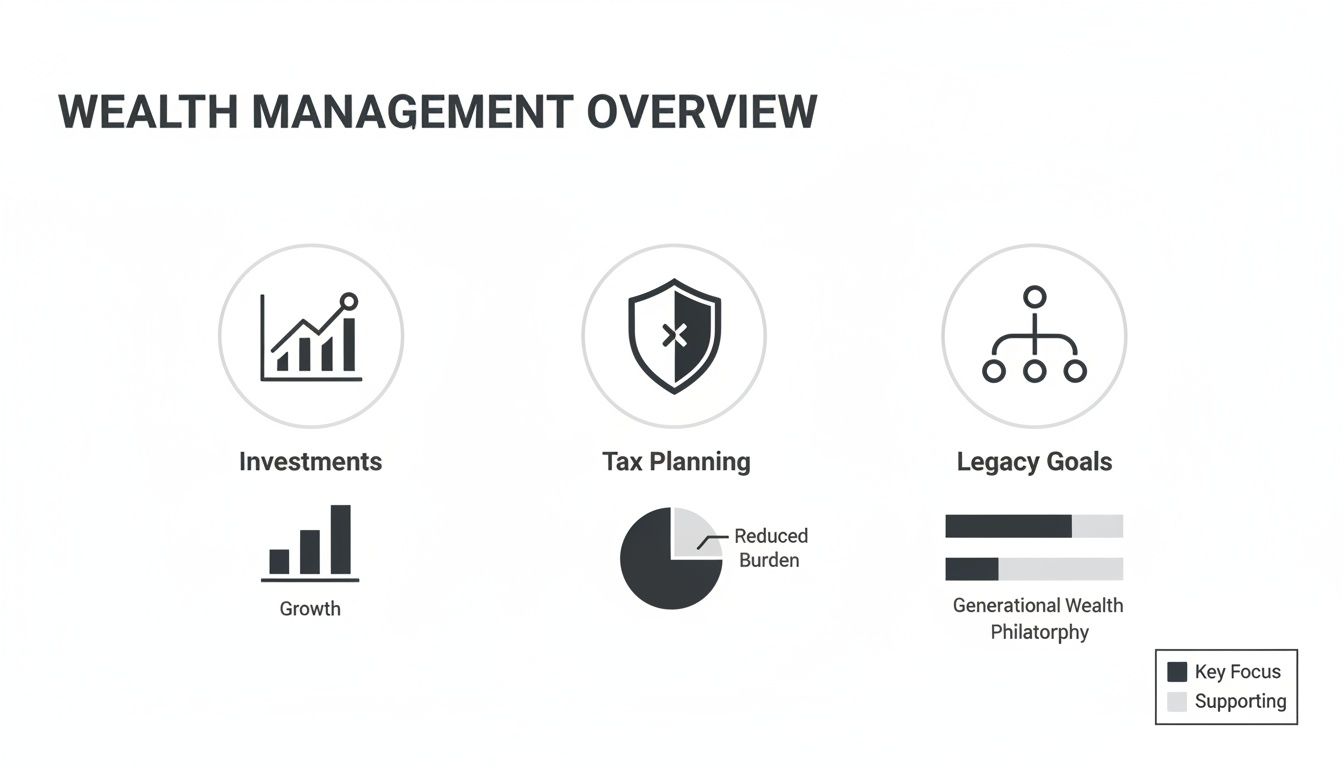
As you can see, a solid strategy isn't just about picking stocks. It’s about creating a holistic plan that balances growth-focused investments with smart, protective measures like tax optimization and long-term legacy planning.
Juggling these interconnected pieces is the key to building resilient, multi-generational wealth. The goal isn't just to capitalize on the good times, but to build a financial structure strong enough to weather any storm. For a more detailed look at where the industry is heading, you might find our article on decoding the future of wealth management interesting. At the end of the day, a proactive strategy is your best defense and your most powerful tool for achieving long-term financial security.
The Core Pillars of Your Financial Strategy
A real wealth management plan isn't some static document you file away. It's a living, breathing strategy built on a few foundational pillars. Think of them like the massive columns holding up a grand building — each is strong on its own, but together, they support a structure designed to last for generations.
When these core pieces work together, they create a financial framework that’s resilient, efficient, and perfectly aligned with your life’s goals. It’s the difference between just owning a random collection of financial products and having a coordinated strategy to build and protect significant wealth.
To really get a handle on what this looks like, let's break down the four essential services that form the backbone of any comprehensive wealth plan.
| The Four Pillars of Wealth Management |
| Service Pillar | Primary Objective | Key Activities |
| Investment Management | Grow assets and generate returns aligned with your personal goals and risk tolerance. | Portfolio construction, strategic asset allocation, risk management, market analysis. |
| Financial & Tax Planning | Preserve capital by maximizing tax efficiency and optimizing financial structures. | Tax-loss harvesting, retirement planning, cash flow management, insurance analysis. |
| Estate & Legacy Planning | Ensure the smooth and efficient transfer of wealth to future generations and causes. | Trust creation, will preparation, charitable giving strategies, business succession. |
| Fiduciary Services | Guarantee all advice and actions are exclusively in the client's best interest. | Transparent fee structures, conflict-of-interest avoidance, objective guidance. |
Each of these pillars addresses a distinct — but interconnected — part of your financial life. Let's dig a little deeper into what each one really means for you.
Strategic Investment Management
At the heart of it all is a sophisticated approach to investing. This goes way beyond just picking hot stocks or trying to time the market. It’s the art and science of building a portfolio that actually powers your financial goals, whether that’s retiring early, launching a business, or setting up a charitable foundation.
A truly strategic investment plan is built around your specific circumstances. It has to account for your personal comfort with risk, the timeline for your goals, and when you'll need cash. The main focus is on strategic asset allocation — the careful balancing of different asset classes like stocks, bonds, real estate, and alternatives to find that sweet spot between return and risk.
For instance, a young entrepreneur might have a portfolio tilted more heavily toward growth stocks to maximize gains over the long haul. On the other hand, someone nearing retirement might shift toward assets that generate steady income to ensure stable cash flow. The key is that the investment strategy is a direct reflection of your life's blueprint. And for those with significant physical assets, understanding how inflation impacts real estate investments is a critical piece of the puzzle.
Proactive Financial and Tax Planning
While investing is all about growing your assets, financial and tax planning is about protecting them. Too many people see taxes as a once-a-year headache. But in true wealth management, tax planning is a proactive, year-round discipline that makes every financial move more efficient.
This means constantly looking for opportunities to minimize your tax bill across your entire financial picture. Some common tactics include:
- Tax-Loss Harvesting: Intentionally selling investments at a loss to cancel out gains you’ve made elsewhere in your portfolio.
- Asset Location: Placing tax-inefficient assets (like corporate bonds) inside tax-sheltered accounts (like an IRA) and putting tax-efficient assets in your regular brokerage accounts.
- Retirement Account Strategy: Fine-tuning contributions and withdrawals from accounts like 401(k)s and IRAs to keep you in a lower tax bracket over your lifetime.
This forward-thinking approach ensures more of your returns stay in your pocket, where they can compound and accelerate your progress.
Thoughtful Estate and Legacy Planning
What happens to your wealth after you’re gone? This is often the most overlooked part of wealth management, yet it’s also the most personal. Estate and legacy planning is the process of creating a clear, legally solid plan for passing your assets to the people and causes you care about. It’s about shaping the impact you’ll leave behind.
This pillar is so much more than just writing a will.
A comprehensive legacy plan is your opportunity to translate financial success into enduring family values, ensuring your wealth serves a purpose long after you are gone.
Effective estate planning uses a range of tools and strategies, including:
- Establishing Trusts: These legal structures can shield assets from creditors, reduce estate taxes, and provide for your heirs with specific instructions.
- Charitable Giving Strategies: Using vehicles like donor-advised funds or charitable remainder trusts to support your philanthropic goals in a tax-smart way.
- Business Succession Planning: For entrepreneurs, this means creating a seamless transition plan for their company's ownership and leadership.
A well-designed estate plan gives you peace of mind, knowing your legacy is protected and your wishes will be carried out.
The Bedrock of Fiduciary Duty
Holding all these pillars together is the single most important element of the advisor relationship: fiduciary duty. A fiduciary is legally and ethically required to act in your best interest, always. This isn't just a marketing slogan; it's a legal standard that ensures every recommendation is free from conflicts of interest.
When a firm operates as a fiduciary, its advice is based solely on what’s best for you, not on which product pays the highest commission. This commitment is the ethical bedrock of a true partnership, creating the trust you need to feel confident that your financial future is in the right hands.
Your Journey with a Wealth Management Partner
Starting a relationship with a wealth management firm is a big decision. It can feel intimidating, loaded with complex questions and high hopes. But the process itself isn't a transaction; it's the beginning of a partnership, one built on a deep understanding of what makes you tick.
Think of it as a collaborative journey from day one. Every single recommendation, every strategic shift, is rooted in your story, your values, and your vision for the future. The whole point is to build a plan around you — your family, your business, your legacy.
The Initial Discovery and Goal Alignment
The first step is easily the most important: discovery. This isn't about filling out a questionnaire on your assets. It’s a real, in-depth conversation where a skilled advisor listens more than they talk. We need to understand what truly matters to you.
We dig into the stories behind the numbers. What are you most proud of? What keeps you up at night? When you picture retirement, what do you see? And what kind of legacy do you want to leave? This is the qualitative stuff, the human element that makes a financial plan feel right and actually work.
True wealth management begins with listening, not talking. A plan built on assumptions is destined to fail; a plan built on a client's authentic story is designed to succeed.
During these initial talks, we'll work together to clarify your goals and put them in order of importance. These goals become the north star for every decision that comes next.
Designing Your Custom Financial Blueprint
Once your goals are crystal clear, it’s time to design a custom financial blueprint. This is where the art and science of wealth management really click. Using everything we learned in the discovery phase, your advisor and their team of specialists will build an integrated strategy covering all the core pillars of your financial life.
This is a hands-on process. Your advisor will walk you through their initial recommendations, explaining the "why" behind each one. You’ll see exactly how different pieces of the puzzle fit together to hit your specific targets.
- Investment Strategy: A proposed asset mix designed to get the growth you need while staying within your personal comfort zone for risk.
- Tax Efficiency Plan: Specific tactics to help you minimize your tax bill and keep more of your hard-earned capital working for you.
- Estate and Legacy Structure: Ideas for trusts, gifting strategies, and other tools to make sure your wealth is passed on exactly as you intend.
You’ll have plenty of time to ask questions, challenge our thinking, and fine-tune the plan until it perfectly reflects your vision. The final blueprint isn't a cookie-cutter template; it's a meticulously crafted document built just for you.
Seamless Implementation of Your Strategy
With a final plan in hand, we move to implementation. A dedicated team gets to work behind the scenes, putting every piece of your strategy into motion. This often means coordinating with your other professional partners — like your CPA and attorney — to make sure everyone is on the same page.
Our goal is to handle the complex administrative lift for you, making the transition as smooth as possible. We take care of opening accounts, transferring assets, and setting up legal entities as needed. And you'll get clear, consistent updates along the way, so you always know what’s happening.
Ongoing Collaboration and Adaptation
Your financial plan isn't meant to be carved in stone and forgotten. It’s a living, breathing roadmap that has to evolve as your life does. This last, and longest, phase of the journey is all about ongoing collaboration and adaptation. This is where the partnership truly shines.
We'll have regular review meetings to check on your portfolio's performance, revisit your goals, and make adjustments. Life happens — a new business venture, a growing family, or a sudden shift in the markets. All of these things require a strategic response. Your advisor acts as a proactive partner, anticipating your needs and helping you navigate whatever comes your way. It’s this continuous cycle of review and adjustment that keeps your strategy sharp and effective for years to come.
Tailored Strategies for Unique Financial Lives
When you’re dealing with a complex financial life, a generic, off-the-shelf plan just won’t cut it. Real wealth management isn't about plugging your numbers into a standard formula. It’s about building a deeply personal strategy from the ground up — one that truly reflects your specific challenges and opportunities.
A cookie-cutter approach that might suit a corporate executive is almost guaranteed to fail a professional athlete with a short, high-earning career. The same goes for a family office tasked with managing wealth across multiple generations. Each situation is unique, and the financial framework must be built to match.
This is where a wealth advisor’s real expertise comes into play. We have to move beyond typical asset allocation and retirement goals to tackle the messy realities of unconventional income, complex business structures, and long-term family dynamics.
Sports and Entertainment: A Unique Financial Playbook
Professionals in the sports and entertainment world live a financial reality unlike almost any other. Their careers often follow a pattern of a few years of incredibly high earnings, followed by a sharp — sometimes sudden — drop in income. This "feast or famine" cycle demands a completely different kind of financial plan.
The challenges are immense. Income isn't just inconsistent; it flows from all sorts of places like salaries, endorsements, royalties, and bonuses, each with its own tax headache. A standard 30-year retirement plan is basically irrelevant. The entire focus shifts to making a handful of peak earning years last a lifetime.
A specialized strategy for this niche has to cover:
- Aggressive Savings and Investment: The goal is to capture a huge chunk of that peak income to build a capital base that can generate returns for decades to come.
- Income Smoothing: We structure investments and cash flow to create a predictable "paycheck" that keeps coming long after the main career is over.
- Complex Contract Navigation: This means working shoulder-to-shoulder with agents and lawyers to fully grasp the financial side of contracts and endorsement deals.
- Risk Management: It’s critical to protect assets from liability and ensure there's proper insurance in place for things like career-ending injuries.
Without this kind of specialized guidance, it’s not hard to see why so many high-earning professionals run into financial trouble later on. A generic plan simply can't account for such extreme variables.
The Intricate World of Family Offices
Family offices are the peak of personalized wealth management, built to serve families with substantial, multi-generational assets. Their needs go way beyond individual investment portfolios. We're talking about preserving and growing a family's legacy for a century or more. The complexity involved requires incredible coordination and strategic vision.
For a family office, wealth management is less about individual returns and more about stewarding a collective enterprise. The focus shifts to governance, legacy, and the seamless transfer of both assets and values to the next generation.
The main objective is creating a single, cohesive structure to manage the family’s investments, philanthropic goals, and overall financial affairs. This is a much broader mission than typical wealth management. For a deeper dive into this, check out our guide on comprehensive family office wealth management solutions.
Key focus areas for family offices include:
- Intergenerational Wealth Transfer: Structuring trusts and legal entities to move assets efficiently across generations while minimizing the tax bite.
- Family Governance: Creating a formal rulebook for making collective financial decisions, handling conflicts, and educating younger family members.
- Unified Asset Management: Bringing together diverse assets — from public stocks and private businesses to real estate and art collections — under a single, integrated strategy.
- Philanthropic Strategy: Setting up and managing charitable foundations or donor-advised funds to help the family make a meaningful impact.
These examples make it clear: effective wealth management is never a one-size-fits-all service. It demands a deep, genuine understanding of a client's world — whether that’s the locker room or the boardroom — and the skill to build a strategy as unique as they are.
How to Choose the Right Wealth Management Firm
Picking a partner to manage your wealth is easily one of the biggest financial decisions you'll ever make. This isn't just about hiring someone to trade stocks; it's about finding a long-term ally whose expertise and values truly line up with your own. The right firm becomes a steward for your family's future, bringing clarity and confidence to every chapter of your life.
The process demands some real homework and knowing which questions to ask. With so many firms out there, it’s critical to tell the difference between a true fiduciary partner and someone just trying to sell you a product. You'll want to zero in on things like their ethical commitments, the full scope of their services, and exactly how they get paid.
Core Criteria for Your Evaluation
Before you even think about signing on the dotted line, you need to size up potential advisors on a few non-negotiable points. How a firm thinks and operates will directly shape the advice you get and, ultimately, the success of your financial plan.
First and foremost, you have to confirm their fiduciary status. A fiduciary is legally required to act in your best interest. Full stop. This is the gold standard, and it ensures the advice you're getting is objective, not tainted by conflicts of interest that pop up when advisors get commissions for pushing certain products.
Next, get a crystal-clear understanding of their fee structure. A fee-only model is the most transparent way to go. Here, the firm is paid directly by you — usually as a small percentage of the assets they manage for you. This structure puts you both on the same side of the table; their success is tied directly to yours. To get a better handle on the industry landscape, it's worth exploring a detailed wealth management fees comparison.
A Checklist for Prospective Partners
To help you guide those initial conversations, use this checklist to make sure you're covering all the important bases. The answers you get will tell you a lot about how they run their shop and whether they’re the right fit for your family.
- What is your investment philosophy? You're looking for a clear, disciplined strategy grounded in evidence and long-term principles — not market timing or chasing the latest hot trend.
- What are your credentials and experience? Designations like CFP (Certified Financial Planner) or CFA (Chartered Financial Analyst) are a good sign of serious expertise and a commitment to the profession.
- Who is your typical client? Make sure the firm has a deep well of experience working with people in situations like yours, whether you’re a founder, a C-suite executive, or heading into retirement.
- How will our relationship work? Ask how often you'll hear from them, who your main point of contact will be, and what their process is for reporting and performance reviews.
Choosing a wealth manager is a deeply personal decision. The goal is to find a team that not only gets the numbers but also gets you — your goals, your worries, and your vision for the future.
Your Top Questions About Wealth Management, Answered
Jumping into the world of high-level financial strategy can feel like learning a new language. To help clear things up, we've put together some straightforward answers to the questions we hear most often from families and individuals thinking about working with a wealth management firm.
Our only goal here is to pull back the curtain, tackle your biggest concerns right away, and give you a clear picture of what to expect.
What’s the Minimum Investment I Need to Get Started?
This is one of the first things people ask, and the answer really varies from one firm to the next. Some of the big, old-school private banks might be looking for tens of millions in assets. But for many independent firms offering the full suite of services, a good starting point is often around $500,000 or more in investable assets.
There’s a practical reason for that number. It’s the level where the complexity of your finances usually justifies the kind of in-depth, hands-on service a dedicated firm provides. It ensures the relationship is a win-win. The best way to know for sure? Just ask a firm about their ideal client — it’s the quickest way to see if you’re a good fit for each other.
A Wealth Manager vs. a Financial Advisor — What’s the Real Difference?
It’s a great question, and the distinction is huge, even though people use the terms interchangeably all the time.
A financial advisor usually zooms in on specific goals, like saving for retirement or funding a college education. A wealth manager, on the other hand, acts as the quarterback for your entire financial life, making sure every part works together in one cohesive strategy.
Let’s break it down with an example:
- A financial advisor might help you pick the best mutual funds for your 401(k).
- A wealth manager makes sure your 401(k) strategy aligns with your tax-loss harvesting plan, your trust and estate documents, your family’s insurance needs, and even your long-term business exit plan.
Wealth managers are built to handle more moving parts and almost always operate under a fiduciary duty. That’s a legal standard requiring them to put your best interests ahead of their own, always.
How Do Wealth Management Firms Get Paid?
You should always have total clarity on how your advisory team is compensated. The most common model you'll see is a fee based on a percentage of your assets under management (AUM). For instance, a firm might charge around 1% per year on the portfolio they’re managing for you.
This AUM fee is popular for a simple reason: it aligns our goals with yours. The firm does better only when your accounts grow. You might also see other structures, like flat annual retainers or hourly fees for one-off projects.
One thing you absolutely want to look for is a firm that’s "fee-only." This means they’re paid only by you, their client. They don’t get commissions for selling you certain products, which neatly removes a major conflict of interest and helps ensure the advice you're getting is truly objective.
Ready to build a financial strategy that’s as unique as you are? At Commons Capital, we specialize in creating integrated wealth management plans for high-net-worth individuals, families, and professionals in the sports and entertainment industries. Discover how our fiduciary approach can bring clarity and confidence to your financial future. Schedule your consultation today.