For high-net-worth individuals, private banking offers financial services that go far beyond a standard bank account. It's a concierge-level approach that combines high-touch daily banking and specialized lending with a long-term wealth strategy, all managed by a dedicated relationship manager. The entire model is built to handle the complex needs of wealthy individuals and their families. This guide explains the core private banking services for high net worth individuals, what they include, and when they make sense.
What Does Private Banking Actually Mean?
If your wealth management strategy is the long-term race plan, private banking is the elite pit crew. It's the advanced engineering and immediate support that keeps your financial engine running at peak performance, giving you the specialized tools and on-the-fly adjustments needed to execute that plan flawlessly.
This isn't just about getting a premium checking account or a personal contact at the bank. True private banking services for high net worth clients become the central nervous system for your wealth, ensuring every financial decision—from taking out a loan to managing a large cash infusion—is cohesive and powerful.
The Core Idea of Private Banking
At its core, private banking is built on a single, powerful relationship with a dedicated manager. This person's job is to know the intricate details of your financial world, from your business's cash flow and investment portfolio to your family's long-term goals and unique liquidity needs.
Think of your private banker as a financial quarterback. They aren't just handling your day-to-day banking; they're coordinating with your wealth advisors, accountants, and legal team. Their role is to ensure that lending, credit, and cash management are all perfectly aligned with your bigger financial picture.
This personalized approach is why demand is growing so quickly. The global private banking market is projected to expand significantly, jumping from an estimated USD 654.54 billion in 2026 to USD 1,519.31 billion by 2034. Much of this growth comes from the increasing number of HNWIs in regions like North America who need more than what traditional banking can provide. You can dig deeper into this market expansion on Fortune Business Insights.
More Than Just a Bank Account
So, what really separates this from a premium offering at a retail bank? The difference is in the integration and customization of services that are simply off the table for the general public. These services are designed to solve the unique financial problems that come with significant wealth.
Key elements include:
- Bespoke Lending Solutions: Getting access to credit structured around your specific assets, whether it’s your investment portfolio, real estate holdings, or even fine art. This creates liquidity without forcing you to sell valuable assets at the wrong time.
- Advanced Cash Management: Using specific strategies to optimize and secure large sums of cash, maybe from a business sale, exercising stock options, or another liquidity event. This makes sure your capital is always working for you, even when it’s not invested in the market.
- A Dedicated Relationship: Having a single point of contact who understands your complete financial situation and can act quickly on your behalf. This alone saves you an incredible amount of time and effort.
Ultimately, private banking for wealthy individuals closes the gap between everyday financial needs and a complex, long-term wealth strategy. It provides the essential infrastructure to manage, protect, and grow significant assets effectively, making it a necessity—not a luxury—for today’s successful individuals and families.
Services: Lending, Cash Management, and Structured Credit
So what does private banking actually do? Beyond the white-glove service, this is where a financial concierge becomes a powerful partner. These services aren't just dressed-up versions of what you'd find at a regular bank; they are entirely different tools built for the unique scale and complexity that comes with significant wealth.
At Commons Capital, we help our clients orchestrate these services. Our job is to make sure the banking and lending side of your financial life is working in perfect harmony with your long-term investment plan. It’s all about creating liquidity when you need it, jumping on opportunities, and navigating big financial moments with skill.
Bespoke Lending and Strategic Credit
One of the biggest advantages of private banking is getting access to credit that's built around you. A standard bank loan is pretty rigid, usually just looking at your income. Private banking, on the other hand, looks at your entire balance sheet, which opens up a world of possibilities you just can't get from a retail bank.
A classic example is securities-based lending. This lets you borrow against the value of your investment portfolio without selling off your assets.
Think about these situations:
- An entrepreneur needs cash for a new venture but doesn't want to sell a chunk of their well-performing stock portfolio and get hit with a massive tax bill.
- A real estate investor spots a unique property and needs to make a fast, all-cash offer before someone else snaps it up.
- An executive is ready to exercise a huge block of stock options but needs the funds to cover both the purchase price and the taxes that come with it.
In every one of these cases, a securities-based line of credit provides the cash needed right away. It allows you to be nimble and decisive without derailing a long-term investment strategy that’s working for you. For those curious, you can learn more about how Commons Capital helps clients use securities-based lending as a strategic financial tool.
Advanced Cash Management for Wealthy Clients
For high-net-worth individuals, even managing cash can be a headache. A business sale, an inheritance, or cashing out of a major asset can leave millions of dollars sitting in a standard bank account. That cash is probably earning next to nothing and could easily be sitting above the FDIC insurance limits.
This is exactly the problem that cash management services for wealthy clients are designed to fix. Instead of just one account, these solutions use a network of accounts or special instruments to:
- Maximize FDIC/SIPC Protection: Intelligently spread cash across multiple institutions so that every dollar is insured.
- Optimize Yield: Move cash into high-yield savings or money market funds that offer much better returns than a typical checking account.
- Ensure Liquidity: Keep funds accessible for big tax payments, planned expenses, or that next great investment opportunity.
It’s a strategic approach that makes sure even your cash reserves are protected and working hard.
Private Banking vs Standard Banking Services
Service AreaStandard BankingPrivate BankingLendingStandardized mortgages, car loans, and personal loans based on income and credit score.Custom credit lines backed by securities, art, and other unique assets. Higher limits and flexible terms.Cash ManagementBasic checking and savings accounts, often with low interest rates and standard FDIC limits.Sophisticated cash sweep programs to maximize yield and FDIC insurance across multiple banks.Daily BankingIn-person branch visits, call centers, and standard online banking portals.A dedicated relationship manager or team who handles transactions, wire transfers, and account needs.Service ModelTransactional; focused on selling individual products like a checking account or a loan.Relationship-based; a holistic approach focused on integrating banking with your overall wealth strategy.
This comparison really highlights that private banking isn't just about higher limits; it’s a completely different service model designed for a different set of needs.
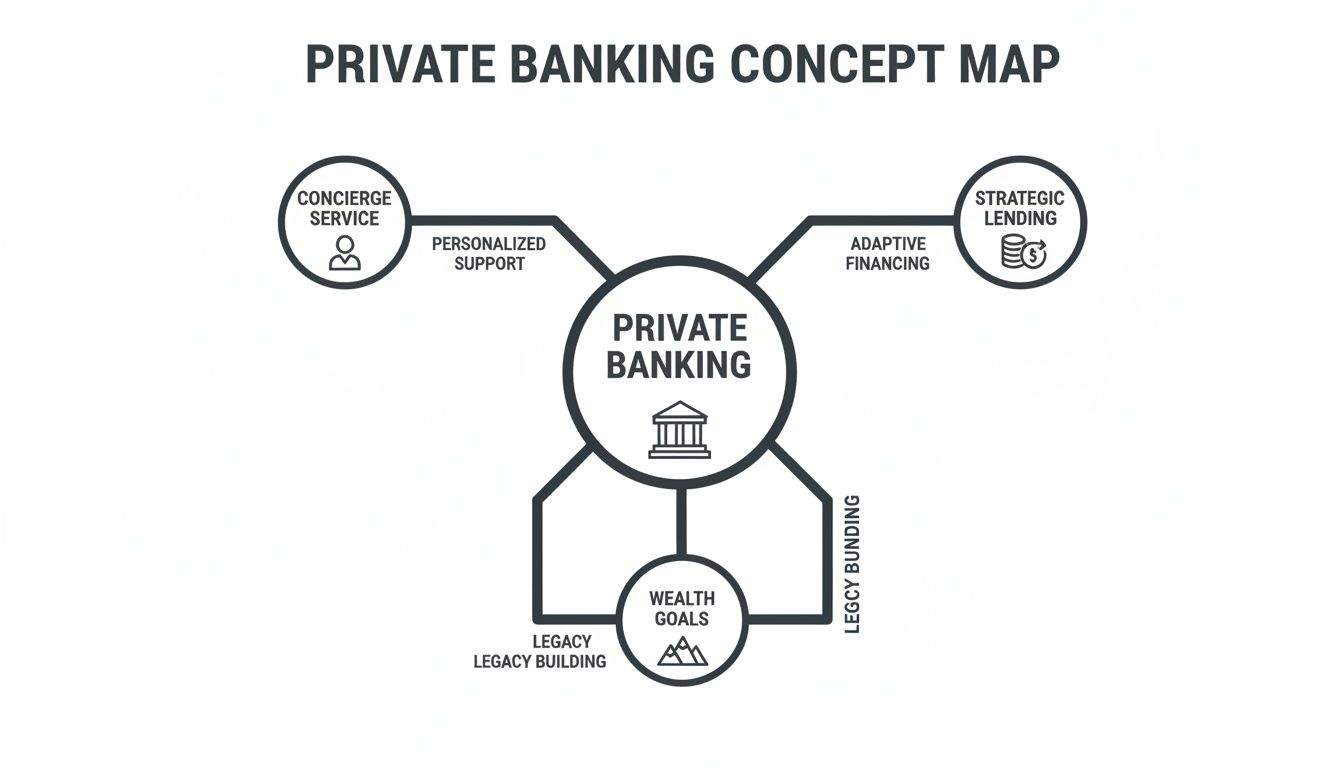
As you can see, the whole point is to connect high-touch service and strategic lending directly to your biggest financial goals.
Structured Credit and Unique Financing
Beyond loans backed by your stock portfolio, private banking opens the door to far more creative financing arrangements. This layer of private banking services for high net worth individuals is where a firm can really help you achieve things a normal bank couldn't.
Private banks understand that valuable assets aren't limited to stocks and bonds. They have the expertise to structure credit against non-traditional collateral that a normal bank wouldn't even consider.
This can include lending for things like:
- Fine Art and Collectibles: Using a valuable art collection as collateral for a line of credit.
- Private Company Stakes: Financing a capital call or a new investment in a privately held business you’re involved with.
- Luxury Assets: Securing loans against assets like yachts, private aircraft, or even exotic car collections.
These kinds of loans require a deep bench of expertise in valuing unique assets and managing risk. By acting as your advocate, we can connect you with the right banking partners who specialize in these niche areas, making sure you get the best possible terms for whatever you're trying to accomplish. It’s these core services that truly show the difference between standard banking and a real private banking relationship.
Difference Between a Private Bank and a Fiduciary RIA
So where does wealth management stop and private banking start? It's a question we hear all the time, and for good reason—the line can feel blurry. But understanding the difference between private banking vs wealth management is the first real step toward building a financial team that actually works in sync for you.
Think of it like this: your fiduciary wealth manager is the architect of your entire financial life. At a firm like Commons Capital, we have a legal duty to be that architect. We design the master blueprint for your long-term success, zeroing in on your investments, retirement, and how your wealth will pass to the next generation. Our job is to always, and only, act in your best interest.
Private banking, on the other hand, provides the specialized tools and heavy machinery to bring that blueprint to life. It's the day-to-day operational muscle, handling everything from liquidity and complex loans to sophisticated transactions.
The Architect and The Engineer
The easiest way to picture this is building a custom home. Your wealth manager is the architect, drawing up detailed plans based on your vision, your family’s lifestyle, and your goals for the future. They make sure the design is sound, serves its purpose, and is built to last for generations. Their focus is always the big picture.
The private banker is the lead engineer or a specialized general contractor. They’re the ones on the ground, providing the heavy equipment and custom-ordered materials. They secure the complex construction loan, manage the cash flow to vendors, and solve the tricky logistical problems that pop up along the way.
These two roles are completely different, but they absolutely must work together. An architect's plans are just paper without an engineer to execute them, and an engineer's work would be chaotic without the architect's vision. You can see more on how we manage this collaboration in our guide on private wealth management.
The Critical Difference of Objectivity
A huge distinction comes down to objectivity and the potential for conflicts of interest. A traditional private bank is almost always a division within a massive financial institution that has its own investment funds, loans, and other products to sell. While convenient, their advisors can face real pressure to recommend their bank's in-house solutions, even when a better or cheaper option exists somewhere else.
The core conflict arises when the advice you receive is influenced by the products the institution needs to sell. Your financial plan should be built around your needs, not a bank's sales targets. An independent advisor's only incentive is your success.
This is exactly why an independent Registered Investment Advisor (RIA) like Commons Capital, which operates under a strict fiduciary standard, is a different animal. We aren't a bank. That independence is our biggest strength—it lets us be your objective advocate, searching across our entire network of partners to find the best banking and lending solutions for your specific situation.
The private banking industry is growing fast, largely because the needs of affluent clients have become so complex. In the U.S. alone, the industry's revenue is on pace to hit $114.7 billion by 2025, with eye-popping profit margins of 39.2%. You can dig into the numbers in this industry analysis by IBISWorld. That kind of profitability shows just how high the demand is, but it also makes it even more critical to have an unbiased advisor who can cut through the noise and lock in the best terms for you.
Ultimately, the private banking vs wealth management debate is about getting the structure right. Wealth management sets the why and the what of your financial strategy. Private banking provides the how—the banking, credit, and transactional engine that powers it all. When those two functions are both best-in-class and objectively managed, you have a truly powerful financial machine.
When HNW Clients Need Private Banking Solutions

The switch from your everyday retail bank to a private bank isn't really about hitting a magic number in your portfolio. It’s about your financial life becoming too complex for off-the-shelf products. It's a move you make when you run into specific situations that demand a much higher level of financial strategy and creativity.
For many high-net-worth individuals, the moment comes when their current bank starts feeling more like a roadblock than a partner. Spotting these triggers is the first step. When your financial picture involves more than a simple checking and savings account—think complex assets, significant capital movements, and unique borrowing needs—the right private banking for wealthy individuals is no longer a luxury. It's a necessity.
Navigating a Major Liquidity Event
One of the most common reasons people seek out private banking is a major liquidity event. This could be anything from selling a business to receiving a large inheritance or cashing in on substantial stock options. All of a sudden, you have a pile of cash that needs to be managed smartly and strategically.
Without a private banker, this flood of capital can be a headache. The money might just sit in a low-yield account, blowing past FDIC insurance limits, while you try to coordinate with different advisors on what to do next. It's a process often bogged down by delays and paperwork.
A good private banking relationship flips the script. Your team sees the event coming and maps out a plan. They can sweep the funds into a structure that maximizes both your yield and insurance coverage from day one. Your capital is safe, productive, and ready to be put to work in your long-term investment plan without skipping a beat.
Requiring Complex Credit for Unique Assets
As your wealth grows, so do your opportunities. You might get the chance to buy into a promising private company, purchase a vacation home with a complicated ownership structure, or add a valuable piece of art to your collection.
Standard lenders see a square hole and offer a square peg. Private banking partners, by contrast, have the expertise to craft a custom solution for any shape of opportunity, no matter how unique.
Your local bank will almost certainly turn you down for a loan against these kinds of non-standard assets. Their lending rules just aren't built to value or underwrite them. That leaves you with two bad options: pass on the opportunity or sell other investments, which could trigger a big tax bill and mess with your portfolio's balance.
With securities lending or a private bank alternative, you can use your existing portfolio as collateral for a flexible line of credit. This lets you move fast on time-sensitive deals, keeping your core investments intact while making your assets work harder for you.
Managing Lumpy and Unpredictable Cash Flow
Entrepreneurs, executives who rely on bonuses, and professionals in sports and entertainment often have to deal with big, irregular paydays. This "lumpy" income makes old-school budgeting and banking a real pain.
Managing these financial cycles takes more than a simple checking account. You need a system that can absorb huge deposits, give you instant access to cash when things are slow, and make sure your money is always working for you. Sophisticated cash management services for wealthy clients are designed for exactly this, smoothing out the financial peaks and valleys.
As global wealth grows, so does the demand for these advanced services. In Luxembourg, a major hub for private banking, assets under management shot up by an impressive €94 billion in just one year. This trend shows a worldwide need for more dynamic financial solutions.
For anyone thinking about this next step, it's crucial to understand how specialized services must work together. For instance, a deep dive into estate planning for high net worth individuals shows how banking solutions have to be woven into your long-term legacy goals. And for those with even more moving parts in their financial lives, exploring our family office services can offer a whole new level of coordination.
How Commons Capital Integrates Banking and Wealth Management

The real magic of private banking for wealthy individuals happens when its tools are perfectly in sync with a long-term wealth strategy. This is where your wealth manager's blueprint meets the real-world execution of a banking partner. At Commons Capital, we’ve built our entire firm around making that connection seamless, objective, and always in your best interest.
We see our role as your financial quarterback. It’s our job to coordinate the sophisticated banking and lending you need with our fiduciary approach to wealth management. This is how you unlock opportunities and pull off complex financial moves with real precision.
Most importantly, we are not a bank. This independence is the foundation of our entire model—and it’s your single greatest advantage. It means our advice is never, ever compromised.
The Power of Objective Advocacy
When your private banker works for a huge institution, the potential for a conflict of interest is always lurking. Their advisors might be incentivized to push the bank’s own loans, investment funds, or cash management products, even when they aren't the best fit. Your goals can easily take a backseat to the bank’s quarterly sales targets.
Our independence completely sidesteps this conflict. As your fiduciary, we are legally and ethically required to act only in your best interest. We don’t have any proprietary banking products to sell. What we do have is a curated network of elite banking partners.
Our role is to be your fierce advocate in the marketplace. We create a competitive environment for your business, forcing banks to compete on terms, rates, and service to win your relationship. This ensures the banking layer of your financial life is a powerful engine, not a source of friction.
This objectivity is absolutely vital today, especially when 55% of HNW clients say digital capabilities are a major factor in choosing a wealth provider. By quarterbacking your banking relationships, we make sure you get not only the best terms but also the modern, responsive service you deserve.
A Process Built Around You
We don't just jump into sourcing a loan. Our process is methodical, and it always starts with a deep dive into your complete financial picture. We're not just looking at your investment portfolio; we're analyzing your cash flow, your business interests, your family dynamics, and your goals—both for tomorrow and for ten years from now.
Only after we’ve built this 360-degree view do we start identifying which private banking tools will actually support your wealth plan. This isn't about finding a single private bank. It’s about assembling the right solutions from the best providers for the job.
Our process breaks down into a few key steps:
- Holistic Financial Review: We map out your entire financial life to find current pain points and future opportunities where smart banking can make a real impact.
- Solution Design: Based on that review, we pinpoint the specific banking needs—maybe it's a securities lending line of credit, advanced cash management services for wealthy clients, or structured credit for a unique asset purchase.
- Marketplace Sourcing: We take your specific needs out to our network of trusted banking partners. This creates a competitive bidding process to get you the most favorable rates and terms.
- Coordination and Execution: We manage the whole show, from application to funding. We'll coordinate between the bank, your legal team, and your accountants to make sure everything goes off without a hitch.
- Ongoing Oversight: Our work isn't done when the accounts are open. We provide continuous monitoring to ensure the banking solutions stay optimal as your needs and the market inevitably change.
Real-World Integration in Action
Let’s say you’re a business owner who just sold your company. You suddenly have millions in cash that needs to be managed and put to work. Our integrated approach ensures that, from day one, your liquidity is protected and optimized.
At the same time, we'd be working with our banking partners to set up a flexible line of credit against your new investment portfolio. This private bank alternative gives you immediate access to capital for a new venture or a real estate buy, but without forcing you to liquidate your carefully built portfolio and create a huge tax bill.
For many high-net-worth individuals, effectively integrating banking and wealth management means thinking globally. For instance, knowing how to open offshore company and bank account in the UAE for global asset management is a perfect example of a specialized banking need that must align with a long-term wealth strategy. Our job is to spot these needs and bring in the right experts to execute them flawlessly, all within the framework of your holistic financial plan. This approach turns private banking from a menu of products into a powerful, integrated part of your long-term success.
Your Questions About Private Banking Answered
Once your wealth reaches a certain point, new questions start to pop up. The term “private banking for wealthy individuals” gets thrown around, but what does it really mean for you and your money?
Let's cut through the noise and answer some of the most common questions we hear from clients who are trying to figure out if this is the right move for them.
What Is the Typical Asset Minimum for Private Banking?
Most private banks start looking for clients with at least $1 million in investable assets, but that number isn't a hard-and-fast rule. Some of the institutions we work with have different thresholds, and frankly, the number on its own isn't the most important part of the equation.
What really matters is the complexity of your financial life. If you're dealing with sophisticated lending needs, require advanced cash management services for wealthy clients, or simply need a real person to coordinate all the moving parts, it's a conversation worth having—regardless of whether you're a little above or below that million-dollar mark.
Can I Have Wealth Management Without Private Banking?
Absolutely, and many people do. It's very common for clients to work with a fiduciary wealth manager like Commons Capital for investment strategy and long-term financial planning. For many, that's the essential first step to getting their financial house in order.
Private banking comes into play when your needs outgrow what a regular retail bank can handle. Think complex loans, specialized lines of credit, and a higher level of daily banking service. As your financial quarterback, part of our job is to help you recognize when it’s time to bring these powerful banking tools into your overall financial plan.
Key Takeaway: Think of it this way: wealth management builds the blueprint for your financial future. Private banking provides the specialized, heavy-duty equipment to execute that plan. They work best together, but you don't always need both at the same time.
Is My Money Safe in a Private Bank?
Yes. In the United States, deposits at private banks are FDIC-insured up to the standard legal limits, just like at any other member bank. For your investment portfolio held by the bank, those assets are typically covered by SIPC insurance, which protects your securities and cash if the firm itself were to fail.
On top of that, established private banks have incredibly robust security protocols to guard client assets and information. A key part of our role as your independent fiduciary is to thoroughly vet any banking partner, making sure they meet the highest standards for safety, stability, and of course, service.
Why Not Just Use a Big Bank for Everything?
It might seem simpler to keep your wealth management and private banking under one big roof, but this convenience can come with a major catch: conflicts of interest. An advisor at a large bank often has incentives—or may even be required—to push their own company's investment products, loans, and banking services.
The problem is, those in-house products might not be the best or most cost-effective solution for you.
An independent fiduciary Registered Investment Advisor (RIA), like Commons Capital, has a legal and ethical duty to work only for you. We have no ties to any specific bank's products. This gives us the freedom to act as your objective advocate, searching the entire market to find the best solutions for your specific situation. This private bank alternative approach means we can coordinate with any institution to ensure you get unbiased advice, not just what's convenient for the bank to sell.
At Commons Capital, we act as your dedicated financial advocate, integrating sophisticated banking solutions with our fiduciary wealth management. Learn about our private banking and lending solutions.